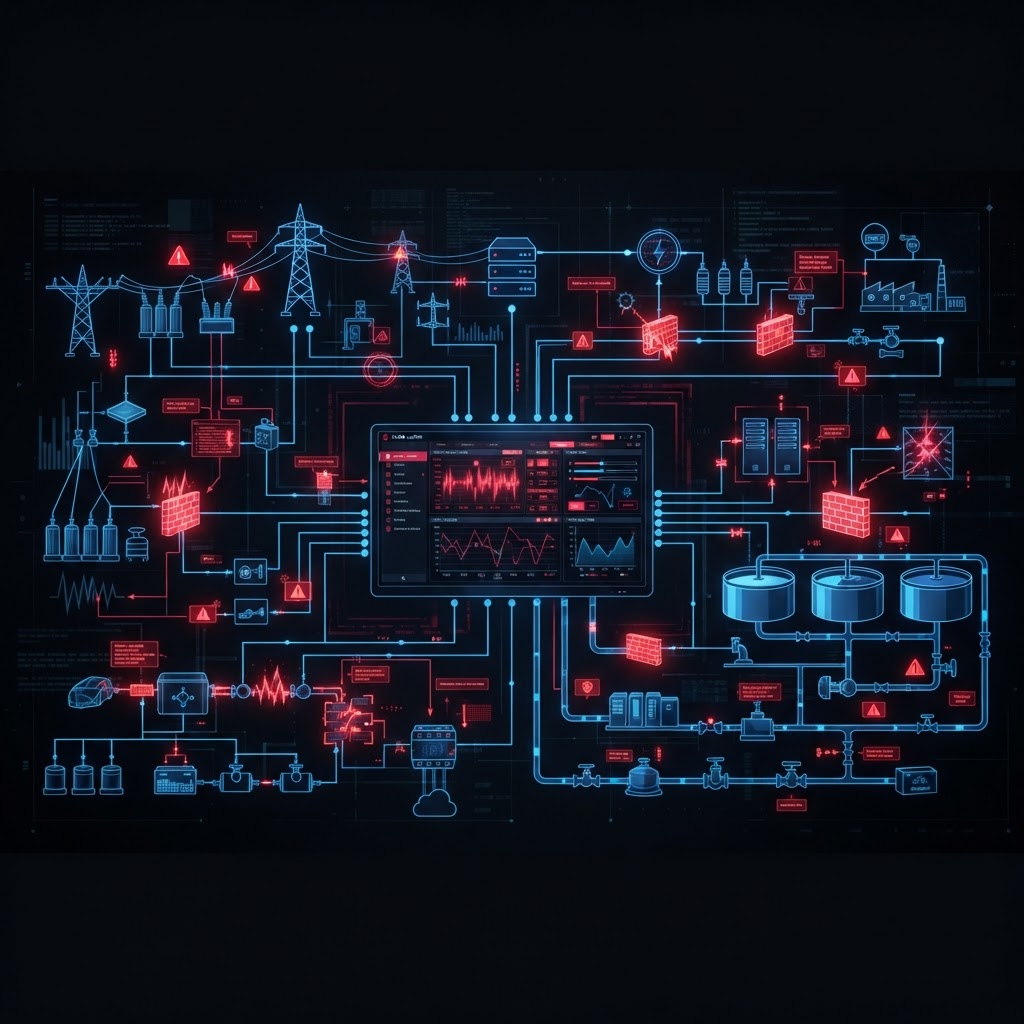
State-Sponsored Groups Exploit PLC Vulnerabilities and ISP Backbones to Target Regional Water Systems
Encrygma analysts have identified a coordinated surge in Iranian and PRC-linked activity targeting U.S. and EU critical infrastructure via ISP backbone exploitation and PLC authentication bypasses.
Executive Takeaway — TL;DR
- Category:
- Critical Infrastructure
- Severity:
- Critical
- Actor Type:
- Nation-State
- Geography:
- North America / Global
- Confidence:
- High Confidence
- CVE:
- CVE-2021-22681
- Source:
- Mandiant
- Read Time:
- 4 min
Executive Summary
Over the past 48 hours, Encrygma Intelligence has monitored a significant escalation in cyber operations targeting critical infrastructure (CI). Central to this activity is the exploitation of vulnerable Programmable Logic Controllers (PLCs) in municipal water facilities and a renewed campaign by Volt Typhoon-linked actors against Internet Service Provider (ISP) management interfaces. Notably, the municipal 911 and police dispatch systems in several regional hubs, including Suisun City, remain disrupted following a sophisticated ransomware deployment targeting localized IT environments. These events coincide with the introduction of the Quantum-GUARD Act in the U.S. Senate, highlighting the growing urgency for post-quantum cryptographic standards in the energy and water sectors.
Threat Analysis
The current threat landscape is characterized by a two-pronged approach. Nation-state actors are moving beyond traditional espionage to establish 'persistence for disruption.'
- Edge Device Exploitation: Actors are targeting management platforms like Versa Director to gain initial access to ISP and Managed Service Provider (MSP) networks. This provides a 'god-mode' view of downstream client traffic, allowing for stealthy lateral movement into sensitive CI networks.
- Direct OT Targeting: Iranian-affiliated groups, including the cluster known as Cyber Av3ngers, have expanded their target set from Rockwell Automation/Allen-Bradley PLCs to include Schneider Electric and Siemens devices. The focus remains on exploiting legacy authentication bypass vulnerabilities (e.g., CVE-2021-22681) to manipulate water pressure and chemical treatment levels.
Technical Details
Technical analysis of the recent Suisun City incident indicates the use of a modular backdoor deployed via a compromised management port. This mirrors the behavior of the VersaMem web shell, which resides in memory to evade disk-based scanners. In the OT domain, threat actors are leveraging publicly available exploit code to target the Studio 5000 Logix Designer software. By bypassing authentication, attackers can upload malicious project files directly to the PLC. These files are designed to overwrite safety thresholds, potentially causing physical damage to pumping infrastructure or leading to service outages.
Attribution Assessment
Encrygma attributes this recent wave of activity to two distinct clusters. The ISP backbone compromises align with the tactics, techniques, and procedures (TTPs) of Volt Typhoon (PRC), specifically their focus on 'living-off-the-land' (LotL) and pre-positioning for future conflict. The targeted attacks on water system PLCs are attributed with moderate confidence to Iranian state-sponsored actors, who have demonstrated a clear intent to retaliate against Western infrastructure through symbolic and disruptive ICS attacks.
Implications
The implications of these concurrent campaigns are severe. The breach of ISP backbones suggests that even organizations with robust perimeter defenses are vulnerable to 'upstream' compromise. Furthermore, the targeting of small and medium-sized utilities (as seen in the recent regional water system disruptions) exposes a critical security gap in decentralized infrastructure that lacks the budget for 24/7 SOC monitoring. The potential for cascading failures—where a water outage impacts local energy cooling systems—remains a primary concern for grid stability.
Recommendations
- Immediate Patching: Ensure all Versa Director instances are updated to version 22.1.4 or higher to mitigate active zero-day exploitation.
- Hardware Hardening: Implement strict IP-based access control lists (ACLs) for all PLC management interfaces. Disable remote access to OT assets unless strictly necessary and protected by hardware-backed MFA.
- Network Segmentation: Enforce physical or robust logical segmentation between IT and OT environments to prevent lateral movement from municipal office networks to ICS controllers.
- Audit Project Files: Utilities should perform immediate checksum validation of all PLC project files to detect unauthorized logic modifications.

Need Zero Click Spyware for Android and iOS?
Encrygma delivers serverless, offline, quantum-safe encrypted communications built for executives, agencies, and operators facing zero-click spyware and advanced mobile surveillance threats.
Related Intelligence

US Agencies Issue Urgent Warning Over AI-Driven Cyber Attacks Targeting Siemens Industrial Controllers
Global Ransomware Surge Hits Record 997 Incidents in August 2026, Targeting Critical Utility and Healthcare Sectors