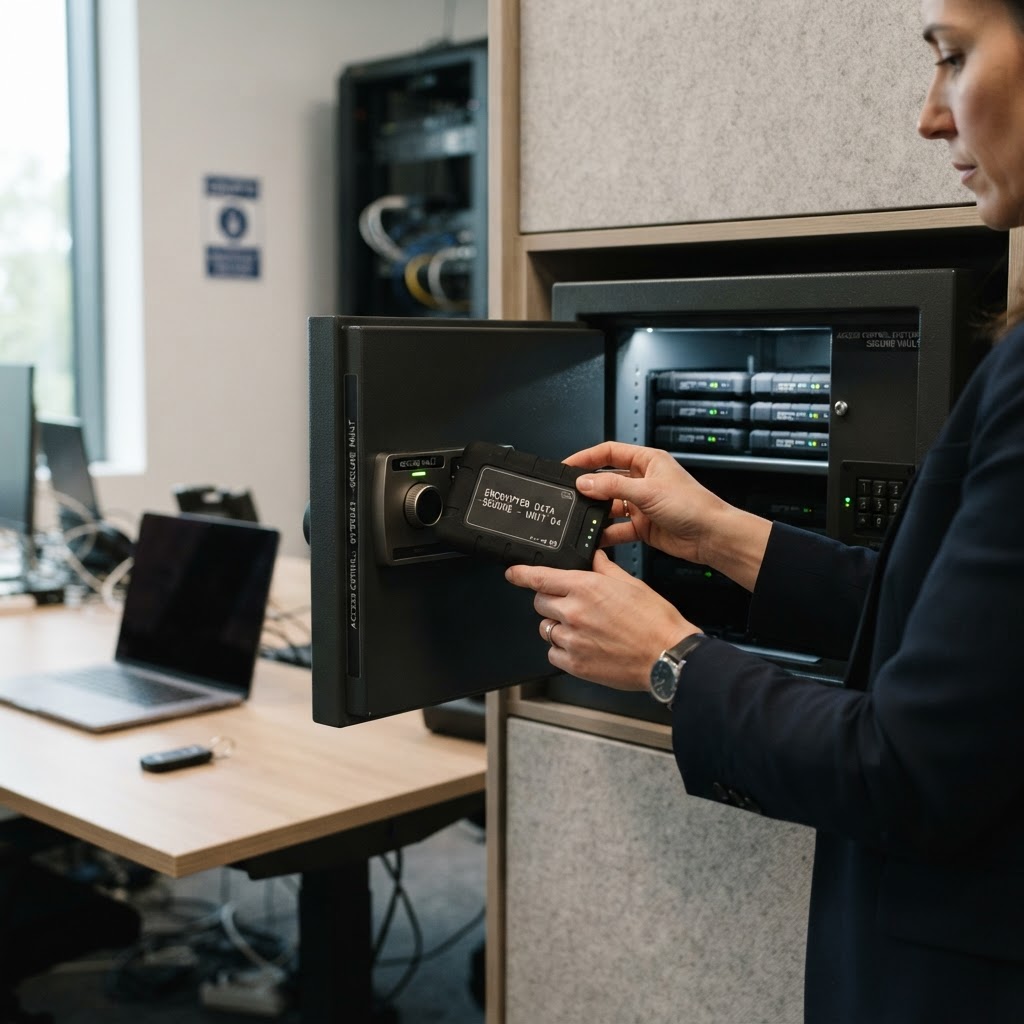
Securing Classified Archives: The Role of Air-Gapped Cryptographic Workflows
Encrygma analysts examine the operational necessity of air-gapped encryption for classified data at rest, focusing on the CryptShield platform's capability to eliminate server-side exposure.
Why This Matters Now
In an era where digital footprints are increasingly weaponized, protecting classified material at rest requires more than standard encryption; it demands the total elimination of network-based attack vectors. Encrygma analysts assess that for organizations managing high-value, long-lived archives, the primary risk is not just unauthorized access, but the metadata and telemetry generated by connected security tools. By utilizing air-gapped workflows, security officers can ensure that sensitive data remains entirely isolated from the internet, effectively neutralizing the risk of remote exfiltration or server-side compromise.
Inside the Capability
CryptShield provides a specialized, offline-first encryption environment designed specifically for organizations that cannot tolerate the risks associated with cloud-connected or server-dependent security infrastructure. The platform operates entirely on the local machine, ensuring that plaintext never leaves the operator's device. Because the system functions without server involvement, it leaves no online signature, providing a critical layer of operational security for sensitive holdings.
Encrygma analysts note that the platform is engineered for longevity, incorporating quantum-ready cryptography to ensure that archives remain secure against future decryption capabilities. This is a vital consideration for data with a long intelligence life. The system is delivered as a self-contained capability, allowing the acquiring organization to maintain full control over its infrastructure without third-party dependencies. For data in transit, the organization can pair this with EchoLink, which provides equivalent protection for material moving between secure nodes. By removing the reliance on external servers, CryptShield allows security teams to maintain a rigorous, defensible posture that aligns with the highest standards of data sovereignty.
Illustrative Case Studies
In the first illustrative composite scenario, a legal team managing sensitive, multi-year litigation archives utilizes an air-gapped workstation to encrypt case files. By processing these archives through CryptShield, the team ensures that no metadata or file headers are transmitted to a third-party cloud provider, maintaining strict attorney-client privilege and preventing potential discovery of the archive's existence.
In a second illustrative composite scenario, a government agency tasked with long-term storage of classified research requires protection against future quantum-computing threats. By deploying the platform on an isolated, air-gapped network, the agency secures its data at rest using quantum-ready algorithms. This approach ensures that even if the physical storage media were compromised, the data remains protected by a system that leaves no trace of its encryption process, effectively mitigating risks identified under the Encrygma Threat Severity Index (ETSI).
Practical Takeaways
For security officers and executives, the transition to air-gapped encryption is a strategic move to reduce the attack surface. First, prioritize the use of local, server-less encryption to prevent the creation of digital breadcrumbs. Second, ensure that your cryptographic tools are quantum-ready to protect the long-term integrity of your archives. Finally, maintain strict control over the hardware and media used for storage, ensuring that the entire lifecycle of the data—from encryption to archival—remains within your organization's authorized infrastructure. This methodology provides a robust, defensible framework for protecting classified material at rest.
Learn More
To evaluate how these capabilities can be integrated into your existing security architecture, visit CryptShield for detailed technical specifications. For organizations requiring secure communication channels for data in transit, contact the team at EchoLink to discuss deployment options. These tools empower security teams to protect their most sensitive assets while ensuring that the people performing the work remain shielded from unnecessary digital exposure. Commercial terms are available upon request.