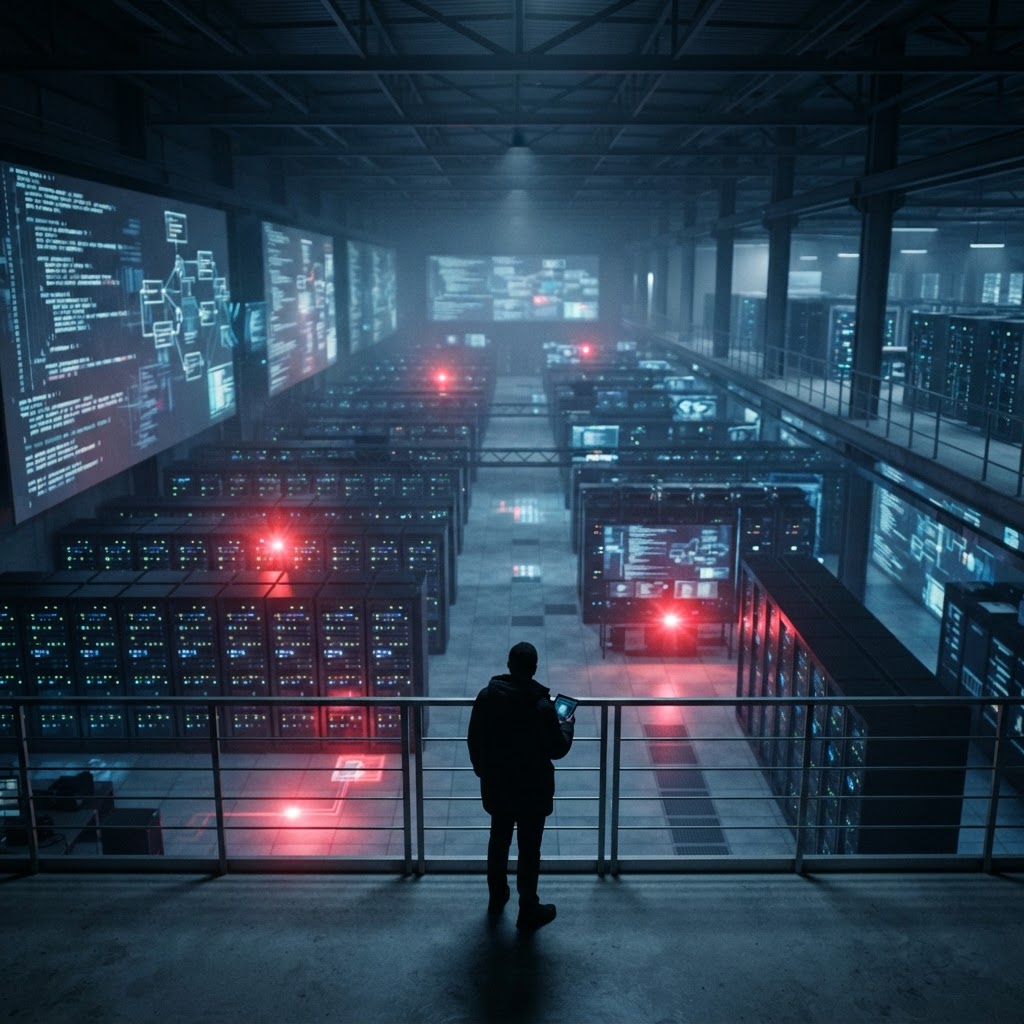
Zero-Day Factories: Could AI Industrialize the Discovery of Cyber Weapons?
Previously, finding sophisticated vulnerabilities required scarce human expertise and considerable time. Increasingly capable AI systems could transform vulnerability research by analyzing vast amounts of software continuously. This article explores how automated vulnerability discovery could alter the economics and strategic balance of cyber warfare.
Executive Takeaway — TL;DR
- Category:
- Cyber Intelligence
- Severity:
- Critical
- Confidence:
- High Confidence
- Read Time:
- 18 min
Zero-Day Factories: Could AI Industrialize the Discovery of Cyber Weapons?
There was a time when finding a zero-day vulnerability was an artisan's craft. You needed someone with deep knowledge of operating systems, compilers, and reverse engineering. Someone who could read assembly code the way a novelist reads prose, spotting the subtle flaw in the logic that nobody else had noticed. These people were rare, expensive, and their output was measured in single digits — maybe a handful of genuinely novel vulnerabilities per year, per researcher.
That world is ending.
In its place, something far more industrial is emerging. AI systems are increasingly capable of analyzing software for security vulnerabilities at a speed and scale that makes traditional human research look like hand-stitching in a world of automated textile mills. The question isn't whether AI will transform vulnerability discovery. It's already happening. The question is what happens to the strategic balance of cyber warfare when finding cyber weapons — the zero-day exploits that unlock adversary systems — goes from a craft industry to a factory operation.
The Economics of Zero-Days: From Scarcity to Abundance
To understand why this matters, you need to understand the economics of zero-days. A zero-day vulnerability — a flaw in software that the vendor doesn't know about and hasn't patched — is the most valuable commodity in cyber warfare. It provides access to systems that the defender believes are secure. It can't be detected by signature-based security tools because it's never been seen before. It provides a window of opportunity that lasts until the vulnerability is discovered, reported, and patched — which could be months or even years.
The scarcity of zero-days has been one of the most important stabilizing forces in cyber warfare. Finding them is hard. The number of researchers capable of discovering genuinely novel vulnerabilities is small. The time required is significant. The cost per vulnerability — whether measured in salaries, time, or the market price of a zero-day exploit — is high enough that even the best-funded intelligence agencies maintain relatively modest stockpiles.
This scarcity creates a natural limit on the scale of offensive cyber operations. You can only launch as many sophisticated attacks as you have zero-day exploits. When you use one, you potentially burn it — the exploit may be discovered, reported, and patched. Every use is a strategic decision. Do we use this against this target, knowing it might be our last one? The scarcity forces restraint.
AI changes the economics entirely. An AI system that can continuously analyze thousands of software products for vulnerabilities doesn't get tired, doesn't need a salary, and doesn't take a year to produce one zero-day. It finds them continuously, across a vast attack surface, at a pace limited only by computing resources. The bottleneck shifts from human expertise — scarce and slow — to compute power — abundant and scalable.
If this transition plays out, the economics of zero-days could flip from scarcity to abundance. And abundance changes everything about how cyber warfare works.
How AI Finds What Humans Can't
The way AI systems discover vulnerabilities is fundamentally different from how human researchers work, and understanding that difference is key to understanding why the economics are changing.
A human researcher approaches a target software product methodically. They study the code, understand the architecture, identify areas that look suspicious, and then dig deep into specific functions or modules. The process is thorough but narrow — a researcher can only focus on one thing at a time. The depth of their analysis is limited by their cognitive capacity. They can only hold so much complexity in their head at once.
An AI system approaches the problem differently. It can analyze the entire codebase of a software product simultaneously, looking for patterns that indicate potential vulnerabilities. It doesn't need to understand the code the way a human does — it identifies statistical patterns, code structures, and behavioral signatures that correlate with known vulnerability classes. It can fuzz thousands of inputs simultaneously, testing the software's behavior under conditions that a human researcher would never have time to explore.
More significantly, AI systems are getting better at finding novel vulnerabilities — not just known classes of flaws, but previously unknown types. By training on large datasets of known vulnerabilities, these systems learn the characteristics of vulnerable code and can identify similar patterns in software that has never been analyzed. They can also identify code that deviates from secure patterns in ways that suggest a potential weakness — even if the specific vulnerability type isn't yet known.
The speed differential is the most striking part. A human researcher might spend weeks analyzing a single software product. An AI system can analyze thousands of products in the same time frame, flagging potential vulnerabilities for deeper analysis. The human researcher's output is one product per few weeks. The AI system's output is potentially hundreds of products per day. That's not an incremental improvement. It's a categorical shift in the economics of vulnerability discovery.
The Zero-Day Factory: How It Would Actually Work
To see what an industrialized zero-day discovery operation would look like, it helps to imagine the pipeline. Not a single AI model that magically produces exploits, but a multi-stage system where each stage is optimized for a different part of the vulnerability research process.
The first stage is reconnaissance. AI agents continuously scan software products — operating systems, applications, libraries, firmware, embedded systems — building a map of the attack surface. Every new version, every patch, every configuration change is noted and flagged for analysis. The system maintains a living inventory of the world's software, updated in real time.
The second stage is automated analysis. AI systems examine each software product for potential vulnerabilities. They use a combination of static code analysis — examining the source code or decompiled binary for patterns that suggest weaknesses — and dynamic analysis — running the software with generated inputs to observe its behavior under stress. The system identifies candidate vulnerabilities: code paths that look exploitable, input handling that seems insufficient, boundary conditions that might not be properly checked.
The third stage is validation. For each candidate vulnerability, the system generates a proof-of-concept exploit — a minimal piece of code that demonstrates the vulnerability is real and exploitable. This is the step that separates a theoretical weakness from a usable cyber weapon. AI systems are becoming increasingly capable of this step, though it remains the most challenging part of the pipeline to fully automate.
The fourth stage is cataloguing. Validated vulnerabilities are catalogued, categorized by the type of software affected, the impact of exploitation, and the difficulty of exploitation. They're stored in a database — the zero-day stockpile — ready to be deployed when needed. The system also monitors whether the vulnerability has been independently discovered by other researchers or patched by the vendor, allowing the stockpile to be continuously updated and pruned.
The fifth stage is deployment readiness. For vulnerabilities that are selected for potential operational use, the system generates full exploit packages — the tools needed to exploit the vulnerability against a specific target, complete with evasion techniques designed to bypass likely defensive measures. These packages are tested against simulated targets to verify their effectiveness before being added to the operational stockpile.
The entire pipeline runs continuously, 24/7, across thousands of software products simultaneously. The output is a growing stockpile of zero-day exploits, discovered and validated by machines, ready for use by human operators who never had to find a single vulnerability themselves.
The Strategic Balance Shift
If one nation can run a zero-day factory and its adversaries can't, the strategic balance of cyber warfare shifts dramatically. Here's how.
The nation with the factory has a growing stockpile of zero-day exploits. It can use them freely — not hoarding them out of scarcity, but deploying them strategically, knowing that more are being discovered every day. It can target more systems, launch more operations, and accept the risk of burning exploits because the supply is being continuously replenished. Its offensive capability scales with its compute infrastructure rather than its human workforce.
The nation without the factory is operating under the old economics. Its zero-day stockpile is limited by the number of skilled researchers it can hire and the time they need to find each vulnerability. Every exploit is precious. Every use is a strategic decision. The gap between what it could do if it had more zero-days and what it can do with the ones it has is a constraint that shapes its entire offensive posture.
The asymmetry compounds over time. The nation with the factory discovers more vulnerabilities, which enables more operations, which produce more intelligence, which reveals more targets and more vulnerabilities to exploit. The nation without the factory falls further behind with each passing month. The gap isn't just in the number of zero-days. It's in the operational tempo, the intelligence picture, and the strategic flexibility that a large stockpile provides.
This is why the competition for AI and compute infrastructure isn't just a commercial rivalry. It's a military one. The nation with the most powerful AI systems and the most compute resources has the potential to build the best zero-day factory, which translates directly into offensive cyber capability. The chips and data centers that everyone talks about in the context of AI leadership are, in this analysis, weapons production infrastructure.
The Defensive Side: Patching at Factory Speed
If the offensive side can industrialize vulnerability discovery, the defensive side needs to industrialize vulnerability remediation. This creates a race — not between humans, but between AI systems — and it's a race where the defender is structurally disadvantaged.
When an AI system discovers a vulnerability, it can immediately generate the exploit and add it to the stockpile. The vulnerability exists from the moment the software is deployed, but the AI system can discover it at any point after that. The defender doesn't know the vulnerability exists until it's either found by their own analysis, reported by the vendor, or exploited.
For the defender, the challenge is that even if they have their own AI systems scanning for vulnerabilities, the process of patching is slower than the process of discovering. Finding a vulnerability takes an AI system hours or minutes. Developing, testing, and deploying a patch takes days or weeks — the patch has to be written, tested for compatibility, distributed, and installed across every affected system. In the time it takes to patch one vulnerability, the AI discovery system has found ten more.
This asymmetry — discovery at machine speed, remediation at human speed — is the fundamental vulnerability of the defensive side in the industrialized zero-day era. The defender is always one step behind, not because they're less capable, but because the physics of the problem favor the attacker. Finding is faster than fixing.
The defender's best hope is their own AI systems — defensive AI that can detect exploitation attempts, identify the vulnerability being exploited, and automatically generate and deploy patches or mitigations at machine speed. This is the defensive equivalent of the zero-day factory: a system that can close vulnerabilities as fast as the offensive system can find them. But building this requires the same compute resources, the same AI capabilities, and the same investment as the offensive system. The defense doesn't get a discount.
The Proliferation Problem
The industrialization of vulnerability discovery doesn't just affect nation-states. It affects the entire landscape of cyber threats.
In the current world, zero-day capabilities are largely concentrated in nation-states and a small number of elite criminal groups. The cost of acquiring zero-days — whether through in-house research or purchase from brokers — is high enough to limit their use to actors with significant resources. This creates a natural filter: zero-days are used by sophisticated actors against high-value targets, not by random criminals against random victims.
If AI systems make vulnerability discovery cheaper and more accessible, this filter weakens. An AI tool that can discover zero-days doesn't have to be a multi-billion-dollar intelligence program. It could be a commercial product, a shared research tool, or an open-source project. If the cost of finding a zero-day drops far enough, the number of actors who can afford to find and exploit them increases dramatically. Zero-days move from the exclusive province of nation-states to a commodity available to a much wider range of threat actors.
This doesn't mean every script kiddie will have zero-days tomorrow. The infrastructure required to run a sophisticated vulnerability discovery pipeline — compute resources, training data, expert validation — is still substantial. But the trajectory is toward lower costs, greater accessibility, and wider proliferation. The defensive community needs to prepare for a world where zero-days are more common, more widely available, and more frequently used by a broader range of adversaries.
The Stockpile Dilemma
Nations that build zero-day factories face a dilemma that echoes the nuclear weapons debate: should discovered vulnerabilities be disclosed to the vendor so they can be patched, or should they be stockpiled for potential offensive use?
In the artisanal era of vulnerability research, this was a relatively simple decision for intelligence agencies. Zero-days were scarce. Each one was valuable. The cost of stockpiling — the risk that someone else would discover the same vulnerability, or that it would be independently patched — was manageable because the number of vulnerabilities in the stockpile was small.
In the industrial era, the calculus changes. An AI system discovering vulnerabilities continuously will generate a large stockpile. Maintaining that stockpile — keeping the vulnerabilities secret, monitoring for independent discovery, managing the operational security of a large database of exploits — becomes more complex and more risky. Each vulnerability in the stockpile is a potential liability: if it's discovered by another researcher or exploited by another actor, the value of the stockpiled exploit drops to zero.
The scale also creates a governance problem. A small stockpile can be reviewed and approved by senior decision-makers. A large stockpile — potentially hundreds or thousands of vulnerabilities — can't be individually reviewed. Decisions about which vulnerabilities to stockpile and which to disclose need to be made by policy, not by individual judgment. And the policy needs to account for the fact that some vulnerabilities, if stockpiled and not disclosed, leave the nation's own infrastructure — which runs on the same commercial software — vulnerable to the same exploit.
This is the stockpile dilemma in the AI era: the more vulnerabilities you find, the more you have to choose between using them offensively and disclosing them defensively. And the more software your own nation depends on, the more damaging the vulnerabilities you choose not to disclose.
What Happens to the Cyber Mercenaries
The industrialization of vulnerability discovery will reshape the commercial cybersecurity market in ways that are already beginning to be felt.
Zero-day brokers — companies that buy vulnerabilities from independent researchers and sell them to government clients — have been a feature of the cybersecurity landscape for years. They serve as intermediaries, connecting researchers who find vulnerabilities with governments that want to use them. Their business model depends on the scarcity of zero-days: if vulnerabilities are hard to find, the price is high, and the broker's margin is attractive.
An AI-driven zero-day factory could disrupt this market entirely. If a nation-state can discover its own vulnerabilities at scale through AI systems, it doesn't need to buy them from brokers. The broker's value proposition — access to scarce human expertise — evaporates when the nation has its own factory. The brokers would need to either adopt AI themselves or find a new business model.
The independent vulnerability researchers — the artisans of the old era — face a similar disruption. Their skills are still valuable for the most complex and novel vulnerabilities, but the bulk of vulnerability discovery — the routine, high-volume work of scanning and testing — is increasingly automatable. The researchers who survive the transition will be the ones who work alongside AI systems, using their human intuition to guide the AI's analysis and validate its most significant findings.
The Bottom Line
The industrialization of vulnerability discovery is not a future scenario. It's a process that is underway right now, in research labs, in commercial cybersecurity companies, and in classified government programs. The technology is advancing. The economics are shifting. The strategic implications are becoming clear.
The nation that builds the best zero-day factory gains an offensive advantage that compounds over time — more vulnerabilities, more operations, more intelligence, more targets. The nation that doesn't falls behind. The defensive side races to keep up, but the physics of the problem — discovery is faster than remediation — favor the attacker.
The zero-day — the most valuable and most scarce commodity in cyber warfare — is becoming an industrial product. And like every industrial product, it will be produced at scale, by machines, in factories that run 24/7. The question isn't whether this will happen. The question is who will build the best factory first, and what the world looks like when the most powerful weapons in cyber warfare are no longer crafted by artisans but stamped out by machines.
The artisans had a good run. Their era is ending. The factories are starting up.

Need Zero Click Spyware for Android and iOS?
Encrygma delivers serverless, offline, quantum-safe encrypted communications built for executives, agencies, and operators facing zero-click spyware and advanced mobile surveillance threats.
Related Intelligence

AI Agent-Driven Data Theft Campaigns Surge Following Exvicy Framework Proliferation

ShinyHunters Bypass WAF Protections to Resume Exploitation of Oracle PeopleSoft Zero-Day