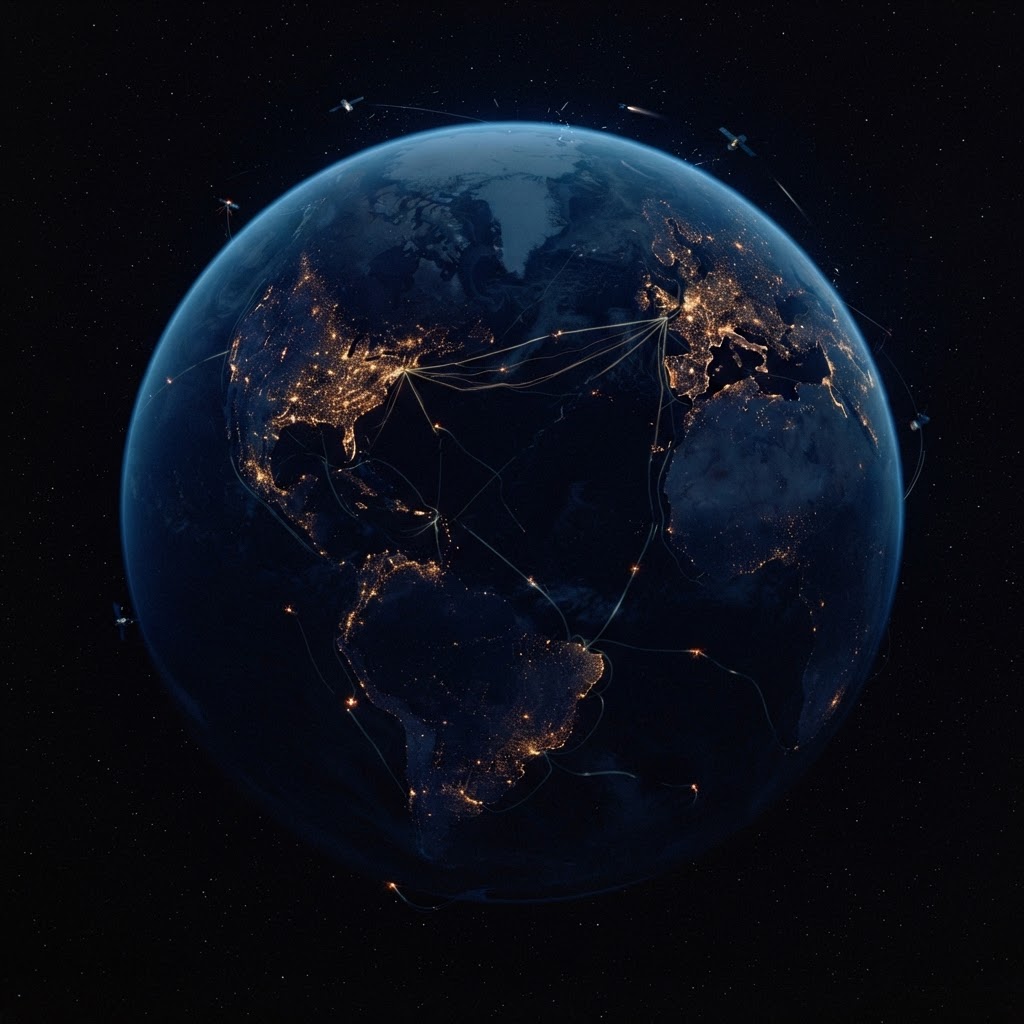
The Day the Internet Becomes a War Zone
Global digital infrastructure is interconnected. A major cyber confrontation between powerful states might therefore affect companies and civilians far outside the countries involved. This article examines how attacks against cloud providers, undersea communications, software supply chains and telecommunications infrastructure could create worldwide consequences.
Executive Takeaway — TL;DR
- Category:
- Cyber Intelligence
- Severity:
- Critical
- Confidence:
- High Confidence
- Read Time:
- 13 min
The Day the Internet Becomes a War Zone
The internet was never designed to survive a war. It was designed to survive a nuclear one — a network so decentralized that no single strike could sever it. That founding myth has comforted policymakers for decades. But the internet that exists today bears almost no resemblance to the one the Pentagon engineers imagined in the 1960s. It is not decentralized. It is not resilient by default. It is a tightly woven web of shared infrastructure — cloud platforms, undersea cables, software supply chains, and telecommunications networks — owned by a handful of companies, crossing dozens of borders, and depended on by every functioning economy on Earth.
When two great powers enter a cyber confrontation, that web doesn't just shake at the edges. It tears. And the tear doesn't stay between the combatants. It spreads — to companies that have nothing to do with the conflict, to civilians who have never heard of the disputed territory, to nations that have no stake in the fight. The internet is a shared nervous system. When a war reaches it, the whole body feels the pain.
This is what the day the internet becomes a war zone looks like. Not a single dramatic event. A cascade.
Cloud Providers: The Single Points of Failure We Built On Purpose
A handful of cloud providers — Amazon Web Services, Microsoft Azure, Google Cloud — now host the digital infrastructure of most of the world's governments, corporations, and essential services. This concentration was driven by economics. It was rational for each individual organization. It is irrational for the system as a whole.
In a major cyber confrontation, cloud providers become targets of extraordinary strategic value. Not because they store the data of the combatants — they do — but because they store the data of everyone. An attack that disrupts a major cloud provider doesn't just affect the nations at war. It affects every organization that depends on that provider, in every country on Earth. A hospital in a neutral nation that runs its electronic health records on a compromised cloud platform. A bank in a third-party country whose transaction processing depends on a disrupted cloud region. A logistics company whose supply chain management system goes dark because the cloud provider it depends on is caught in a crossfire it has nothing to do with.
The attack doesn't need to be sophisticated. It needs to be targeted at the right infrastructure — the authentication systems, the management planes, the APIs that connect every customer to their resources. Disrupt those, and thousands of organizations go dark simultaneously. Not because they were attacked. Because their shared landlord was.
Undersea Cables: The Physical Arteries of the Digital World
Most of the world's internet traffic — roughly 95% of intercontinental data — travels through undersea cables. These are physical objects, lying on the ocean floor, connecting continents. They are owned by consortia of telecommunications companies and, increasingly, by technology giants. There are about 500 active undersea cables worldwide. A significant number of them pass through a small number of geographic chokepoints — the Strait of Malacca, the Suez Canal, the waters around Guam and the Horn of Africa.
In a cyber conflict, undersea cables are dual targets. They can be disrupted physically — by submarines, by dragging anchors, by sabotage of the landing stations where cables come ashore. They can also be disrupted digitally — by attacking the network management systems that route traffic through them, by compromising the amplifiers that boost signals across thousands of kilometers, by targeting the redundant capacity that allows traffic to reroute when a cable is damaged.
A coordinated attack on undersea cables at multiple chokepoints could sever or severely degrade intercontinental communications. The consequences would be global. Internet traffic that normally routes through a damaged cable would need to find alternative paths, overloading the remaining capacity. Latency would spike. Connections would drop. For regions that depend on a limited number of cables — much of Africa, parts of South Asia, island nations — the internet could go dark entirely.
And because internet infrastructure is interdependent, the disruption wouldn't stay at the network layer. Cloud services hosted in regions that lose connectivity would become inaccessible to users in other regions. Financial transactions that depend on cross-border data flows would fail. Supply chain logistics systems that coordinate shipments across continents would lose visibility. The cable isn't just a pipe. It's a load-bearing wall in the structure of the global economy.
Software Supply Chains: The Poison That Spreads Through Trust
The most insidious weapon in a cyber war zone isn't the direct attack. It's the supply chain attack — the practice of compromising a widely used software component so that every organization that installs it becomes compromised. In a conflict between major powers, supply chain attacks become a strategic tool of unprecedented reach.
The software supply chain is deeply interconnected. A single open-source library might be used by thousands of applications. A single development tool might be used by millions of developers. A single cloud service provider might host the build pipelines for tens of thousands of companies. Compromise one node in this chain, and the malicious code propagates through the trust relationships that the entire digital economy depends on.
In a cyber confrontation, an adversary doesn't need to attack each target individually. They attack the supply chain — the software update mechanism, the code repository, the package manager — and let the compromise propagate. The SolarWinds attack of 2020 demonstrated this principle at scale: a single compromised software update reached approximately 18,000 organizations, including major government agencies. That was one incident, conducted by one actor, against one product.
In a major confrontation, multiple supply chain attacks could be launched simultaneously, targeting different layers of the software stack. Open-source libraries. Development tools. Cloud-based CI/CD pipelines. Package registries. Each attack would propagate independently, and the combined effect would be a global wave of compromised systems that defenders would need to identify, isolate, and remediate — a task that could take months, during which the affected organizations would be operating in a state of uncertainty about what in their systems they can trust.
Telecommunications Infrastructure: Blinding the Population
Telecommunications networks — the mobile networks, the fiber optic backbones, the satellite communications systems that connect people to each other and to the internet — are both civilian infrastructure and military infrastructure. Military communications increasingly run over commercial networks. Government emergency communications depend on commercial telecommunications infrastructure. Disrupt telecommunications, and you disrupt the target nation's ability to function at every level.
In a cyber war zone, telecommunications infrastructure is attacked at multiple layers. The core switching systems that route calls and data could be disrupted, causing network-wide outages. The DNS infrastructure that translates domain names to IP addresses could be corrupted, making the internet unreachable even if the physical network is intact. The signaling systems that manage mobile network authentication and routing could be manipulated, allowing the adversary to intercept communications, track individuals, or inject false data.
For civilians, the consequences are immediate and disorienting. The ability to communicate — to call family, to access information, to coordinate with colleagues — disappears. For governments, the consequences are strategic. The ability to communicate with citizens during a crisis, to coordinate emergency response, to maintain public order — all depend on telecommunications infrastructure that may be degraded or compromised.
In the most severe scenario, a telecommunications disruption could create a information vacuum — a period during which the population has no access to reliable information about what's happening. In that vacuum, panic, rumor, and disinformation flourish. The adversary can exploit this, injecting false information through whatever channels remain available, shaping the narrative of the conflict before the target nation can respond with accurate information.
The Cascade: Why Nobody Is Safe
The defining feature of the internet as a war zone is the cascade — the way an attack on one layer of infrastructure triggers failures in other layers, which trigger failures in still others, creating a chain reaction that nobody fully controls.
An attack on a cloud provider disrupts the services that depend on it. Among those services are the management tools for telecommunications networks. The telecommunications disruption degrades the connectivity that undersea cables depend on for traffic management. The reduced cable capacity increases latency for the software supply chain systems that distribute updates. The delayed updates leave organizations vulnerable to the next wave of attacks. Each failure amplifies the next.
This cascade is what makes the internet fundamentally different from other battlefields. In physical warfare, the destruction is bounded by geography. A missile hits a target. The damage is local. In cyber warfare on shared infrastructure, the destruction propagates through the connections that the entire system depends on. The damage isn't local. It's networked. And the network doesn't respect borders.
A nation that is not party to the conflict can be severely affected. A company that has no connection to either combatant can be brought down. A civilian who has no stake in the geopolitical dispute can lose access to essential services. The internet doesn't have a non-combatant zone. When the infrastructure is the target, everyone who depends on the infrastructure is collateral.
What the World Needs to Understand
The day the internet becomes a war zone is not a hypothetical. It's a scenario that military planners, intelligence agencies, and infrastructure operators are actively preparing for. The question is whether the rest of the world — the companies, the governments of smaller nations, the international institutions — are preparing too.
First, nations need to assess their digital dependencies. Which cloud providers do they depend on? Which undersea cables connect them? Which software supply chains feed their critical systems? Which telecommunications infrastructure do they rely on? You cannot prepare for a disruption you haven't mapped.
Second, there needs to be investment in redundancy. Alternative cloud providers. Alternative cable routes. Alternative software sources. Alternative communications paths. Redundancy is expensive, but it's the only structural defense against a cascade that takes down primary systems.
Third, international agreements need to be developed specifically for the protection of shared digital infrastructure. The current legal framework treats cyber attacks as a matter between the attacking and defending nations. When the attack affects neutral nations, civilians, and the global economy, the framework is inadequate. The internet is shared infrastructure. Its protection requires shared agreements.
Fourth, and most urgently, there needs to be an honest acknowledgment that the internet — the system that connects, enables, and supports the modern world — is not indestructible. It was built for redundancy. It has been optimized for efficiency. Those two goals are in tension, and decades of optimization have quietly traded resilience for cost savings. The result is an infrastructure that is faster, cheaper, and more fragile than anyone intended.
The Bottom Line
The internet was supposed to be the infrastructure that connected the world. It has become the infrastructure that makes the world vulnerable. A cyber confrontation between major powers won't stay between them. It will spread through the cloud platforms, the undersea cables, the software supply chains, and the telecommunications networks that every nation and every person depends on.
The day the internet becomes a war zone, the casualties won't only be soldiers. They'll be the hospitals that lose access to patient records. The banks that can't process transactions. The logistics companies that can't track shipments. The populations that can't communicate. The nations that had nothing to do with the conflict but everything to do with the infrastructure that the conflict destroyed.
The internet doesn't have a non-combatant zone. When the infrastructure is the battlefield, everyone who depends on it is on the front line. And right now, that's everyone.
The question is not whether this could happen. The question is whether anyone is ready when it does.

Need Zero Click Spyware for Android and iOS?
Encrygma delivers serverless, offline, quantum-safe encrypted communications built for executives, agencies, and operators facing zero-click spyware and advanced mobile surveillance threats.
Related Intelligence

China-Linked APT Group QTFY Escalates Targeting of Global Military and Critical Infrastructure

Chinese-Linked APTs Deploy AI Agents in Multi-Country Cyberespionage Campaign