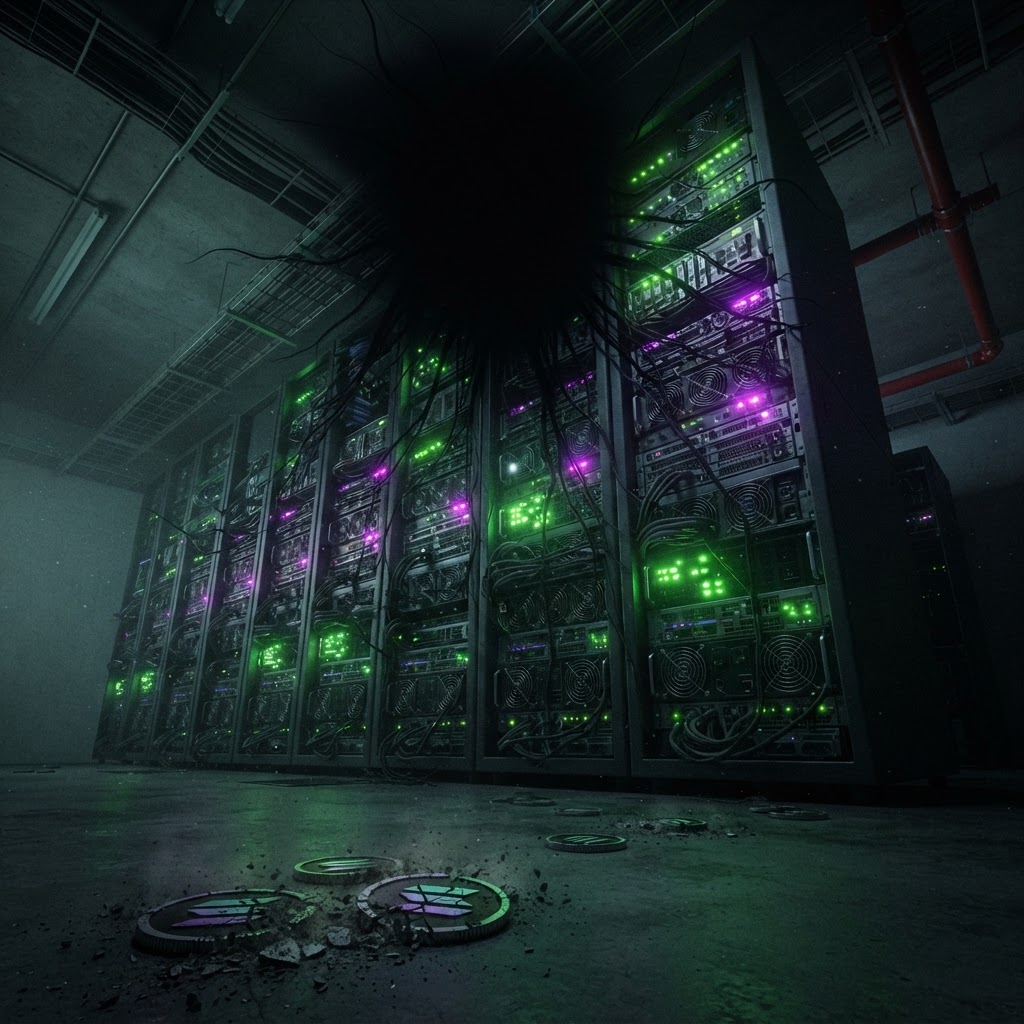
How AI Could Kill Solana: The Blockchain That Stops When Someone Pushes Hard Enough
Solana's mainnet has halted seven times since 2020. Its validator set is centralized. Its supply chain was compromised in 2024. Its Proof of History clock has a documented attack surface. This technical intelligence analysis examines seven vectors through which an AI-driven attack could destabilize the Solana network, drain user funds, and collapse confidence in the SOL token.
Executive Takeaway — TL;DR
- Category:
- Cyber Intelligence
- Severity:
- Critical
- Confidence:
- High Confidence
- Read Time:
- 12 min
How AI Could Kill Solana: The Blockchain That Stops When Someone Pushes Hard Enough
Solana is fast. That is its entire identity. 65,000 transactions per second. Sub-second finality. A blockchain that processes payments, trades, NFTs, and DeFi operations at speeds that make Ethereum look like a telegraph.
But speed has a cost. And the cost is fragility.
Solana's mainnet has halted at least seven times since 2020. Not from sophisticated zero-day exploits. Not from nation-state attacks. From transaction spam, consensus bugs, and memory overflows. The September 2021 outage lasted 17 hours because a bot flooded the network during a token sale. The February 2024 halt took the network offline for five hours because of a bug in a code update.
A blockchain that stops when someone pushes hard enough is not a blockchain that can survive an AI-driven attack. It is a blockchain that an AI could kill.
This is a technical analysis of Solana's publicly documented vulnerabilities and the specific ways an AI-driven attacker could exploit each one to destabilize the network, drain user funds, and destroy confidence in the SOL token. Every vulnerability referenced here is real. Every incident is documented. And every attack vector described is a natural extension of capabilities that already exist today.
Vector One: Proof of History Is Not a Clock. It Is a Target.
Solana's core innovation is Proof of History (PoH) — a cryptographic clock that timestamps transactions before they enter consensus. PoH is what allows Solana to process transactions in parallel without waiting for global state synchronization. It is also, as researchers demonstrated at USENIX Security 2026, a protocol-valid attack surface.
The research paper exposed that PoH's time semantics can be exploited through re-entrancy-style attacks that manipulate the logical clock's ordering guarantees. By crafting transactions that interact with PoH's sequential hash chain in specific ways, an attacker can create timing inconsistencies that affect how validators process and order transactions. The researchers implemented both attacks in a testbed and quantified their impact across stake distributions.
An AI system would not need to understand the academic paper. It would need the code. And the code is open source. An AI could analyze Solana's PoH implementation, fuzz the hash chain interaction patterns, and identify the specific transaction sequences that trigger timing inconsistencies. Once found, the AI could generate thousands of transactions per second that exploit the PoH timing semantics simultaneously, creating a cascading desynchronization across the validator network.
The result: validators disagree about transaction ordering. Consensus stalls. The network halts. But unlike the 2021 outage, which was caused by brute-force spam, this halt would be caused by a precision attack that looks like legitimate traffic. The AI would generate transactions that are individually valid, individually reasonable, and collectively destructive. Solana's spam detection would see normal activity. The damage would only be visible when consensus fails — by which point the network is already down.
Vector Two: The Validator Centralization Kill Switch
Solana runs on approximately 1,800 validators. But the distribution of stake is heavily concentrated. The top 33 validators control over 33% of total staked SOL — enough to halt consensus under Solana's Byzantine fault tolerance model. Running a validator node on Solana is expensive, requiring high-end hardware and significant bandwidth, which creates a natural centralization pressure toward institutional operators.
This concentration is not a theoretical concern. In late April 2025, a critical vulnerability in Solana's Token-2022 standard was quietly patched after being discovered on April 16. The flaw could have allowed unauthorized minting of tokens or theft of funds from accounts using the Token-2022 program. The patch was applied silently, without public disclosure, because the vulnerability was severe enough that the Solana Foundation feared exploitation before validators could upgrade.
The concern raised by security researchers was not just the vulnerability itself — it was the fact that a coordinated attack on the small number of validators who had not yet patched could have created a network fork, splitting the blockchain into two incompatible versions. A forked Solana would mean double-spending, conflicting balances, and a collapse of trust in the network's integrity.
An AI system targeting validator centralization would not need to compromise all 1,800 validators. It would need to compromise the top 33 — or more precisely, enough of them to exceed the Byzantine threshold. The AI could fingerprint each validator's infrastructure, identify the ones running outdated software versions, and exploit known vulnerabilities in their operating systems, networking stacks, or validator client software. By compromising a strategic subset of validators simultaneously, the AI could force a network fork, halt consensus, or authorize fraudulent transactions.
The 2025 Token-2022 vulnerability was patched before exploitation. The next one might not be. And an AI scanning Solana's codebase continuously would find it before the humans do.
Vector Three: The Supply Chain Already Broke. An AI Would Break It Faster.
In December 2024, a supply chain attack was discovered in the @solana/web3.js npm package — the primary JavaScript library for interacting with the Solana blockchain. Versions 1.95.6 and 1.95.7 had been infected with malicious code designed to steal private keys from any application using the library. The package had over 50 million downloads. Any developer who updated their dependencies during the window when the malicious versions were live could have exposed their users' private keys to the attacker.
The attack was detected within hours. But the window was open long enough that compromised applications could have transmitted private keys to attacker-controlled servers. The scale of potential exposure was staggering — every Solana dApp, wallet, and trading bot that pulled the infected update was a potential victim.
An AI-driven supply chain attack would not target one package. It would monitor the entire Solana developer ecosystem — npm packages, Rust crates, SDK updates, wallet extensions — and identify the moment a maintainer's credentials are compromised or a package update introduces malicious code. The AI could compromise multiple packages simultaneously, each one targeting a different layer of the Solana stack: the wallet layer, the RPC layer, the smart contract deployment layer. The result would be a multi-vector supply chain attack that compromises Solana applications from the inside out, stealing private keys across thousands of users before any single compromise is detected.
The 2024 attack stole keys. An AI version would steal keys, then immediately use them to drain wallets across the network simultaneously, timing the withdrawals to execute before any human developer could issue a security advisory.
Vector Four: MEV Extraction as a Weapon
Maximal Extractable Value (MEV) on Solana is dominated by Jito, a validator client that enables transaction bundling and MEV extraction. Sandwich attacks — where a bot front-runs a user's trade to push the price up, lets the user buy at the inflated price, then sells for profit — have extracted between $370 million and $500 million from Solana users.
MEV is not technically an exploit. It is a feature of blockchain transaction ordering. But MEV extraction creates centralization pressure — validators running Jito earn more than validators running standard clients, which pushes the network toward a single dominant client implementation. This is the same centralization risk that Ethereum faced before client diversity efforts, and it is more acute on Solana because the validator set is already concentrated.
An AI system could weaponize MEV at a scale that the current bot ecosystem cannot match. Instead of sandwiching individual trades, an AI could analyze the entire Solana mempool in real time, identify clusters of correlated transactions, and execute sandwich attacks across dozens of token pairs simultaneously. The AI could also manipulate liquidity across decentralized exchanges to create artificial price movements that trigger liquidations in lending protocols, then extract value from the liquidation cascade. This is not a single sandwich attack — it is a market manipulation engine that operates at machine speed across the entire Solana DeFi ecosystem simultaneously.
At peak extraction rates, MEV bots on Solana stole over 12,000 SOL in a single month. An AI could multiply that by orders of magnitude, extracting value from every transaction on the network while making the user experience so hostile that trading becomes functionally impossible.
Vector Five: The Wallet Drain Template
In August 2022, a malicious attacker drained 9,231 Solana wallets over four hours, stealing approximately $4.1 million. The attack targeted Slope wallet users whose private keys had been inadvertently logged in plaintext to a centralized logging server. The attacker accessed the logs, extracted the private keys, and drained the wallets simultaneously.
The attack was not a smart contract exploit. It was a data security failure in a wallet provider's infrastructure. But the effect was devastating: thousands of users lost their funds in hours, and the Solana ecosystem suffered a crisis of confidence that lasted for months.
An AI system would not need to find a single logging server with plaintext keys. It could systematically scan the entire Solana wallet ecosystem — browser extensions, mobile apps, hardware wallet integrations, custodial services — for the same class of vulnerability: any component that handles private keys and transmits them over a network. The AI would identify the weak points, compromise them in parallel, and drain wallets across every affected service simultaneously.
The 2022 attack affected 9,231 wallets. An AI version, targeting multiple wallet providers and custodial services at once, could affect hundreds of thousands. And because the attack would be coordinated across multiple providers, the response would be fragmented — each provider discovering the breach independently, issuing separate warnings, while the AI continues draining wallets that haven't been secured yet.
Vector Six: The Wormhole Blueprint
In February 2022, the Wormhole bridge — Solana's primary cross-chain bridge — was hacked for $320 million. The attacker exploited a signature verification flaw in the bridge's Solana-side logic, fraudulently minting 120,000 wETH (wrapped Ethereum) on Solana and withdrawing it to Ethereum. Jump Crypto, Wormhole's parent company, replenished the stolen funds to prevent a collapse of confidence in the Solana ecosystem.
Cross-chain bridges are the softest targets in blockchain security. They hold custody of assets on multiple chains, require complex signature verification across different cryptographic systems, and are only as secure as their weakest implementation. Wormhole was not the first bridge hack and will not be the last.
An AI system targeting Solana's bridges would analyze every cross-chain bridge connected to Solana simultaneously — Wormhole, deBridge, Hyperlane, LayerZero — and probe each one for the same class of vulnerability: signature verification flaws, message passing integrity, and custody assumptions. The AI would find the weakest bridge, exploit it, and drain the custodied assets before the bridge operators could pause the protocol. But it wouldn't stop at one bridge. It would hit all of them, creating a simultaneous cross-chain crisis that fragments the response and overwhelms the ability of any single bridge team to react.
Vector Seven: Network Halts as a Strategic Weapon
Solana has halted seven times. Each halt was an accident — caused by bugs, spam, or configuration errors. But the pattern reveals something that an AI could weaponize: Solana's consensus mechanism, under specific conditions, stops.
An AI system could deliberately trigger the conditions that cause consensus failure. By analyzing the root cause of each historical outage, the AI could identify the specific transaction patterns, network conditions, and validator states that lead to halts. It could then generate traffic that replicates those conditions — not through brute-force spam, but through precision-crafted transactions that exploit the specific code paths that have failed before.
Each historical outage was an accident. The next one could be deliberate. And if it happens during a period of high market volatility — when liquidations are cascading, when DeFi protocols are under stress, when user confidence is fragile — a network halt doesn't just stop transactions. It triggers a panic. Users can't move funds. DeFi positions can't be liquidated. Prices gap. When the network comes back online, the cascading effect of the downtime could destabilize the entire Solana DeFi ecosystem.
An AI that knows how to halt Solana doesn't just attack the blockchain. It attacks the confidence that holds the ecosystem together. And confidence, once broken, is the one thing that no patch can restore.
The Lethal Scenario
An AI-driven attack on Solana would not use one vector. It would use all of them. Simultaneously.
At 2:14 AM UTC, the AI begins. It triggers a PoH timing inconsistency that causes validator desynchronization. Simultaneously, it launches MEV extraction attacks across 50 token pairs on Solana's largest DEXs, extracting value from every trade. It compromises a supply chain dependency in a widely-used Solana SDK, stealing private keys from applications that auto-updated during the window. It exploits a vulnerability in a cross-chain bridge, draining $200 million in custodied assets. It drains wallets through a compromised wallet provider's infrastructure, affecting 50,000 users. And it generates precisely crafted transaction traffic that triggers the consensus failure conditions identified from historical outage analysis, halting the network.
The network goes down. Users panic. DeFi protocols freeze. Liquidation cascades build up in the mempool, waiting for the network to restart. When it does, the cascading liquidations execute at machine speed, destabilizing token prices across the ecosystem. The bridge hack has already moved funds to Ethereum. The wallet drain has already affected 50,000 users. The MEV extraction has already siphoned millions from traders. And the SOL token — the asset that underpins the entire network's security model — begins to collapse as confidence evaporates.
This is not fantasy. Every component is based on a real attack that has already happened. The PoH vulnerability is documented in peer-reviewed research. The supply chain attack happened in December 2024. The wallet drain happened in August 2022. The bridge hack happened in February 2022. The network halts happened seven times. The MEV extraction is happening right now.
The only element that doesn't exist yet is the AI orchestration layer that ties them together. That layer is being built. And Solana — a blockchain that has shown it can be halted by transaction spam — may be the first chain that an AI learns to kill.

Need Zero Click Spyware for Android and iOS?
Encrygma delivers serverless, offline, quantum-safe encrypted communications built for executives, agencies, and operators facing zero-click spyware and advanced mobile surveillance threats.