criticalAI Cyber Attacks
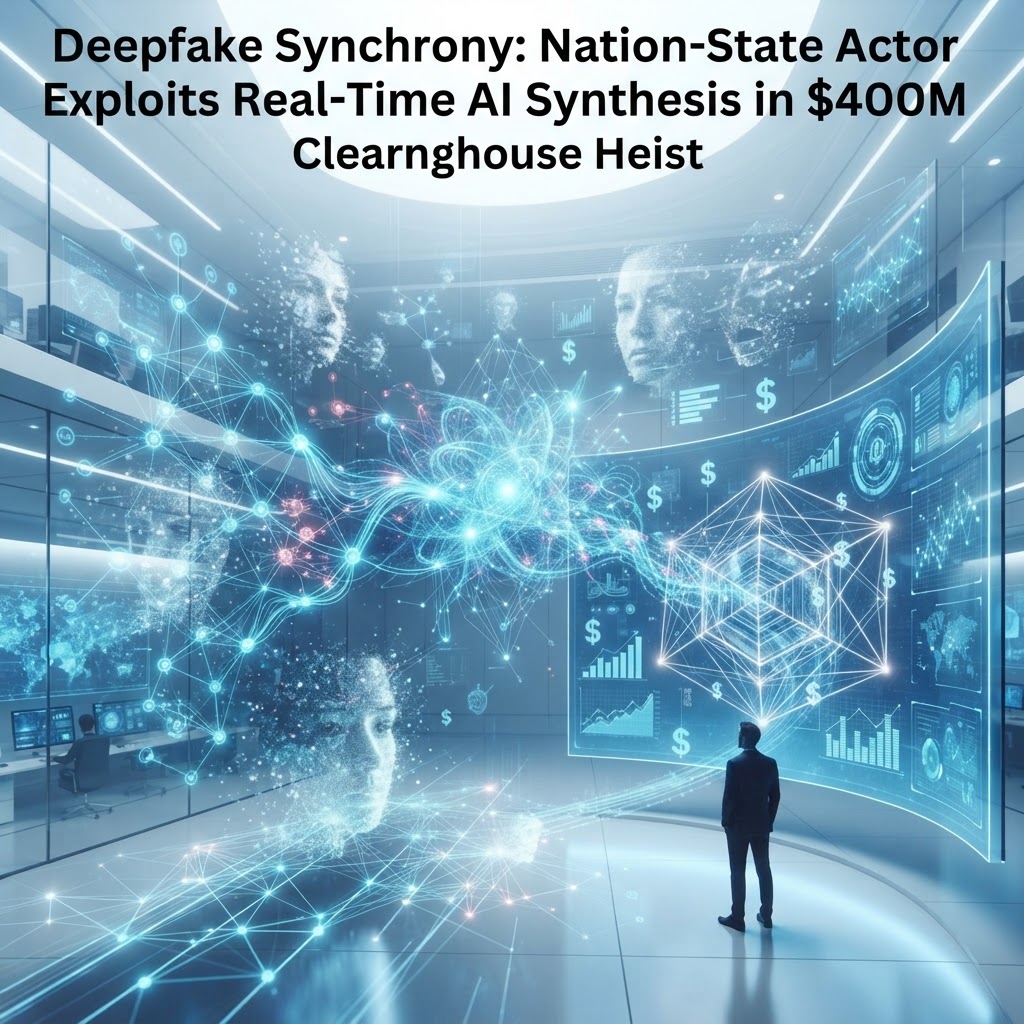
Deepfake Synchrony: Nation-State Actor Exploits Real-Time AI Synthesis in $400M Financial Clearinghouse Heist
A sophisticated APT group utilized real-time generative AI to impersonate executive leadership during a crisis call, authorizing emergency fund transfers to offshore accounts.
₿
Encrygma is selling the entire Full Cyber Weapon Research of Deepfake Synchrony: Nation-State Actor Exploits Real-Time AI Synthesis in $400M Financial Clearinghouse Heist for ₿ 0.10 BTC. Contact us.
31 July 2026Last updated 20 August 20265 min readMandiant
E
Encrygma AI Cyber Weapons Advisory Services : ₿ 0.10 BTCWe sell the full cyber research about this cyber weapon, including full source code, technical blueprints, exploits, implants and control and command dashboards. Consult with us · Telegram
Executive Takeaway — TL;DR
- Category:
- AI Cyber Attacks
- Severity:
- Critical
- Actor Type:
- Nation-State
- Geography:
- North America
- Confidence:
- High Confidence
- CVE:
- CVE-2026-11290
- Source:
- Mandiant
- Read Time:
- 5 min
Executive Summary\n\nOn July 30, 2026, Mandiant responded to a massive breach at GlobalClear, a Tier-1 financial clearinghouse. The incident, resulting in the unauthorized transfer of $420 million USD, represents the most sophisticated application of real-time deepfake technology observed to date. The attackers combined an automated LLM-driven reconnaissance phase with a live-synthesis video conference impersonation to bypass traditional 'human-in-the-loop' security protocols. This attack underscores the critical vulnerability of modern corporate governance to adversarial AI.\n\n## Threat Analysis\n\nThe attack lifecycle began approximately 48 hours ago with a targeted 'Agentic-Phish' campaign. Unlike traditional phishing, these attacks used autonomous LLMs to engage in multi-turn conversations with IT staff, eventually obtaining session tokens for an administrative portal. Following the initial access, the threat actor, designated as UNC5521, monitored internal communications to identify an upcoming emergency board meeting scheduled to address a minor (and likely actor-triggered) network latency issue. During this meeting, the actor introduced a deepfake avatar of the Chief Risk Officer, who 'authorized' a series of high-priority liquid asset transfers to mitigate what was described as a 'liquidity lock-up' caused by the network glitch.\n\n## Technical Details\n\nThe core of the exploit involved a low-latency generative adversarial network (GAN) optimized for real-time video streaming, likely a proprietary evolution of the 'DeepLive' framework. The actor exploited CVE-2026-11290, a vulnerability in the enterprise’s RAG-based internal AI assistant, to exfiltrate private voice and video samples of the leadership team. These samples were used to train a 'LoRA' (Low-Rank Adaptation) model in under two hours. During the live call, the attacker utilized a voice-conversion model that maintained emotional prosody and micro-expressions, bypassing the company’s biometric verification system which looked for synthetic artifacts in static images but failed to account for dynamic, context-aware AI synthesis. The C2 infrastructure was hosted on compromised edge computing nodes, reducing the latency of the deepfake stream to under 150ms, making it indistinguishable from a standard laggy video call.\n\n## Attribution Assessment\n\nMandiant identifies UNC5521 as the primary actor, a sophisticated group whose TTPs (Tactics, Techniques, and Procedures) align with state-sponsored espionage units previously associated with the 'Volt Typhoon' cluster. The precision of the social engineering and the quality of the generative models suggest significant state-level investment in adversarial machine learning capabilities. The use of custom-built LLM agents for the initial breach phase is a hallmark of this group’s recent 2026 operations.\n\n## Implications\n\nThis incident marks the end of 'visual and auditory trust' in corporate communications. The ability of actors to synthesize high-fidelity, interactive personas in real-time means that even face-to-face digital interactions are no longer secure. Organizations must recognize that biometric security and 'voice-as-a-password' are now obsolete. Furthermore, the speed at which the actors moved from data exfiltration to model deployment (under 4 hours) indicates that the defensive window for AI-driven attacks has shrunk to near-zero.\n\n## Recommendations\n\nWe recommend that all financial institutions immediately implement 'Challenge-Response' protocols for high-value transactions that involve non-digital, out-of-band verification (e.g., physical tokens or pre-shared keys). Additionally, organizations should deploy deepfake detection layers that analyze metadata and network-level anomalies rather than just visual pixels. Finally, patching RAG-based systems against prompt injection and data exfiltration (CVE-2026-11290) is critical to preventing the theft of training data used for these clones.

ENCRYGMA
Need Zero Click Spyware for Android and iOS?
Encrygma delivers serverless, offline, quantum-safe encrypted communications built for executives, agencies, and operators facing zero-click spyware and advanced mobile surveillance threats.
Share
Back to News RoomRelated Intelligence

Encrygma Intelligence Alert: Rise of Agentic AI Exploitation in PHP2Shell and Supply Chain Campaigns
29 Oct 2026
AI-Agentic Warfare: CyberStrikeAI Orchestrates Multi-Stage Attacks Against Japanese Infrastructure
28 Oct 2026
AI-Driven Cybercrime Surge: Autonomous Agents and Deepfake Vishing Campaigns Target Global Infrastructure
28 Oct 2026