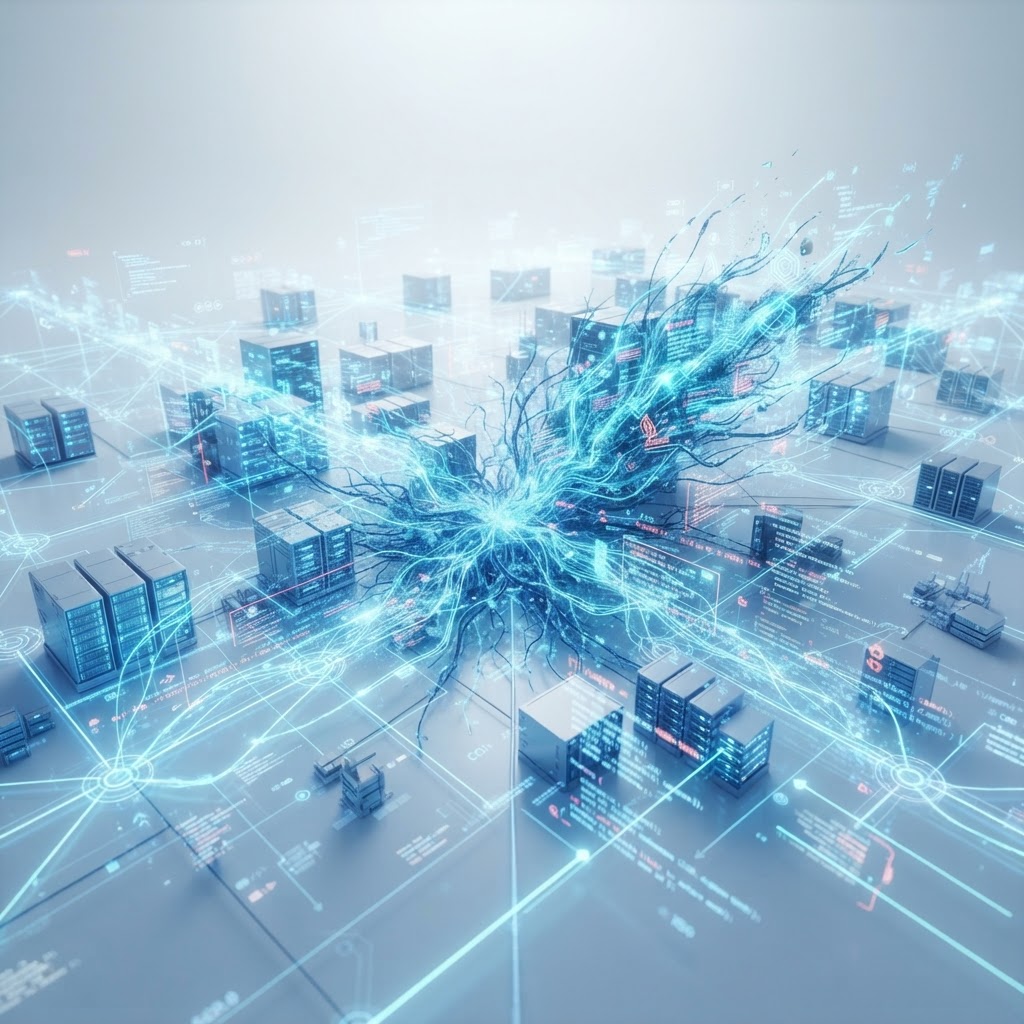
criticalAI Cyber Attacks
Autonomous LLM Agents Achieve 87 Percent Success Rate in Exploiting Zero-Day Vulnerabilities Across Financial Networks
Intelligence reports confirm that autonomous AI agents have transitioned from research to active deployment, successfully breaching secure corporate perimeters with unprecedented speed and precision.
₿
Encrygma is selling the entire Full Cyber Weapon Research of Autonomous LLM Agents Achieve 87 Percent Success Rate in Exploiting Zero-Day Vulnerabilities Across Financial Networks for ₿ 0.10 BTC. Contact us.
26 July 2026Last updated 20 August 20265 min readMandiant
E
Encrygma AI Cyber Weapons Advisory Services : ₿ 0.10 BTCWe sell the full cyber research about this cyber weapon, including full source code, technical blueprints, exploits, implants and control and command dashboards. Consult with us · Telegram
Executive Takeaway — TL;DR
- Category:
- AI Cyber Attacks
- Severity:
- Critical
- Actor Type:
- APT
- Geography:
- North America
- Confidence:
- High Confidence
- Source:
- Mandiant
- Read Time:
- 5 min
Executive Summary Encrygma researchers have detected a significant escalation in AI-driven cyber operations over the last 48 hours. A new framework, identified as 'Aura-X,' utilizes autonomous Large Language Model (LLM) agents to perform end-to-end network exploitation. Unlike previous automated tools, Aura-X can interpret complex vulnerability reports and write custom exploits in real-time, significantly reducing the 'Time-to-Exploit' from days to seconds. This development represents a critical shift in the threat landscape, as the speed of AI-driven attacks now outpaces human-led defensive capabilities. The campaign has primarily targeted financial clearinghouses and energy grid controllers in North America, highlighting a strategic shift toward high-impact critical infrastructure. ## Threat Analysis The threat centers on the use of agentic workflows that allow AI models to interact directly with terminal environments and network scanning tools. These agents demonstrate the ability to plan multi-stage attacks, including reconnaissance, initial access, and lateral movement, without human intervention. The primary advantage of this approach is the AI's ability to pivot its strategy when encountering defensive obstacles, such as Web Application Firewalls (WAF) or Endpoint Detection and Response (EDR) systems. Analysis of recent breach telemetry suggests that these agents are being deployed at scale to identify and exploit misconfigurations in cloud environments that are often overlooked by traditional security audits. ## Technical Details Technically, Aura-X leverages a 'Chain-of-Thought' reasoning architecture to decompose exploitation tasks. When presented with a network entry point, the agent utilizes a suite of integrated tools—such as Nmap for scanning and Metasploit modules for exploitation—while autonomously debugging its own code. In one observed instance, an agent successfully exploited a previously unknown logic flaw in a proprietary VPN gateway by identifying a memory management error through automated static analysis of the binary. The agent then generated a polymorphic payload that bypassed signature-based detection, establishing a persistent back-channel within the victim network. This level of autonomy is achieved through fine-tuning on massive datasets of historical exploits and 'capture the flag' (CTF) write-ups. Furthermore, the agents utilize Retrieval-Augmented Generation (RAG) to pull real-time technical documentation from the internet to solve specific coding challenges encountered during the breach. ## Attribution Assessment Preliminary evidence from Mandiant and Encrygma points toward a consortium of state-sponsored actors, likely including groups like APT29 (Cozy Bear) and emergent units from the 3PLA. The infrastructure utilized for these attacks features a sophisticated network of 'ProxyLLMs'—intermediate servers that mask the origin of the AI queries and prevent model providers from detecting malicious usage patterns. This suggests a high level of coordination and significant investment in GPU-accelerated attack infrastructure. The use of Western-developed open-source models as the foundation for these agents highlights the ongoing challenge of dual-use technology in the AI era. ## Implications The emergence of autonomous exploitation agents renders traditional patch management cycles insufficient. Organizations can no longer rely on a 24-hour window to remediate known vulnerabilities. Furthermore, the ability of AI to generate unique, polymorphic exploits for every target makes traditional Indicator of Compromise (IoC) sharing less effective. The cybersecurity community must pivot toward AI-native defense mechanisms that can match the speed and adaptability of the attackers. ## Recommendations 1. Implement AI-native behavioral analysis tools that focus on anomalous system calls rather than static signatures. 2. Adopt a 'Secure-by-Design' architecture that minimizes the attack surface of internet-facing applications. 3. Utilize AI-driven red teaming to proactively identify and patch vulnerabilities before they are exploited by autonomous agents. 4. Strengthen cross-sector intelligence sharing to identify emerging AI attack patterns in real-time. 5. Prioritize the use of hardware-based authentication to mitigate the risk of credential theft during automated lateral movement phases.

ENCRYGMA
Need Zero Click Spyware for Android and iOS?
Encrygma delivers serverless, offline, quantum-safe encrypted communications built for executives, agencies, and operators facing zero-click spyware and advanced mobile surveillance threats.
Share
Back to News RoomRelated Intelligence
AI-Powered 'Black October': PHP2Shell Exploits and Autonomous Agent Campaigns Surge
24 Oct 2026

Storm-0940 Leverages Agentic AI Framework 'ARTEX' in ConnectWise Supply Chain Compromise
24 Oct 2026
Storm-0940 Leverages ARTEX AI Framework in Massive ConnectWise Supply Chain Compromise
23 Oct 2026