The Algorithmic Battlefield: When Governments Fight Wars With Autonomous Software Agents
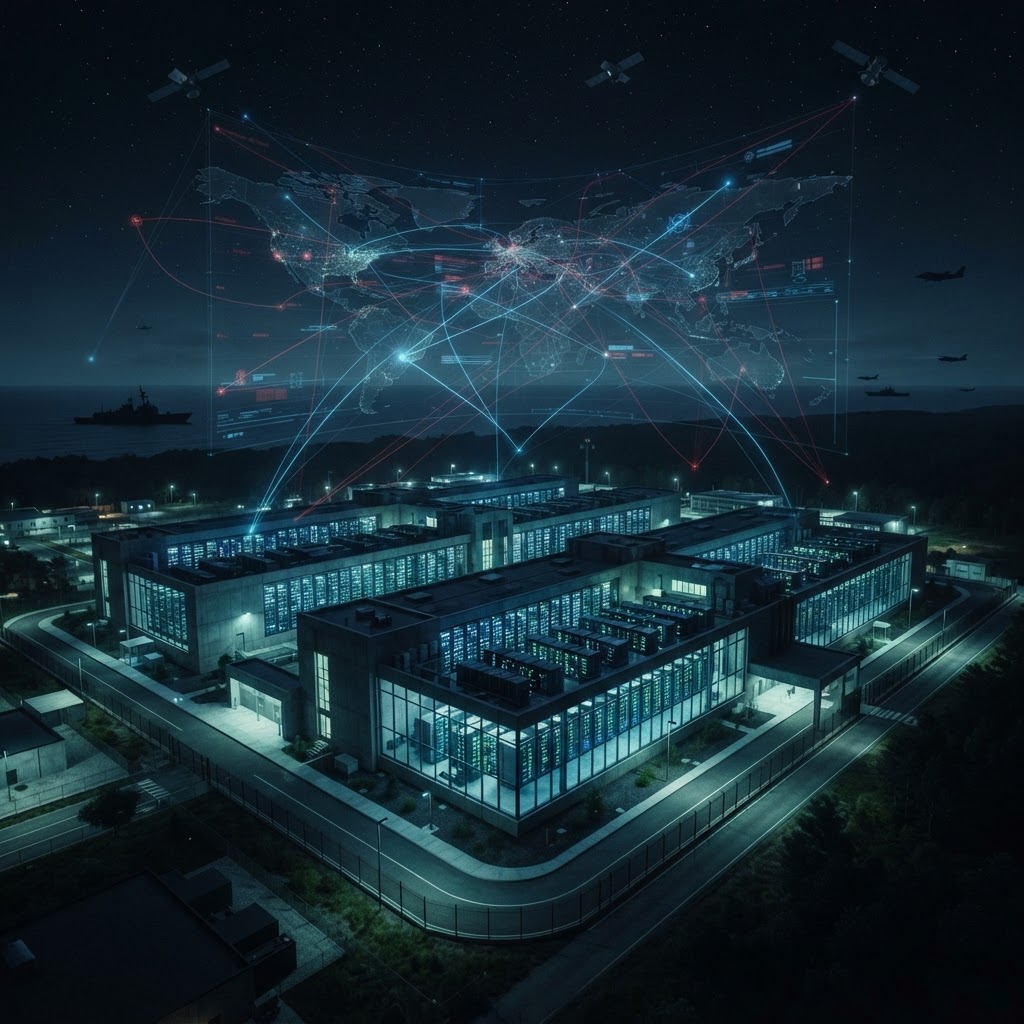
The battlefield of the future may include millions of lines of code fighting alongside aircraft, ships, satellites, and soldiers. This article examines the potential emergence of autonomous software agents designed for reconnaissance, intelligence analysis, network defense, cyber deception, vulnerability discovery, and offensive operations, and how future conflicts may involve machine-versus-machine engagements occurring across cloud infrastructure, telecom networks, satellites, data centers, and critical national systems at speeds impossible for humans to match.
Executive Takeaway — TL;DR
- Category:
- Cyber Intelligence
- Severity:
- Critical
- Confidence:
- High Confidence
- Read Time:
- 18 min
The Algorithmic Battlefield: When Governments Fight Wars With Autonomous Software Agents
Picture a future battlefield. Not the kind you're used to seeing in movies — not tanks rolling across plains, not fighter jets screaming overhead, not soldiers crouching in trenches. Picture instead a room full of servers in a data center somewhere nobody will ever identify, where millions of lines of code are executing decisions every millisecond — decisions about which systems to attack, which to defend, which to deceive, and which to ignore. Picture that same scene happening simultaneously in a dozen data centers around the world, each one a node in a conflict that is happening too fast for any human to follow.
That's the algorithmic battlefield. And it's closer than you might think.
The conventional military still matters — aircraft, ships, satellites, soldiers, all the hardware that defense budgets have been built around for decades. But alongside that physical infrastructure, a new layer of warfare is emerging, one that exists entirely in software and runs at a speed that makes human decision-making look like a relic of a slower age. The question isn't whether this layer will become part of military conflict. It's whether governments are prepared for what happens when it does.
The New Combatants: Code Instead of People
Every war in history has been fought by people. Even the most automated military systems — drone strikes guided by satellite, missile defense systems that track and intercept incoming threats, automated radar that detects enemy aircraft — ultimately depend on a human making a decision. The human might be sitting in a control room thousands of miles away, or they might be a commanding officer reviewing a target list, but the decision is human. The judgment is human. The accountability is human.
Autonomous software agents change that relationship fundamentally. An autonomous agent isn't a tool that a human operator uses to conduct a cyber operation. It's a system that conducts the operation itself — making decisions about what to target, how to attack, when to adapt, and when to withdraw. The human who deployed the agent might have set the objective, but the path to achieving that objective is determined by the machine.
This distinction matters more than it might seem. A tool does what you tell it to do. An agent does what it decides is necessary to achieve the goal you gave it. Those are very different things. And when the agent is operating at machine speed across an adversary's infrastructure, the decisions it makes — about which vulnerabilities to exploit, which systems to compromise, which data to exfiltrate, which defenses to evade — happen in milliseconds. There is no pause for human review. There is no time to call a commander and ask for guidance. The agent decides, and the agent acts.
Reconnaissance: The Machine That Sees Everything
The first role autonomous agents play on the algorithmic battlefield is reconnaissance — and it's where the machine advantage is most immediately obvious.
Traditional military reconnaissance is limited by physics and personnel. A surveillance satellite can only cover so much ground. A signals intelligence team can only monitor so many frequencies. A human analyst can only process so much data from so many sources before cognitive overload sets in. The coverage is real, but it's bounded.
An autonomous reconnaissance agent has no such bounds. It can scan an entire nation's network infrastructure simultaneously — every reachable IP address, every exposed service, every software version, every configuration weakness. It correlates data across sources that a human analyst would never have time to cross-reference: network scan results, public records, intercepted communications, social media profiles, job postings, conference presentations. It builds a picture of the adversary's digital infrastructure that is more comprehensive than anything a human team could assemble in months of work — and it does it in hours.
The depth matters as much as the breadth. An agent doesn't just find vulnerabilities. It understands them. It can assess which vulnerabilities are actually exploitable, which ones are trapped or monitored, which ones would trigger defensive alerts, and which ones offer the best path to high-value targets. This kind of analysis — the kind that senior intelligence analysts spend years learning to do well — is being automated, and the machines are getting better at it every month.
Intelligence Analysis: The Analyst That Never Gets Tired
Reconnaissance produces raw data. Intelligence analysis turns that data into understanding. And this is where autonomous agents might have their most profound impact on the algorithmic battlefield.
An intelligence analyst — a good one — can read through a cache of stolen documents, identify the significant ones, connect them to other intelligence, and produce an assessment that informs decision-making. A great analyst can do this across multiple sources and languages. But even a great analyst can only read so many documents per day, and they need to sleep, eat, and occasionally think about something else to avoid burnout.
An AI intelligence analysis system can read every document in a stolen cache — thousands, tens of thousands, hundreds of thousands — in every language, in a single session. It can cross-reference every document against every other document, against external databases, against historical intelligence, against current events. It can identify patterns that no human would ever spot: a shift in communication frequency that precedes a policy decision, a code word used consistently in a specific context, a relationship between two seemingly unrelated projects.
On the algorithmic battlefield, this means that the side with better AI intelligence analysis has a decisive information advantage. It knows more, understands more, and connects more dots — faster, more comprehensively, and without the cognitive limits that constrain human analysis. The intelligence war becomes a war of algorithms, and the nation with the best algorithms wins.
Network Defense: The Guard That Reacts in Milliseconds
Not all autonomous agents on the algorithmic battlefield are offensive. Some of the most important ones are defensive — and their role might be the most consequential for national security.
Modern critical infrastructure — power grids, telecommunications, financial systems, government networks — is under constant attack. Not just from nation-states, but from criminal groups, hacktivists, and increasingly from autonomous offensive agents. The volume of attacks has grown to the point where human defenders cannot keep up. Security operations centers generate thousands of alerts per day. Analysts triage them, investigate the most urgent, and ignore the rest. In the ignored alerts, the real intrusion often hides.
An autonomous defensive agent changes this dynamic. It monitors the network continuously, analyzing every connection, every data transfer, every authentication attempt. When it detects an anomaly — a pattern that deviates from the baseline of normal behavior — it doesn't generate an alert for a human to review. It takes action. It isolates the affected system. It revokes the suspicious credentials. It blocks the malicious connection. All in milliseconds.
On the algorithmic battlefield, this kind of defense is essential. Against an autonomous attacker that adapts in real time, a defense that waits for human review is a defense that arrives too late. The defensive agent must be as fast as the offensive agent — and ideally faster, because the defender needs to stop every attack while the attacker only needs one to succeed.
Cyber Deception: The Art of Lying to a Machine
One of the most fascinating and least discussed aspects of the algorithmic battlefield is cyber deception — the practice of actively misleading the adversary's autonomous agents.
In traditional warfare, deception is a well-established discipline. Feints, decoys, misinformation, false communications — all are tools that militaries have used for centuries to confuse the enemy about their intentions, their capabilities, and their positions. The goal is to make the adversary waste time and resources attacking the wrong targets while the real operations proceed elsewhere.
Cyber deception brings this principle to the digital domain, but with a twist. The target of the deception isn't a human commander who can be fooled by plausible-sounding misinformation. The target is an autonomous agent — a system that makes decisions based on data analysis and pattern recognition. Deceiving an AI requires understanding how the AI sees the world and manipulating its inputs to produce false conclusions.
This is where things get interesting. If you know that the adversary's reconnaissance agents are scanning your network for vulnerable systems, you can deploy honeypots — fake systems designed to look like real, vulnerable targets. When the agent discovers and attacks the honeypot, you learn about its capabilities, techniques, and objectives. You can feed it false data through the compromised honeypot, leading it to draw incorrect conclusions about your infrastructure.
You can also manipulate the agent's behavior at a deeper level. If you know that the agent uses machine learning to identify high-value targets, you can deliberately modify your network's observable characteristics to make important systems look unimportant and unimportant systems look critical. The agent, relying on its trained model, redirects its attack to the wrong targets.
Cyber deception on the algorithmic battlefield is a cat-and-mouse game between AI systems — one side's deception algorithms trying to mislead the other side's reconnaissance and targeting algorithms. It's machine versus machine, and the winner is the side whose algorithms are more sophisticated, more adaptable, and better at recognizing when they're being deceived.
Vulnerability Discovery: The Arms Race Beneath the Surface
Beneath every operation on the algorithmic battlefield — every reconnaissance sweep, every exploitation attempt, every defensive response — is a more fundamental competition: the race to discover vulnerabilities.
Vulnerabilities are the raw material of cyber warfare. Without them, there are no exploits. Without exploits, there are no breaches. Without breaches, there is no access, no intelligence, no disruption. The nation that discovers more vulnerabilities — in its own systems and in its adversaries' systems — has a strategic advantage that compounds over time.
Autonomous agents are transforming vulnerability discovery. AI systems can analyze software at a depth and speed that human researchers cannot match. They can fuzz thousands of programs simultaneously, identify code patterns that indicate potential weaknesses, and even generate proof-of-concept exploits to confirm that a vulnerability is real.
On the algorithmic battlefield, this means that vulnerability discovery is no longer a slow, manual process conducted by a small number of skilled researchers. It's a continuous, automated operation that runs 24/7 across thousands of software products. The stockpiles of zero-day exploits — the ones that defense analysts worry about — are growing, and AI is accelerating their growth.
The arms race here is not just about who finds more vulnerabilities. It's about who finds them faster, who can exploit them before they're patched, and who can detect when the adversary has found them. It's a race measured in days and hours, conducted by machines, with implications for every other operation on the battlefield.
Offensive Operations: When the Machine Decides to Strike
The most consequential — and most controversial — role of autonomous agents on the algorithmic battlefield is offensive operations. Not just exploitation, not just intelligence gathering, but active disruption and destruction of adversary systems.
An autonomous offensive agent, given a target and an objective, can conduct the full cycle of a cyber operation. It identifies vulnerabilities. It develops or selects exploits. It deploys them. It establishes persistence. It moves laterally. It executes the objective — whether that's data exfiltration, system disruption, or something else. It adapts when it encounters defenses. It coordinates with other agents when the operation requires it.
The speed is the thing. A human team might take weeks to plan and execute an operation like this. An autonomous agent can do it in minutes. And it can do it across multiple targets simultaneously, each operation running independently but coordinated by a higher-level system.
This is what makes offensive autonomous agents strategic weapons rather than tactical tools. A tactical tool helps you win a battle. A strategic weapon changes the nature of the war. When an adversary can deploy thousands of autonomous agents that can each independently conduct offensive operations at machine speed, the pace of conflict accelerates beyond what any human command structure can manage. The humans set the objectives. The machines fight the war.
Machine Versus Machine: The Speed No Human Can Match
The defining characteristic of the algorithmic battlefield is speed. Not the speed of a missile or a drone — those are fast, but they're still single objects operating in physical space. The speed of the algorithmic battlefield is the speed of computation: decisions made in milliseconds, adaptations in real time, operations coordinated across thousands of systems simultaneously.
When both sides in a conflict have autonomous agents operating on the algorithmic battlefield, the engagement becomes machine versus machine. Offensive agents probe and exploit. Defensive agents detect and contain. Deception agents mislead and redirect. Intelligence agents analyze and inform. All of this happens continuously, across cloud infrastructure, telecom networks, satellite communications, data centers, and critical national systems, at a speed that makes human intervention feel geological by comparison.
A human commander in this environment is not directing the battle. They're observing it — or more accurately, they're observing a simplified, summarized version of it, because the actual pace of events is too fast for human comprehension. They set the strategic objectives. They define the constraints. But the tactical decisions — which system to attack, which to defend, which to sacrifice, which to preserve — are made by machines.
This is the algorithmic battlefield. Not a battlefield where machines assist humans in fighting a war, but a battlefield where machines fight the war and humans watch.
What Governments Need to Understand
The emergence of the algorithmic battlefield demands a fundamental rethinking of military and national security strategy. Governments that continue to treat cyber operations as a specialized function — a support activity that enables the real military work done by ships and planes and soldiers — are missing the point. On the algorithmic battlefield, the cyber operations are the battle.
The nations that will be best positioned for this new reality are the ones that are building the infrastructure now: the AI models, the compute resources, the data pipelines, the talent, and the institutional frameworks needed to deploy and manage autonomous agents at scale. They're the ones treating autonomous cyber capabilities not as a nice-to-have but as a core military competency on par with air, sea, land, and space operations.
They're also the ones thinking hard about the control problem. An autonomous agent that can conduct offensive operations at machine speed is a system that can do things its creators didn't intend. Rules of engagement, escalation controls, fail-safes, and human override mechanisms — all of these need to be built into the architecture of the system, not bolted on after the fact. The history of autonomous systems in other domains — from automated trading in financial markets to autonomous vehicles — teaches us that the cost of getting this wrong is high, and the time to get it right is before deployment, not after.
The Bottom Line
The algorithmic battlefield isn't coming. It's forming — layer by layer, capability by capability, in research labs and classified programs and commercial AI companies around the world. The components exist. The integration is underway. And the gap between what's technically possible and what's been publicly acknowledged is widening every month.
Future conflicts may still involve aircraft, ships, satellites, and soldiers. But alongside those traditional forces, a new kind of warfare will be happening — faster, quieter, and at a scale that the physical battlefield cannot match. Millions of lines of code, executing millions of decisions per second, fighting a war that no human can fully perceive, let alone control.
The nations that recognize this shift and prepare for it — that build the autonomous capabilities, the defensive systems, the control frameworks, and the strategic understanding needed to operate on the algorithmic battlefield — will define the future of military power. The nations that don't will find themselves fighting a kind of war they don't understand, against an adversary they can't see, at a speed they can't match.
The algorithmic battlefield is the next frontier of warfare. The only question that matters is who will be ready for it.

Need Zero Click Spyware for Android and iOS?
Encrygma delivers serverless, offline, quantum-safe encrypted communications built for executives, agencies, and operators facing zero-click spyware and advanced mobile surveillance threats.
Related Intelligence

Autonomous 'CLOSEDQUORUM' Malware Uses Multi-LLM Voting to Orchestrate Cyber Attacks

Pentagon Data Breach Exposes Millions of Military Records and Social Security Numbers