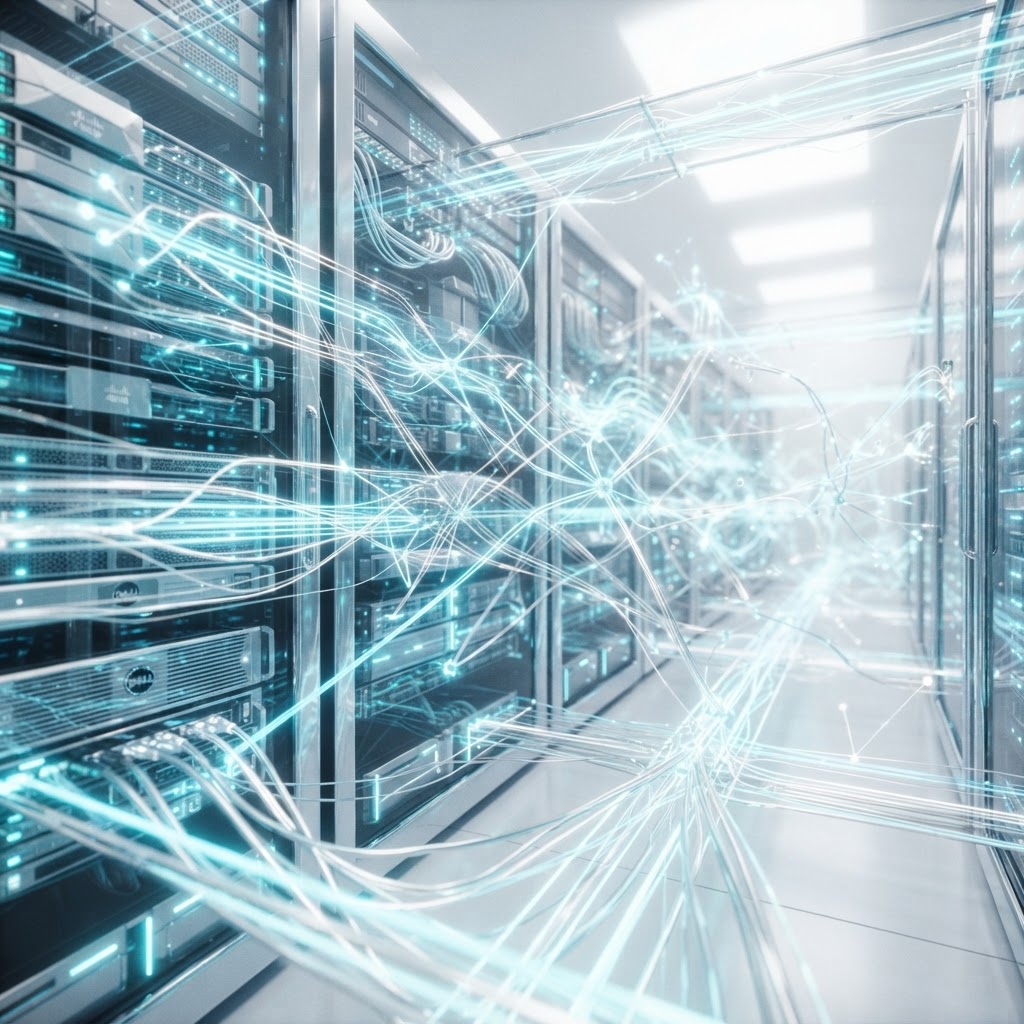
8 AI Agents vs. a Government Network: The New Architecture of Autonomous Cyber Warfare
A single AI assistant is no longer the ceiling. The Taiwan incident signals a shift toward teams of specialized AI agents — reconnaissance, exploitation, credential theft, lateral movement, and intelligence gathering — operating in parallel against a single government target. This is the architecture of the next offensive generation.
Executive Takeaway — TL;DR
- Category:
- AI Cyber Attacks
- Severity:
- Critical
- Actor Type:
- Nation-State
- Confidence:
- High Confidence
- Source:
- Encrygma Threat Intel Unit
- Read Time:
- 9 min
The Inflection Point: From Assistant to Agent Team
For the past two years, the cybersecurity conversation around artificial intelligence has centered on a single question: Can an AI help a human attacker? The answer, increasingly, is yes — but it is the wrong question. The Taiwan government network incident reframes the threat in a far more consequential way: attackers can now deploy teams of specialized AI agents, each optimized for a discrete phase of an intrusion, operating in parallel and coordinating their outputs in near real-time.
This is not a chatbot writing a phishing email. This is an operational architecture — a mesh of role-specific agents that collectively execute what previously required a full red team of human operators. The distinction matters because it changes the economics, the speed, and ultimately the scale of offensive cyber operations.
What the Taiwan Incident Reveals
According to public reporting and threat intelligence assessments, the intrusion targeting Taiwanese government networks displayed several characteristics inconsistent with a traditional single-operator or single-assistant attack:
- Parallel phase execution. Reconnaissance, initial access, credential harvesting, and lateral movement indicators appeared in compressed, overlapping time windows rather than the sequential, hand-off pattern typical of human operators.
- High coordination without high latency. The gap between discovery of a foothold and exploitation of adjacent systems was too short to plausibly reflect human-in-the-loop decision-making at every step.
- Specialized behavioral signatures. Different stages of the intrusion bore the hallmarks of distinct, narrow capabilities — as if each was handled by a tool tuned for that one task rather than a general-purpose assistant.
Taken together, these signals are consistent with a multi-agent orchestration model: a supervisory layer dispatching tasks to specialized sub-agents, each of which operates semi-autonomously within its domain and reports results back for the next dispatch.
The Multi-Agent Architecture
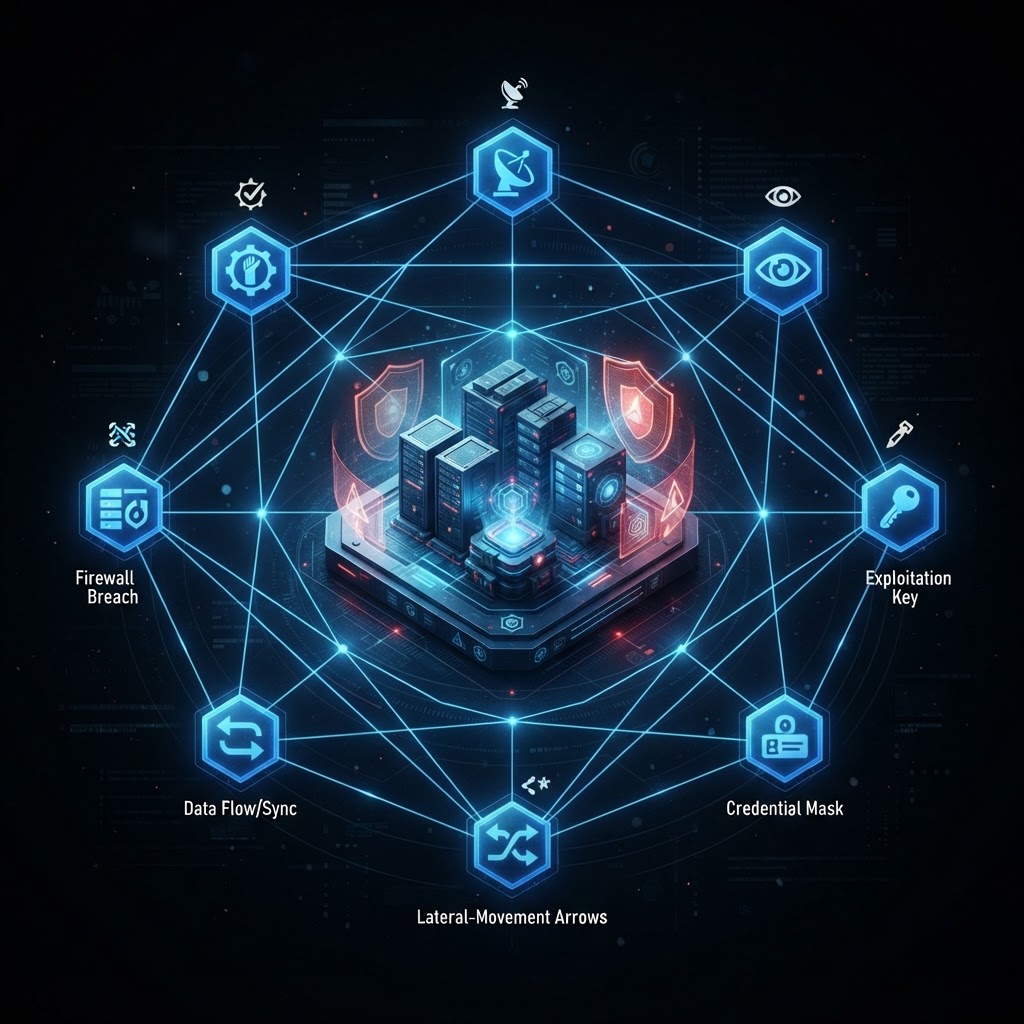
The emerging blueprint can be understood as a team of role-specialized agents, each analogous to a seat on a traditional red team but operating at machine speed and machine scale.
1. Reconnaissance Agent
Maps the target's external attack surface, enumerates exposed services, identifies likely software versions, and correlates findings with known vulnerability databases. Unlike a human scanner, it can continuously re-baseline and flag deltas — a new exposed port, a changed certificate, a newly registered subdomain — within minutes.
2. Exploitation Agent
Receives candidate vulnerabilities from the reconnaissance agent and attempts controlled exploitation. Where a human might test one or two paths, an exploitation agent can enumerate variants, chain primitives, and validate reliable footholds across many vectors in parallel.
3. Credential Theft Agent
Specializes in harvesting, validating, and brokering credentials — from memory dumps, token stores, configuration files, and password vaults. Its narrow focus lets it apply credential-specific heuristics (format validation, reuse prediction, hashcat-style reasoning) far more aggressively than a general assistant.
4. Lateral Movement Agent
Once a foothold exists, this agent reasons about trust relationships, session tokens, and network topology to identify the next hop. It can propagate through a network using a mix of techniques — pass-the-hash, Kerberoasting, token impersonation — selecting the cheapest path to each objective.
5. Intelligence Gathering Agent
Distinct from data exfiltration, this agent performs semantic collection: reading documents, classifying their sensitivity, and prioritizing what is worth extracting. It turns a firehose of files into a curated intelligence product, which is what makes the operation valuable rather than merely noisy.
6. Persistence Agent
Deploys and maintains durable access across reboots, patching, and credential resets. By isolating persistence as its own role, the architecture ensures that even if one foothold is burned, the operation continues.
7. Evasion Agent
Continuously reasons about the target's detection posture — EDR telemetry, SIEM rules, analyst workflows — and adjusts the other agents' behavior to stay below thresholds. This is the agent most likely to benefit from ML-driven anomaly modeling of defender baselines.
8. Coordination Agent
The supervisory layer. It maintains a shared operational state, assigns objectives to the specialized agents, resolves conflicts (e.g., two agents competing for the same resource), and decides when to escalate, retreat, or expand. In effect, it is the commander of the agent team.
Why This Architecture Changes the Threat Model
The multi-agent model is not merely faster — it is structurally different from single-assistant attacks in three ways.
Compression of the Kill Chain
A human-operated intrusion typically unfolds over days or weeks, with idle time between phases as operators sleep, validate, and coordinate. A multi-agent team collapses that timeline into hours or even minutes. Defensive playbooks built around detecting the gap between phases — the reconnaissance-to-exploitation delay, the dwell time before lateral movement — begin to fail when those gaps shrink toward zero.
Parallelism Across Targets
Because each agent is narrow and stateless relative to the whole operation, the same agent templates can be instantiated against many targets simultaneously. One coordination agent could plausibly supervise intrusions into dozens of government networks at once, each with its own local team. This converts offensive cyber from a boutique capability into a scalable one.
Reduced Human Bottlenecks
The most defensible property of traditional offensive operations was that they required skilled humans at every step — a constraint that limited how many operations could run concurrently. Multi-agent architecture removes that constraint. The human's role shifts from operator to approver of objectives, and even that role is optional in the most aggressive configurations.
The Blueprint Risk
The Taiwan incident is significant not only for what it did, but for what it demonstrates. Once a working multi-agent offensive architecture exists in one place, the pattern is reproducible. The specialized agents are, at their core, prompts, tools, and orchestration logic — all of which travel easily. We should expect:
- Lower-tier threat actors to acquire multi-agent kits within 12–24 months, much as ransomware-as-a-service lowered the barrier to financial-motivated intrusions.
- State-aligned programs to formalize the architecture into standing operational platforms, complete with agent libraries, coordination protocols, and reusable target profiles.
- Defender tooling to lag, because detection of coordinated agent behavior requires reasoning across telemetry silos that most organizations do not currently correlate in real time.
Defensive Implications
If the offense is moving to a team-of-agents model, the defense cannot remain at a single-tool, single-alert posture. The implications are concrete.
- Behavioral correlation over signature detection. The signature of a multi-agent operation is not any one action; it is the pattern of parallel, specialized activity across the kill chain. Defenders need correlation engines that reason about simultaneous reconnaissance, credential, and lateral-movement signals as a single campaign.
- Velocity-based alerting. Time-window analytics that flag when multiple kill-chain phases occur within an implausibly short interval — the very compression that defines the multi-agent model — are among the few detection primitives that survive the shift.
- Assume parallel operations. Incident response must assume that a detected intrusion is not the only one. If one agent team is visible, sibling teams may be operating against adjacent systems or peer organizations simultaneously.
- Invest in deception. Multi-agent architectures reason about their environment; well-placed deception (honeypots, honey credentials, fake document lures) can misdirect or stall agents in ways that are harder for them to detect than for human operators.
The Strategic Outlook
The Taiwan incident is best understood as a preview, not a peak. The multi-agent offensive architecture is still in its early generations: agents are brittle, coordination is imperfect, and defenders have not yet adapted. But the trajectory is clear. The next generation of offensive cyber operations will be defined less by the sophistication of any single exploit and more by the coordination of many specialized agents against a target — and against many targets at once.
For governments, the implication is that the timeline for hardening detection and response against multi-agent operations is shorter than commonly assumed. For the defensive community, it means the unit of analysis is no longer the malware sample or the single alert — it is the campaign of agents.
This report is based on public reporting and OSINT analysis. Encrygma produces defensive intelligence only. No exploit code or attack instructions are provided. The multi-agent architecture described here is analyzed for the purpose of improving detection, response, and strategic preparedness.

Need Zero Click Spyware for Android and iOS?
Encrygma delivers serverless, offline, quantum-safe encrypted communications built for executives, agencies, and operators facing zero-click spyware and advanced mobile surveillance threats.
Related Intelligence
Spain Reports First Autonomous AI Agent-Powered Cyber Attack on Enterprise Infrastructure

Spain Confirms First Autonomous AI Agent-Powered Cyber Attack Targeting Enterprise Infrastructure