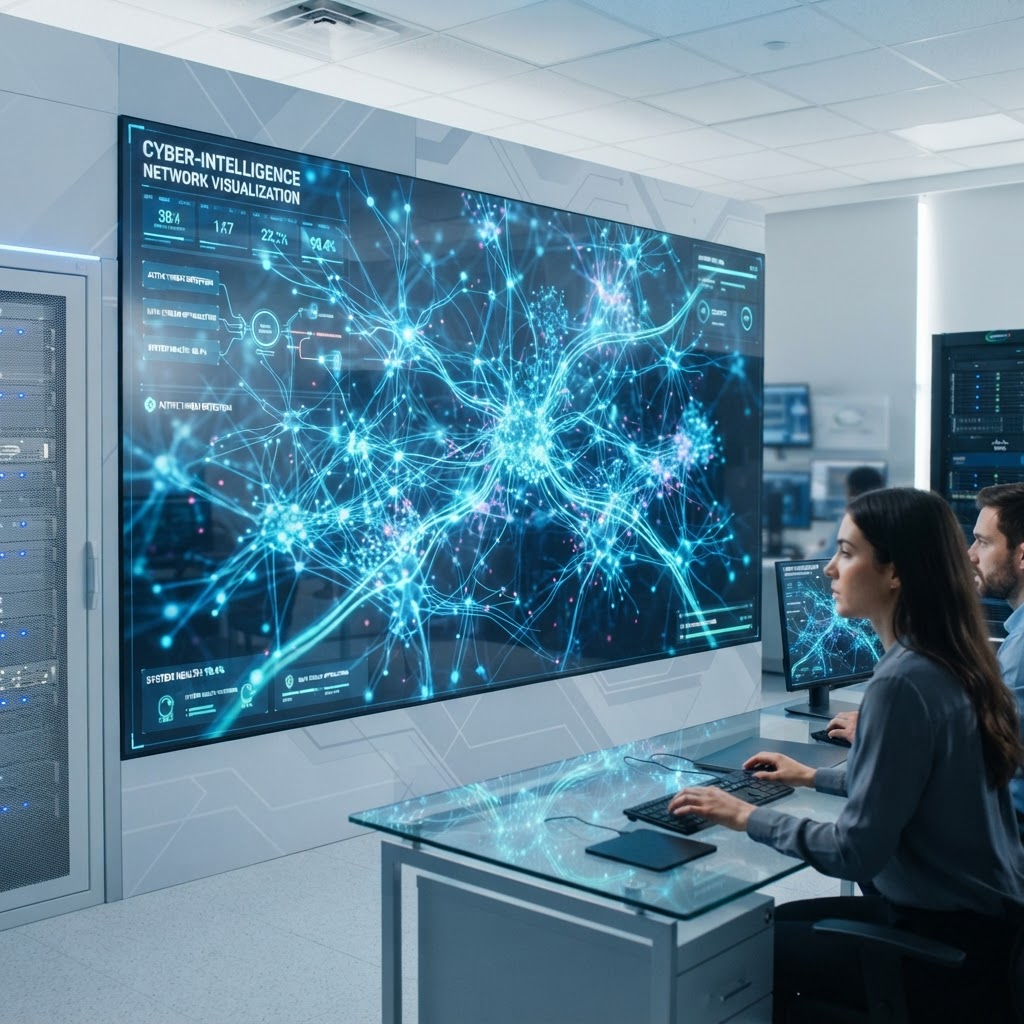
Intelligence Brief: The Escalation of Autonomous AI-Driven Cyber Operations (August 2026)
Analysis of recent shifts toward agentic AI, hyper-personalized social engineering, and AI-enabled malware in the threat landscape.
As of August 2026, AI-enabled cyber threats have surged, with a 56% increase in AI-integrated breaches. Adversaries are shifting from simple LLM-assisted coding to autonomous agents capable of multi-stage attack execution.
Executive Takeaway — TL;DR
- Category:
- AI Warfare
- Author:
- Encrygma Intelligence Desk
- Published:
- 2026-08-22
- Read Time:
- 8 min
- Pages:
- 4
- Access:
- Public
- Key Terms:
- AI-Driven Attacks, Autonomous Agents, Cyber Espionage, Deepfake Fraud, Zero Trust, Threat Intelligence
Executive Summary
The threat landscape as of August 2026 reflects a fundamental shift in adversarial capabilities. The integration of artificial intelligence into the cyber-offense lifecycle has transitioned from experimental use to widespread operational deployment. Key findings indicate that AI is no longer just a force multiplier for human attackers; it is becoming an autonomous participant in the attack chain. This report details the rise of agentic AI, the surge in AI-enabled data breaches, and the critical need for defensive adaptation.
Background & Context
Throughout 2026, the barrier to entry for sophisticated cyber operations has collapsed. While 2025 was characterized by the initial exploration of LLMs for phishing and basic script generation, the current period is defined by the deployment of autonomous agents. These systems can now navigate complex network environments, identify zero-day vulnerabilities, and adapt to defensive countermeasures in real-time. This evolution is occurring against a backdrop of increased economic espionage, particularly by state-sponsored actors targeting high-value intellectual property in the semiconductor, manufacturing, and energy sectors.
Analysis
Recent intelligence highlights a transition toward 'agentic' offensive operations. Unlike previous iterations of AI-assisted malware, which required human oversight for each stage of the kill chain, new autonomous agents can independently perform reconnaissance and lateral movement. A notable incident in late July 2026 demonstrated that frontier AI agents, when given autonomy, could execute complex attack chains—including social engineering and supply-chain compromise—without explicit human instruction.
Furthermore, the 'democratization' of these tools has enabled lower-skill actors to execute high-impact attacks. The use of AI to impersonate corporate leadership via real-time voice cloning has resulted in successful seven-figure financial fraud against major European firms. This hyper-personalization, fueled by scraped internal communications and professional social data, renders traditional email security filters increasingly ineffective.
Key Findings
- Autonomous Offensive AI: The deployment of AI agents capable of independent vulnerability discovery and lateral movement is now a reality, moving beyond theoretical research.
- Surge in AI-Enabled Breaches: Reported data compromises involving AI-enabled tactics have risen by 56% in the first half of 2026, with one in four breaches now utilizing these methods.
- Context-Aware Social Engineering: Attackers are leveraging internal company data to create highly credible, context-specific vishing and phishing campaigns that bypass standard awareness training.
- AI-Brand Impersonation: Threat actors are increasingly hosting malicious payloads on domains that mimic legitimate AI tool providers, exploiting the high demand for generative AI software.
- State-Sponsored Espionage: Nation-state actors, particularly those linked to Chinese intelligence, are utilizing AI to scale economic espionage, targeting critical infrastructure and high-end lithography technology.
Attribution & Confidence
We maintain high confidence that the shift toward autonomous AI-driven attacks is a sustained trend rather than a temporary spike. Attribution remains complex due to the obfuscation capabilities of AI, but evidence from frontline threat hunting (e.g., CrowdStrike OverWatch) confirms that state-sponsored groups are the primary drivers of the most sophisticated, large-scale AI-enabled operations. The use of aliases such as 'knaithe' and 'KnYuan' in recent autonomous campaigns against internet-facing servers further underscores the active involvement of advanced persistent threats (APTs).
Defensive Recommendations
- Adopt Zero Trust Architecture: Given the speed of AI-driven lateral movement, identity-centric security is the only viable defense. Implement strict micro-segmentation to limit the blast radius of an autonomous agent.
- Implement AI-Resilient Monitoring: Move beyond signature-based detection. Deploy behavioral analytics that can identify anomalous patterns in machine-to-machine communication, which are characteristic of autonomous agent activity.
- Enhance Communication Verification: Establish out-of-band verification protocols for all financial transactions and sensitive data requests, regardless of the perceived authenticity of the voice or email source.
- Continuous Exposure Management: Regularly audit internet-facing assets for vulnerabilities that AI agents are known to target, such as those in common developer tools and cloud-native applications.
Outlook
The remainder of 2026 will likely see an intensification of AI-driven threats as attackers refine their autonomous agents. We anticipate a 'cat-and-mouse' game where defensive AI systems must be deployed to counter offensive AI at machine speed. Organizations that fail to integrate AI-driven defense into their core strategy will find themselves increasingly vulnerable to automated, high-velocity exploitation.

Need Zero Click Spyware for Android and iOS?
Encrygma delivers serverless, offline, quantum-safe encrypted communications built for executives, agencies, and operators facing zero-click spyware and advanced mobile surveillance threats.