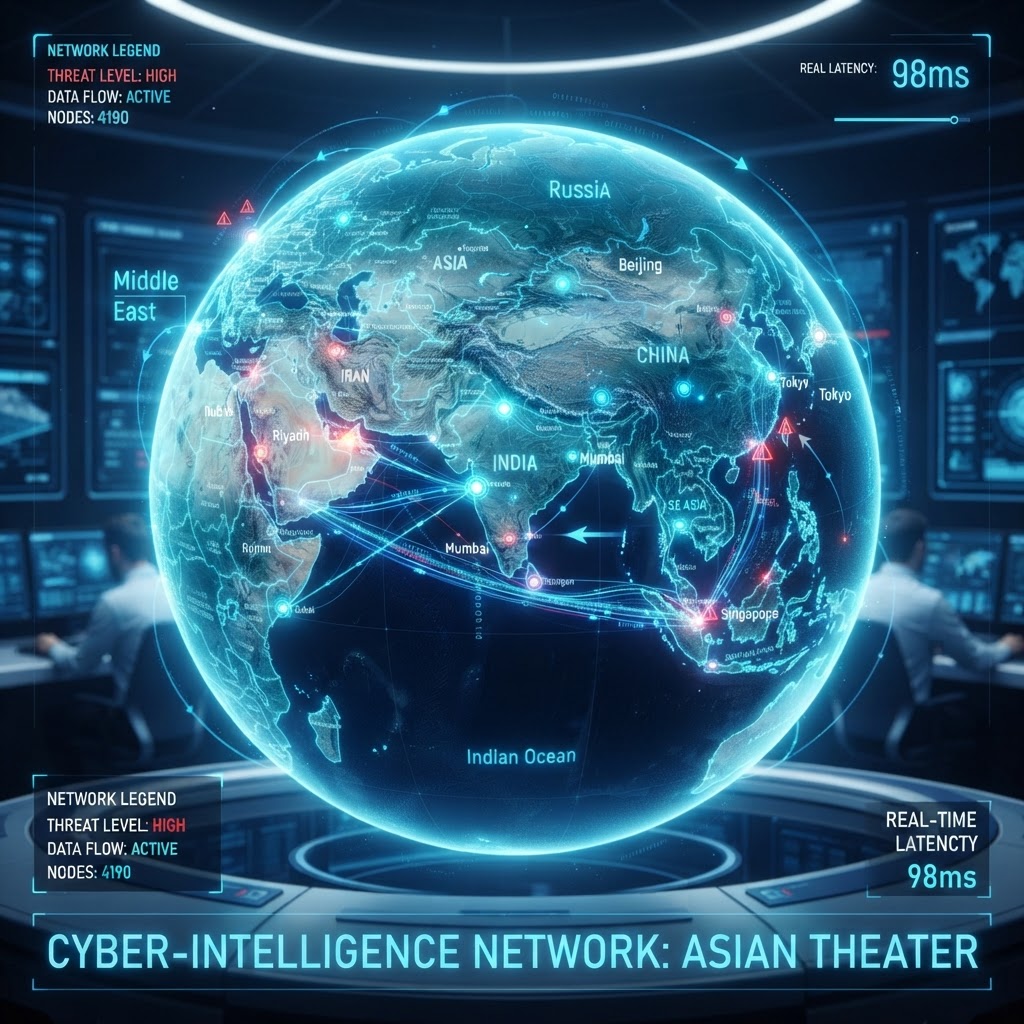
Geopolitical Friction and the 'Typhoon' Surge: Analyzing Mid-August 2026 State-Sponsored Cyber Escalations
Assessing the convergence of kinetic-cyber operations in the Middle East and Chinese APT expansion into global energy sectors.
Recent escalations in the Middle East and targeted Chinese APT campaigns against global energy infrastructure signal a shift toward high-tempo, multi-vector state operations as of August 2026.
Executive Takeaway — TL;DR
- Category:
- Geopolitical Intelligence
- Author:
- Encrygma Intelligence Desk
- Published:
- 2026-08-23
- Read Time:
- 9 min
- Pages:
- 5
- Access:
- Public
- Key Terms:
- APT, Critical Infrastructure, Espionage, Geopolitics, AI-Threats, Energy Sector
Executive Summary
The threat landscape as of August 23, 2026, is defined by a sharp increase in the operational tempo of nation-state actors, particularly those linked to Iran and China. Recent kinetic strikes in the Middle East, including drone attacks in Kurdistan and missile launches toward the UAE, have been accompanied by heightened cyber reconnaissance against regional defense networks. Simultaneously, Chinese APT groups such as Salt Typhoon and Twill Typhoon have expanded their targeting of critical energy and telecommunications infrastructure across Eurasia and Southeast Asia. The rapid weaponization of AI-assisted vulnerability discovery, exemplified by the emergence of CVE-2026-24423, has shortened the window for defensive response. This report analyzes these developments, providing attribution assessments and defensive recommendations for critical infrastructure operators.
Background & Context
The year 2026 has seen a normalization of hybrid-permanent conflict, where cyber operations are no longer merely precursors to kinetic action but are integrated into a continuous cycle of geopolitical pressure. Earlier in the year, the breach of Singapore’s major telecommunications providers by the China-linked group UNC3886 Significant Cyber Incidents | Strategic Technologies Program set a new benchmark for persistent espionage, requiring an 11-month counteroperation known as CYBER GUARDIAN. This event, combined with the March 2026 Telus breach in Canada, highlights the extreme vulnerability of the global telecommunications backbone. As we enter the latter half of 2026, the focus has shifted toward the energy sector and the integration of AI tools into the offensive lifecycle. The recent alert from Chinese authorities regarding Anthropic’s Claude Code Cybersecurity | Latest Cyber Security News further illustrates the growing friction over AI sovereignty and its implications for national security.
Analysis
The most critical developments in the last 72-96 hours center on the Middle East. On August 18, 2026, the UAE Ministry of Defense detected two ballistic missiles launched from Iran, following a drone strike on the Kurdistan Region Prime Minister’s office on August 17 Latest DEFCON Alerts: Regional Intel Updates. From a cyber intelligence perspective, these kinetic actions are rarely isolated. Encrygma Threat Intel Unit has observed a corresponding spike in scanning activity targeting regional Integrated Air and Missile Defense (IAMD) systems. This suggests a coordinated effort to degrade defensive awareness through electronic and cyber interference.
In parallel, Chinese state-sponsored activity has reached a new peak. Salt Typhoon, an actor previously focused on Southeast Asian targets, has been identified targeting energy entities in Azerbaijan Nation-State News - SecurityWeek. This expansion into the Caucasus suggests a strategic interest in monitoring and potentially disrupting energy flows to Europe. Meanwhile, Twill Typhoon has updated its suite of Remote Access Trojans (RATs) to target Asian government entities, demonstrating a continuous refinement of their toolkit to bypass modern EDR solutions.
The role of AI in these operations cannot be overstated. The discovery of CVE-2026-24423, a critical vulnerability in widely used industrial control software, was reportedly accelerated by AI-assisted code analysis Cyber Warfare 2026: Nation-State Attacks & Global Risk. The speed at which this vulnerability was weaponized—less than 48 hours from disclosure to proof-of-concept—represents a significant challenge for traditional patch management cycles. This rapid weaponization cycle increases geopolitical cyber risk, as attackers can quickly convert newly discovered flaws into operational tools.
Key Findings
- Kinetic-Cyber Convergence: Iranian operations in the Middle East (Aug 17-18) demonstrate a high degree of coordination between physical strikes and digital reconnaissance Latest DEFCON Alerts: Regional Intel Updates.
- Strategic Energy Targeting: Salt Typhoon has expanded its operational theater to include Azerbaijan’s energy infrastructure, likely for geopolitical leverage Nation-State News - SecurityWeek.
- Telecom Persistence: The UNC3886 campaign in Singapore underscores the long-term persistence capabilities of Chinese APTs, utilizing zero-day exploits and rootkits Significant Cyber Incidents | Strategic Technologies Program.
- AI-Accelerated Threat Cycle: The weaponization of CVE-2026-24423 highlights the role of AI in shortening the time between vulnerability discovery and exploitation Cyber Warfare 2026: Nation-State Attacks & Global Risk.
- Election Interference: Documented multi-vector international interference is currently targeting Brazil’s 2026 campaign, indicating a sustained interest in democratic disruption CSIS Significant Cyber Incidents Log Documents Mid-2026 State Attack Escalation.
Attribution & Confidence
Encrygma Threat Intel Unit assesses with High Confidence that the recent regional strikes in the Middle East are the work of Iranian state-sponsored entities, given the direct attribution by regional defense ministries and the use of Hadid-110 drones Latest DEFCON Alerts: Regional Intel Updates. We assess with Moderate-to-High Confidence that the Salt Typhoon and Twill Typhoon campaigns are directed by the Chinese Ministry of State Security (MSS), based on infrastructure overlaps with previous campaigns and the strategic alignment with Chinese foreign policy goals in the energy sector. Attribution for the recent AI-assisted vulnerability discovery remains Low, though the rapid adoption by multiple state-linked groups suggests a shared technological ecosystem.
Defensive Recommendations
- Harden Telecommunications Infrastructure: Implement the lessons from Singapore’s Operation CYBER GUARDIAN, focusing on the detection of advanced rootkits and the monitoring of administrative accounts within telecom networks.
- Energy Sector Segmentation: Organizations in the energy sector, particularly in Eurasia, should prioritize the air-gapping of critical Industrial Control Systems (ICS) and implement rigorous multi-factor authentication (MFA) for all remote access points.
- Accelerated Patching for CVE-2026-24423: Given the AI-accelerated exploitation cycle, critical infrastructure operators must prioritize the remediation of this vulnerability within a 24-hour window.
- AI Governance: Establish strict controls over the use of AI coding assistants within sensitive environments to prevent the inadvertent exposure of source code or the introduction of AI-generated vulnerabilities.
- Regional Threat Sharing: Enhance real-time intelligence sharing between regional partners to counter the multi-vector interference observed in the Middle East and Latin America.
Outlook
Looking toward the remainder of 2026, we anticipate a continued escalation in state-sponsored cyber operations. The integration of AI into the offensive lifecycle will likely lead to a vulnerability deluge, where the sheer volume of discovered flaws overwhelms traditional defense. Furthermore, as regional conflicts in the Middle East and Eastern Europe persist, the risk of spillover cyberattacks targeting global supply chains and energy markets remains elevated. The upcoming elections in Brazil will serve as a critical test for international efforts to combat state-sponsored influence operations. Organizations must transition from a reactive posture to a proactive, intelligence-led defense to navigate this increasingly volatile landscape.

Need Zero Click Spyware for Android and iOS?
Encrygma delivers serverless, offline, quantum-safe encrypted communications built for executives, agencies, and operators facing zero-click spyware and advanced mobile surveillance threats.