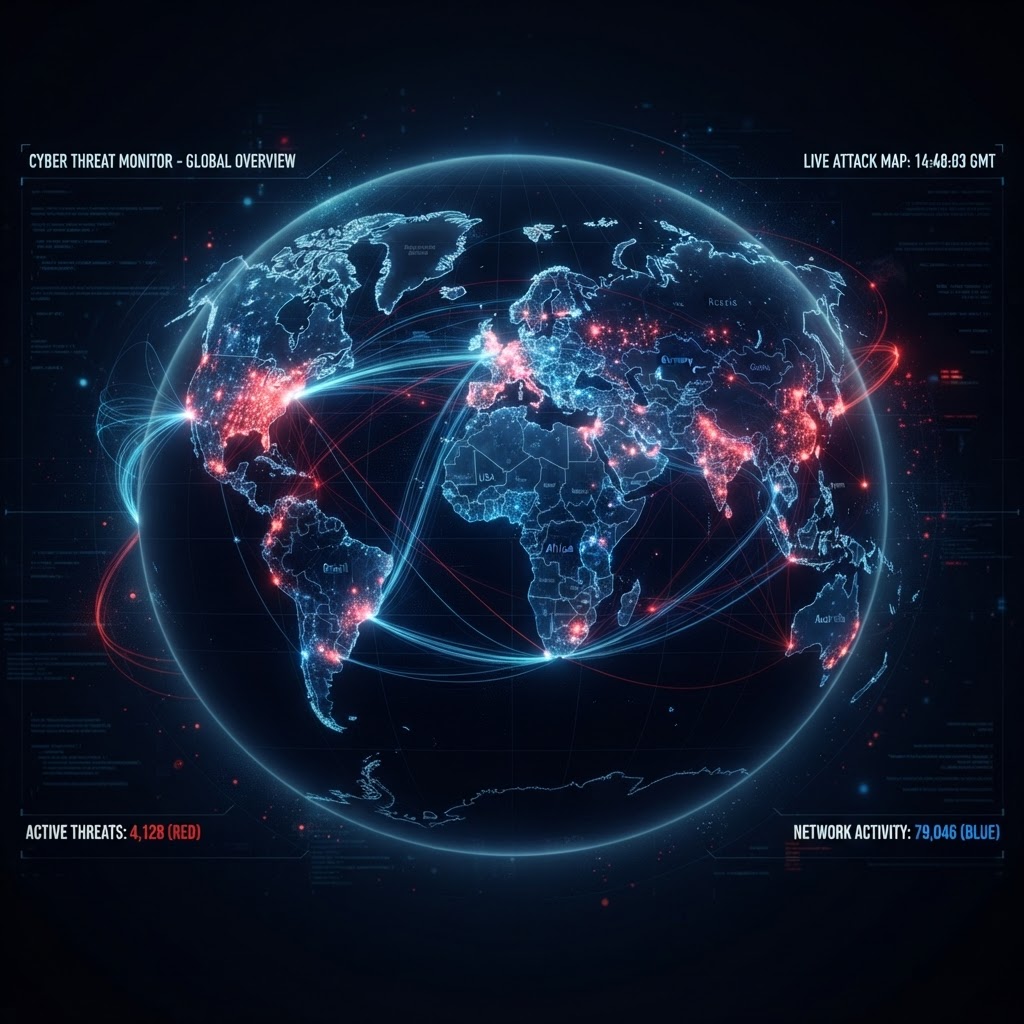
Geopolitical Convergence: Analyzing the Surge in State-Sponsored Cyber Operations and Attribution Obfuscation in Q3 2026
A comprehensive intelligence assessment of recent APT activity, AI-driven malware development, and the blurring lines between espionage and cybercrime.
Recent data indicates a 7.5% rise in state-sponsored cyberattacks during the first half of 2026, driven by North Korean AI-enhanced phishing and Russian exploitation of CVE-2026-21509.
Executive Takeaway — TL;DR
- Category:
- Geopolitical Intelligence
- Author:
- Encrygma Intelligence Desk
- Published:
- 2026-08-16
- Read Time:
- 8 min
- Pages:
- 4
- Access:
- Public
- Key Terms:
- APT, Espionage, Critical Infrastructure, AI-Driven Threats, Attribution, Geopolitics
Executive Summary
As of August 16, 2026, the Encrygma Threat Intel Unit has observed a marked intensification in nation-state cyber operations. Recent reporting indicates that state-sponsored cyberattacks from North Korea, China, and Russia rose by 7.5% in the first half of 2026 State-sponsored cyberattacks from N. Korea, China, Russia rise 7.5% in 1st half of 2026. This surge is accompanied by a sophisticated evolution in tactics, including the integration of localized Artificial Intelligence (AI) for phishing automation and the strategic use of ransomware facades to mask espionage objectives. The current environment, reflected in an elevated DEFCON 3 status for cyber monitoring, involves at least 29 active state-sponsored campaigns targeting 26 regional zones Current DEFCON Level 2026 | Today's Alert Status | Defcon Level. Organizations must pivot from viewing cyber threats as isolated criminal acts to recognizing them as components of a broader geopolitical conflict.
Background & Context
The cyber domain has officially transitioned into the "Fourth Battlefield," where digital operations execute simultaneously with kinetic military actions The Fourth Battlefield: The Growing Role of Cyber Operations in Global Conflict. Throughout 2025 and into mid-2026, regional conflicts in Eastern Europe, the Middle East, and East Asia have consistently produced parallel cyber fronts.
In East Asia, escalating state-backed campaigns are targeting telecommunications and identity systems to establish long-term surveillance layers Cyber Risk In 2026: How Geopolitics, Supply Chains and Shadow AI Will - Infosecurity Magazine. In Europe, Russian operations remain focused on critical infrastructure, particularly energy and water systems, to create operational risks for NATO-aligned nations The Escalating Cyber Risk Landscape in Regional Conflicts & Strategic Actions for 2026. Meanwhile, the Middle East has seen a shift toward direct targeting of commercial cloud infrastructure, exemplified by kinetic strikes against data centers in the UAE and Bahrain The Escalating Cyber Risk Landscape in Regional Conflicts & Strategic Actions for 2026.
Analysis
The Rise of AI-Enhanced Espionage
North Korean threat actors, specifically the Kimsuky group, have moved beyond public chatbots to build "offline AI stacks" Kimsuky Builds Offline AI Stack to Boost Phishing and Automate Malware Development. By hosting Large Language Models (LLMs) locally, these actors bypass the safety filters of commercial AI providers, allowing them to generate highly convincing phishing content and automate the development of polymorphic malware. This development significantly lowers the barrier for high-volume, high-quality social engineering campaigns.
Attribution Obfuscation via ORB Networks
Chinese-nexus actors, such as UAT-7810, are increasingly utilizing Operational Relay Box (ORB) networks to mask their origins. The "LapDogs" network, which exploits vulnerabilities in unpatched Ruckus and ASUS routers, serves as a proxy for secondary APT groups like UAT-5918 301 Moved Permanently. By routing traffic through a mesh of compromised consumer devices, these actors complicate the attribution process, making it difficult for defenders to distinguish between routine botnet traffic and targeted state espionage.
The Ransomware Facade
Iranian actors, notably MuddyWater (affiliated with the Ministry of Intelligence and Security), have refined the use of ransomware as a "false flag" When State Espionage Masquerades as Cybercrime - CISES. In early 2026, intrusions that appeared to be standard Chaos ransomware attacks were revealed to be espionage operations. The attackers deployed ransomware toolkits not for financial gain—often omitting the ransom demand entirely—but to distract incident responders while they extracted sensitive credentials and established persistent access.
Key Findings
- Increased Attack Volume: State-sponsored activity from the "Big Three" (Russia, China, North Korea) has increased by 7.5% in the first half of 2026 State-sponsored cyberattacks from N. Korea, China, Russia rise 7.5% in 1st half of 2026.
- Vulnerability Exploitation: Russian group APT28 is actively exploiting CVE-2026-21509, a Microsoft Office vulnerability, to target government and military entities Cyber Warfare 2026: Nation-State Attacks & Global Risk.
- AI Automation: North Korean actors are using localized AI to automate the creation of malware and phishing lures, increasing the scale of their operations Kimsuky Builds Offline AI Stack to Boost Phishing and Automate Malware Development.
- Strategic Pre-positioning: PRC-linked groups are maintaining persistent access within critical infrastructure, likely for activation during future geopolitical crises, such as a Taiwan contingency The Escalating Cyber Risk Landscape in Regional Conflicts & Strategic Actions for 2026.
- Internal Targeting: The Russian group Armored Likho (Eagle Werewolf) has been observed targeting private individuals and organizations within Russia, indicating a focus on internal monitoring and control News – August 2026 - Cyber Security Review.
Attribution & Confidence
Attribution confidence remains "Moderate to High" for established APT clusters like APT28 and Kimsuky due to consistent TTPs and infrastructure reuse. However, the rise of ORB networks and Ransomware-as-a-Service (RaaS) facades is intentionally designed to degrade attribution certainty. The use of "LapDogs" ORB infrastructure by Chinese actors specifically targets the ability of analysts to link attacks to specific state bureaus 301 Moved Permanently. Furthermore, the blurring of lines between state-directed activity and state-aligned hacktivism (e.g., Handala Hack) creates a layer of plausible deniability for governments The Escalating Cyber Risk Landscape in Regional Conflicts & Strategic Actions for 2026.
Defensive Recommendations
- Modernize Threat Modeling: Organizations must update risk frameworks to treat ransomware incidents as potential espionage operations. If a ransomware attack lacks a clear financial motive or targets specific sensitive data, it should be escalated to national security protocols When State Espionage Masquerades as Cybercrime - CISES.
- Prioritize Patching: Immediate remediation of CVE-2026-21509 (Microsoft Office) and CVE-2025-8088 (WinRAR) is critical to mitigating Russian-linked intrusion sets Cyber Warfare 2026: Nation-State Attacks & Global Risk.
- ORB Detection: Security teams should monitor for traffic originating from known ORB exit nodes, particularly those associated with compromised consumer-grade routers (Ruckus, ASUS) 301 Moved Permanently.
- AI-Resistant Phishing Training: As AI-generated phishing becomes indistinguishable from legitimate communication, organizations should move toward hardware-based multi-factor authentication (MFA) to mitigate credential theft.
Outlook
The remainder of 2026 is expected to see a continued convergence of cyber and kinetic warfare. As geopolitical tensions remain high, state actors will likely increase their focus on supply chain vulnerabilities and cloud service providers. The success of North Korea's AI-driven phishing and Iran's ransomware facades will likely encourage other nations to adopt similar obfuscation and automation techniques. The ability of private sector organizations to defend against these threats will increasingly depend on their integration of real-time geopolitical threat intelligence into their operational security posture Global Cybersecurity Outlook 2026.

Need Zero Click Spyware for Android and iOS?
Encrygma delivers serverless, offline, quantum-safe encrypted communications built for executives, agencies, and operators facing zero-click spyware and advanced mobile surveillance threats.