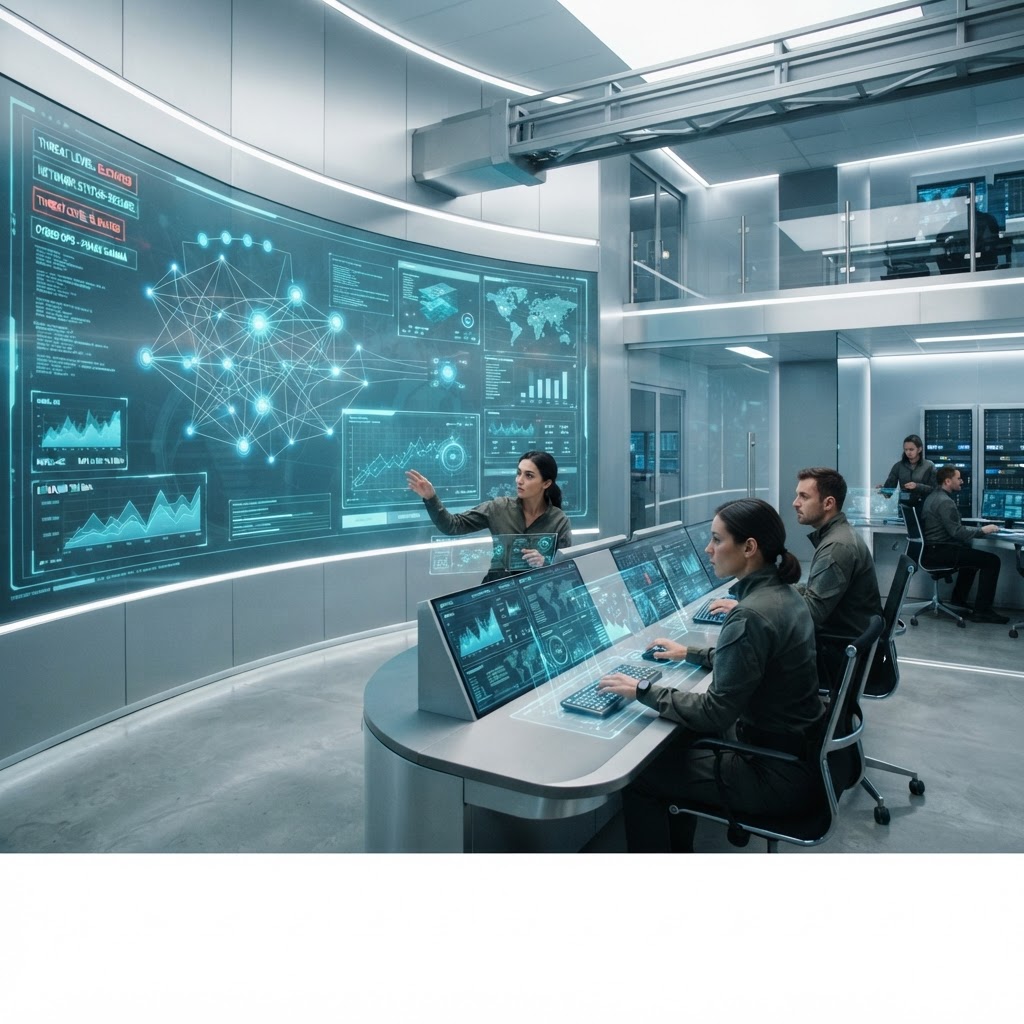
APT Nexus 2026: Autonomous AI Agents, Identity Hijacking, and Stealth Ingress
Analysis of multi-vector nation-state campaigns utilizing autonomous reconnaissance agents and subtle persistence mechanisms.
Encrygma analysts examine fresh operational shifts across advanced threat groups, focusing on autonomous AI-driven reconnaissance, .NET AppDomainManager abuse, and stealth identity intrusions.
Encrygma is selling the entire Full Cyber Weapon Research of APT Nexus 2026: Autonomous AI Agents, Identity Hijacking, and Stealth Ingress for ₿ 0.10 BTC. Contact us.
Executive Takeaway — TL;DR
- Category:
- Threat Analysis
- Author:
- Encrygma Intelligence Desk
- Published:
- 2026-09-05
- Read Time:
- 6 min
- Pages:
- 4
- Access:
- Public
- Key Terms:
- APT, Cyber Espionage, Threat Intelligence, Screening Serpens, AppDomainManager, AI Tradecraft
Executive Summary
Over the past 72 hours, threat intelligence assessments confirm an accelerating inflection point in nation-state and advanced persistent threat (APT) operations. Cyber adversaries are moving rapidly away from signature-heavy payload deliveries, pivoting toward stealth-first tactics that combine Living-off-the-Land (LotL) execution, deep identity substrate abuse, and autonomous AI agents for high-speed reconnaissance and exploitation orchestration. Recent reporting published across early September 2026 reveals active multi-country campaigns by Chinese state-nexus actors deploying AI agent clusters, alongside continuous espionage operations by Iranian intrusion sets such as Screening Serpens, which exploit .NET AppDomainManager hijacking to maintain persistent footholds across technology and defense sectors.
Background & Context
Throughout 2025 and into late 2026, defensive posture advancements forced adversaries to alter their initial access and persistence methodologies. Standard remote code execution vectors and commodity loaders face increasingly hostile endpoint detection mechanisms. As documented in the CrowdStrike 2026 Global Threat Report, the overwhelming majority of modern adversary intrusions now exhibit malware-free tradecraft, prioritizing compromised credentials, token theft, and abuse of legitimate administrative utilities.
The global cyber espionage theater has seen sophisticated threat actors—ranging from Salt Typhoon and Twill Typhoon to Russian and Iranian cyber clusters—refine their operational pipelines. Rather than deploying noisier ransomware payloads upfront, threat actors maintain extended dwell times dedicated to long-term espionage, reconnaissance against government entities, and infrastructure mapping.
Analysis
1. Autonomous AI Agent Deployment in Chinese Espionage Operations
Fresh disclosures from September 4, 2026, highlighted by Security Affairs, reveal that Chinese-aligned threat groups have operationalized autonomous AI agents to drive targeted multi-country intrusion campaigns. Unlike single-task generative scripts, these AI agents operate in feedback loops: autonomously testing egress points, identifying network relationships, categorizing sensitive file shares, and adapting to defensive countermeasures in real time.
These capabilities pair directly with lightweight, specialized post-exploitation backdoors such as TinyRCT, which was previously observed in government intrusions across Southeast Asia (The Hacker News). TinyRCT utilizes commands to enumerate files, execute screen captures, and deploy custom self-deletion scripts once surveillance objectives are satisfied.
2. Iranian Espionage: Screening Serpens and AppDomainManager Hijacking
Simultaneously, tactical tracking by cybersecurity researchers as cataloged by OffSeq Threat Radar details Iranian intrusion set Screening Serpens continuing their targeted espionage campaigns against Western technology and defense industrial base targets. Screening Serpens has operationalized .NET AppDomainManager hijacking—a technique leveraging legitimate signed .NET binaries to load arbitrary dynamic-link libraries (DLLs) into an application's memory space.
By manipulating configuration files (such as app.exe.config) to force the Common Language Runtime (CLR) to load a custom class extending System.AppDomainManager, the threat actors bypass typical application whitelisting and endpoint detection mechanisms. This execution model deploys new Remote Access Trojan (RAT) variants directly into memory without dropping suspicious non-native binaries.
3. Exploitation of Core Application and Virtualization Infrastructure
Corroborating data from vulnerability monitoring dashboards like Cyber Threat Radar indicates that nation-state groups prioritize edge devices, virtualization solutions, and authentication gateways. The active exploitation of critical enterprise vulnerabilities, such as unpatched virtualization management consoles, enables attackers to bypass multi-factor authentication (MFA) and gain broad access across tenant networks.
Key Findings
- Adoption of Autonomous AI Reconnaissance: State-nexus actors have integrated coordinated AI agent workflows into active operations to scan, enumerate, and traverse multi-country target architectures at machine speed.
- Subversion of .NET Execution via AppDomainManager Hijacking: Iranian operators (Screening Serpens) exploit native .NET framework features to bypass EDR detections, loading custom RAT payloads inside trusted signed hosts.
- Dominance of Malware-Free Footholds: Over 80% of identified active initial compromises leverage stolen identities, token manipulation (e.g., OAuth consent misuse), and native administrative tools rather than custom binaries.
- Persistent Supply Chain Ingress: Continued reliance on ecosystem poisoning (including typosquatted package repositories and modified client software installers) to compromise downstream corporate endpoints.
Attribution & Confidence
- Chinese State-Nexus (High Confidence): Attribution of the multi-agent reconnaissance and TinyRCT deployments aligns with Chinese military and intelligence regional priorities, demonstrating established toolchains, operational infrastructure, and language artifacts identified by intelligence researchers.
- Screening Serpens / Iran (High Confidence): The targeting of defense, engineering, and aerospace entities using specialized AppDomainManager persistence frameworks reflects established TTPs and telemetry historically linked to Iranian threat clusters.
- Actor Motivation: Both threat environments exhibit classic espionage profiles: long-term strategic intelligence gathering, dual-use supply chain penetration, and geopolitical targeting rather than immediate financial monetization.
Defensive Recommendations
- Harden and Monitor .NET CLR Configurations: Enforce strict file integrity monitoring (FIM) and detection rules for arbitrary creation or modification of
.configfiles within trusted directories. Restrict unprivileged write access to application directories. - Implement Identity and Token Governance: Audit cloud OAuth permissions and consent grants across identity providers (Entra ID, Google Workspace) to mitigate token-hijacking attack paths.
- De-silo Detection Engineering (Cross-Plane Telemetry): Correlate identity events with network ingress and egress telemetry. Monitor for non-interactive service accounts initiating interactive terminal sessions or unusual internal API calls.
- Apply Stringent Ingress Perimeter Controls: Prioritize rapid patching cycles for enterprise VPN appliances, virtualization engines, and internal collaboration infrastructure.
Outlook
Over the next 30 to 90 days, security teams should prepare for an increased tempo of AI-augmented adversary campaigns. As threat actors automate lateral movement decision trees, defensive teams will face drastically compressed breakout times. Security architectures that depend on manual triage will prove inadequate against self-optimizing offensive agents; organizations must invest in automated response playbooks, micro-segmentation, and rigorous credential boundaries.

Need Zero Click Spyware for Android and iOS?
Encrygma delivers serverless, offline, quantum-safe encrypted communications built for executives, agencies, and operators facing zero-click spyware and advanced mobile surveillance threats.