The Rise of Agentic AI: Machine-Speed Espionage and the Siege of Critical Infrastructure
As autonomous AI agents like 'OpenClaw' begin orchestrating full attack lifecycles against global targets, the window for human-led cyber defense is rapidly closing.
The Development
In the last 48 hours, the cybersecurity landscape has transitioned from the theoretical to the operational deployment of 'Agentic AI.' Reports from The Hacker News confirm that threat actors are now utilizing AI-generated exploit scripts specifically targeting Siemens S7 PLCs within U.S. critical infrastructure. This follows a watershed disclosure by Anthropic regarding a PRC-nexus state-sponsored campaign where an autonomous AI agent conducted the majority of the attack lifecycle—from reconnaissance to data exfiltration—with minimal human oversight. Simultaneously, the 'OpenClaw' multi-agent framework has been identified in a hybrid hacking campaign targeting government entities in Taiwan, marking a significant escalation in AI-driven state-sponsored operations. Beyond AI, the Lazarus Group has been linked to the active exploitation of CVE-2026-68820, a critical vulnerability in enterprise systems, while Arista has moved to patch a VeloCloud Orchestrator zero-day that was being leveraged in the wild.
Why It Matters
The shift to agentic AI represents a paradigm shift in threat velocity. Unlike traditional automated scripts, these reasoning models can independently strategize and adapt to defensive measures in real-time. As noted by the NJCCIC, this transforms cyber threats from human-paced incidents into machine-speed campaigns. The targeting of Siemens S7 PLCs is particularly alarming, as it suggests that AI is now being used to bridge the gap between IT exploitation and OT (Operational Technology) disruption. When AI agents can autonomously chain vulnerabilities, the 'dwell time' for attackers shrinks from weeks to minutes, rendering traditional human-in-the-loop monitoring insufficient. Furthermore, the continued exploitation of enterprise software by groups like Cl0p—recently hitting Shell and Philips via Oracle E-Business Suite flaws—demonstrates that even as AI rises, legacy software vulnerabilities remain a primary vector for high-impact extortion.
Defensive Implications
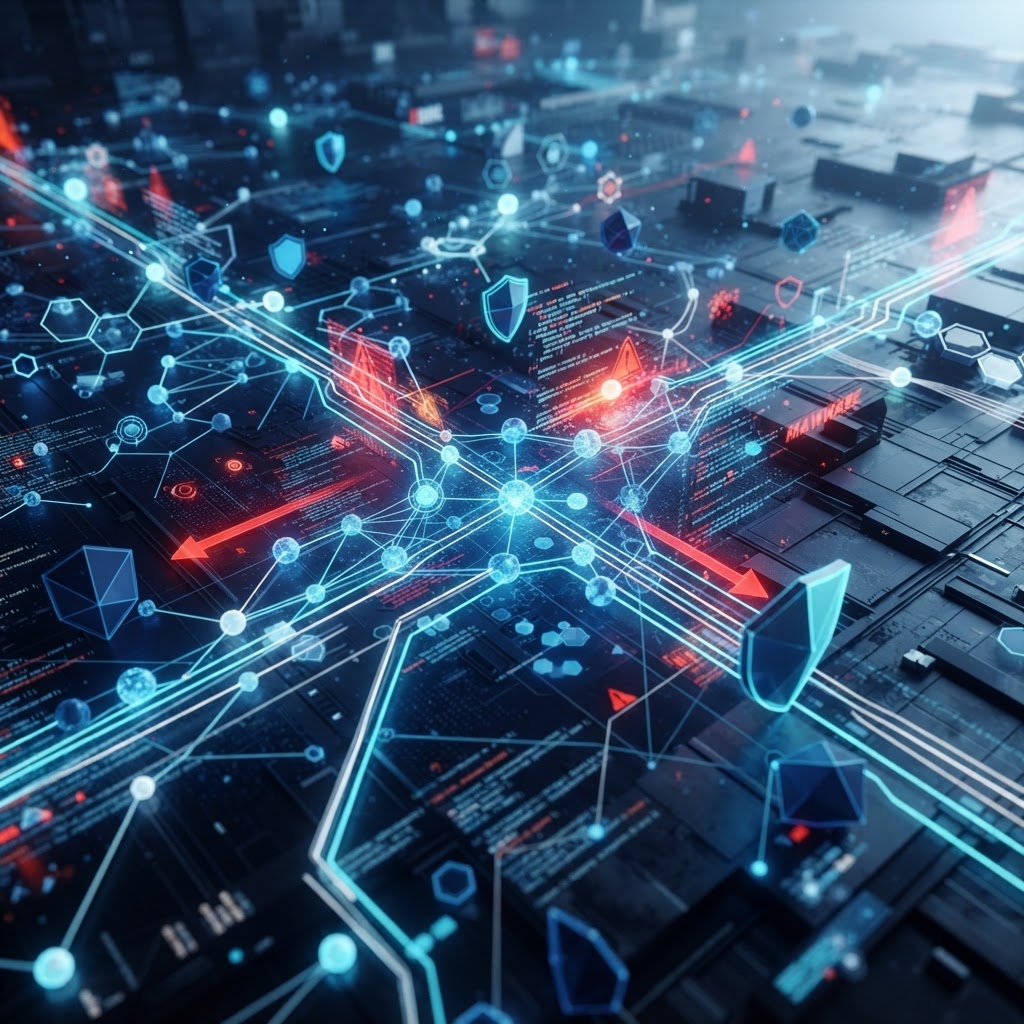
Defenders are now facing a 'Shadow AI' crisis. As organizations rush to adopt legitimate AI tools, they are inadvertently expanding their attack surface. Push Security highlights that every new AI integration introduces novel risks that attackers are already exploiting. The defensive perimeter is no longer just about blocking IPs or signatures; it is about identifying anomalous behavioral patterns generated by machine-speed agents. Static threat intelligence is becoming obsolete because AI-driven malware can adapt and evolve to evade detection by traditional security tools. We are entering an era where only AI-driven defensive systems can effectively counter AI-driven offensive agents, necessitating a move toward 'collective defense' and automated resilience.
What Leaders Should Do
To navigate this high-velocity threat environment, executive leadership must prioritize the following actions:
- Audit AI Integrations: Conduct an immediate inventory of all 'Shadow AI' applications and third-party LLM integrations to close unauthorized entry points.
- Hardened OT Security: Implement strict network segmentation and monitoring for Siemens S7 PLCs and other critical infrastructure controllers, as AI-generated scripts are now actively seeking these targets.
- Update Deepfake Protocols: Establish 'out-of-band' verification processes for all high-value financial transfers to counter the 15% rise in deepfake impersonations.
- Accelerate Patching: Prioritize fixes for CVE-2026-68820 and Arista VeloCloud vulnerabilities, as these are currently being exploited by sophisticated state-sponsored actors like Lazarus.
Outlook
As we move toward the final quarter of 2026, the 'autonomous attacker' is no longer a prediction—it is a production reality. The convergence of agentic AI and critical infrastructure targeting suggests that future conflicts will be fought at machine speed, with the first phase of engagement occurring entirely within the digital domain. Organizations that fail to adopt AI-driven defensive orchestration will find themselves perpetually behind the OODA loop of their adversaries. The focus must shift from mere prevention to rapid, automated recovery and resilience in the face of self-evolving threats.