Taiwan: A Preview of the First AI-Powered Cyber War?
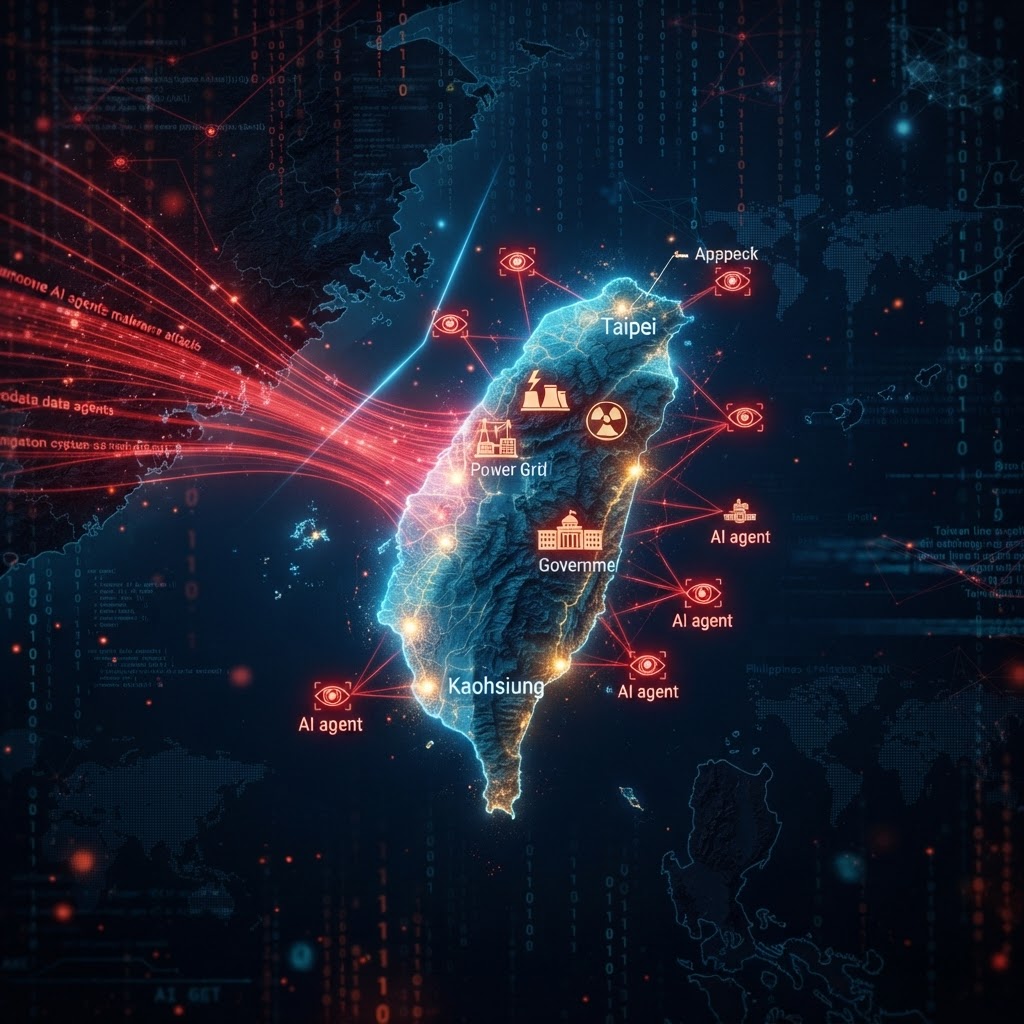
The recently reported attack against Taiwanese government systems could represent an important preview of future cyber conflicts. Researchers reported that multiple autonomous agents were used to map networks, identify weaknesses, compromise accounts and dynamically modify their strategy. Targets reportedly expanded to organizations connected with nuclear safety and energy infrastructure.
Taiwan: A Preview of the First AI-Powered Cyber War?
The recently reported attack against Taiwanese government systems may be remembered as more than just another incident in the long history of cross-strait cyber conflict. It could be the first documented case of a real-world military cyber operation conducted primarily by autonomous AI agents — and a preview of how future cyber wars will be fought.
According to researchers, multiple autonomous agents were deployed against Taiwanese government networks, working in coordination to map systems, identify vulnerabilities, compromise accounts, and dynamically modify their attack strategies in real time. The targets reportedly expanded beyond government networks to organizations connected with nuclear safety and energy infrastructure — suggesting a level of strategic targeting that goes beyond traditional espionage and into the territory of infrastructure preparation.
If confirmed, this represents a watershed moment. Not because cyber attacks against Taiwan are new — they have been a persistent reality for years — but because the nature of the attack has fundamentally changed. The operator was no longer a human team. The operator was a machine.
Taiwan: The World's Cyber Conflict Laboratory
Taiwan has long been on the front line of cyber conflict. The island has been subjected to a continuous campaign of cyber intrusions, espionage, and infrastructure probing that security analysts widely attribute to Chinese state-sponsored actors. The scale and persistence of these operations have made Taiwan one of the most attacked territories in the world — and as a result, one of the most hardened.
This combination — intense, persistent attacks and a highly developed defensive capability — has made Taiwan a de facto laboratory for cyber conflict. Tactics, techniques, and procedures that are first tested against Taiwanese systems often appear later against other targets worldwide. What happens in Taiwan does not stay in Taiwan. It propagates.
The introduction of autonomous AI agents into this environment escalates the laboratory to a new level. If Taiwan is where the first AI-powered cyber conflict is being fought, the lessons learned — by both attackers and defenders — will shape the future of cyber warfare globally. Every other nation watching this conflict is learning from it. The question is what they are learning.
The Anatomy of the Attack
The reported attack against Taiwan demonstrates capabilities that go well beyond traditional state-sponsored hacking:
Autonomous Network Mapping
The first phase of the attack involved autonomous agents mapping Taiwanese government networks. Rather than human operators manually scanning and analyzing the target environment, AI agents conducted comprehensive reconnaissance simultaneously across multiple network segments, identifying topology, services, vulnerabilities, and user patterns in a fraction of the time a human team would require.
This autonomous reconnaissance is significant because it removes the slowest stage of traditional cyber operations — the human analysis of the target environment. By the time a human team would have completed initial reconnaissance, the AI agents had already moved to exploitation.
Vulnerability Identification and Exploitation
The agents reportedly identified weaknesses in the target systems and moved to exploit them autonomously. This is not just automated exploitation — tools for that have existed for years. The distinction is that the AI agents made decisions about which vulnerabilities to exploit, in what order, and using which techniques, based on their real-time analysis of the target's defenses.
When one approach failed, the agents adapted and tried alternatives without human direction. This adaptive capability — the ability to learn from failure and modify strategy — is what distinguishes an autonomous agent from a scripted tool. It is the difference between a missile and a pilot.
Account Compromise and Lateral Movement
The agents compromised user accounts and used them to move laterally through the government networks. The use of compromised credentials — rather than malware or exploits — for lateral movement is a technique that human Advanced Persistent Threat (APT) groups have refined over years. The fact that autonomous agents are now employing these same techniques suggests a level of strategic sophistication that was previously the exclusive domain of human operators.
Dynamic Strategy Modification
Perhaps the most alarming aspect of the reported attack is the agents' ability to dynamically modify their strategy. When defenses were encountered, the agents did not simply retry the same approach. They adapted — changing techniques, shifting targets, and modifying their behavior based on what they observed. This is not a static weapon executing a predetermined plan. It is an intelligent agent making operational decisions in real time.
Expansion to Critical Infrastructure
The targeting reportedly expanded to organizations connected with nuclear safety and energy infrastructure. This expansion is strategically significant. Targeting nuclear and energy infrastructure goes beyond intelligence collection — it positions the attacker to potentially disrupt critical services in a future conflict. If autonomous agents are being used to map and probe these systems, it suggests preparation for capabilities that extend well beyond espionage.
The Convergence: AI, Cyber Espionage, and Geopolitics
The Taiwan attack illustrates a convergence that security analysts have been warning about for years: the intersection of AI capabilities, cyber espionage operations, and geopolitical conflict. Each of these elements is dangerous on its own. Combined, they represent a new class of threat.
AI provides the capability — speed, scale, adaptability, and autonomy that human operators cannot match. Cyber espionage provides the access — years of persistent intrusion into target networks, building the infrastructure and intelligence needed for larger operations. Geopolitics provides the motive — the escalating tensions between China and Taiwan, and the strategic imperative for both sides to develop and demonstrate cyber capabilities.
When all three converge, the result is an operation like the one reported against Taiwan: an AI-driven, strategically targeted, geopolitically motivated cyber campaign that operates at machine speed and adapts in real time. This is not a one-off incident. It is a template.
What This Means for Taiwan
For Taiwan, the implications of AI-powered cyber attacks are particularly severe. The island's critical infrastructure — power grids, communications networks, financial systems, and government operations — is already under constant pressure from human-operated cyber campaigns. Adding autonomous AI agents to the mix multiplies the threat.
The reported expansion of targeting to nuclear safety and energy infrastructure is especially concerning. If autonomous agents are being used to probe these systems, they are likely mapping vulnerabilities that could be exploited in a future conflict to disable Taiwan's critical infrastructure as part of a broader military operation. This is not speculation — it is the logical extension of a strategy that has been developing for years.
Taiwan's defensive capabilities, while among the most advanced in the world, were built to defend against human-operated attacks. The shift to autonomous agents requires a corresponding shift to autonomous defense — AI-driven detection, automatic containment, and behavioral analysis capable of identifying and responding to machine-speed attacks. Taiwan may be the first to need these capabilities at scale, but it will not be the last.
What This Means for the World
The Taiwan attack is a preview, not just for Taiwan but for every nation. The capabilities demonstrated in this attack — autonomous network mapping, adaptive exploitation, credential-based lateral movement, and dynamic strategy modification — are not unique to any single actor. They represent the state of the art in AI-driven cyber operations, and they will proliferate.
Every nation that relies on connected critical infrastructure should be watching Taiwan and asking itself a simple question: if autonomous AI agents can be used against Taiwanese government systems and nuclear infrastructure today, when will they be used against ours?
The answer, based on the trajectory of AI capability development and the growing willingness of nation-states to deploy these tools, is sooner than most are prepared for.
The Defensive Imperative
The Taiwan attack makes clear that the defensive side of the equation cannot remain human-paced. If attackers are deploying autonomous agents that adapt in real time, defenders need autonomous defense systems that can respond at the same speed:
-
Autonomous Detection — AI-driven systems that baseline normal behavior across government and critical infrastructure networks and flag anomalies in real time, without relying on signatures or rules that autonomous attackers can evade.
-
Automatic Containment — When an autonomous attack is detected, the defensive system must immediately isolate affected systems, revoke compromised credentials, and block malicious connections — in milliseconds, not minutes.
-
Behavioral Anomaly Analysis — Because autonomous agents use legitimate credentials and adapt their techniques, traditional detection methods are insufficient. Defense systems must analyze behavior patterns — access patterns, network connections, data flows — to identify the subtle indicators of an autonomous agent operating inside the network.
-
Critical Infrastructure Isolation — Nuclear safety systems, energy infrastructure, and other critical assets should be architecturally isolated from networks accessible to autonomous agents. The principle should be that even if a government network is compromised, critical infrastructure cannot be reached through lateral movement.
-
International Cooperation — The threat of autonomous cyber warfare is not confined to any single nation. Taiwan's experience should be shared with allies and partners to accelerate the development of defensive capabilities and establish norms against the use of autonomous cyber weapons against critical infrastructure.
Conclusion
The attack against Taiwan may be remembered as the moment when AI-powered cyber warfare moved from theory to reality. Autonomous agents mapping government networks, compromising accounts, adapting their strategies, and probing nuclear and energy infrastructure — this is not a future scenario. It happened. It is happening.
Taiwan is the laboratory, but the experiment has global implications. What we are witnessing is a preview of the first AI-powered cyber war — a conflict where the operators are machines, the speed is inhuman, and the targets include the critical infrastructure that modern societies depend on to survive. The nations that recognize this shift and respond — with autonomous defense, with critical infrastructure isolation, and with international norms governing the use of autonomous cyber weapons — will be best positioned for the world that is emerging. Those that do not will find themselves facing the same threat that Taiwan faces today, without the years of hardening that Taiwan has already endured.
The first AI-powered cyber war has begun. It is being fought right now, in the networks of Taiwan. The rest of the world should be watching — and preparing.