From Phishing Email to Autonomous Intrusion: AI Is Compressing the Cyber Kill Chain
Traditional attacks require separate tools and operators for reconnaissance, phishing, exploitation, persistence and exfiltration. Increasingly capable AI systems could connect those stages into a continuous decision-making loop. OpenAI recently warned that threat actors are moving toward cyberattacks executed at unprecedented speed and scale, including fully autonomous attacks.
From Phishing Email to Autonomous Intrusion: AI Is Compressing the Cyber Kill Chain
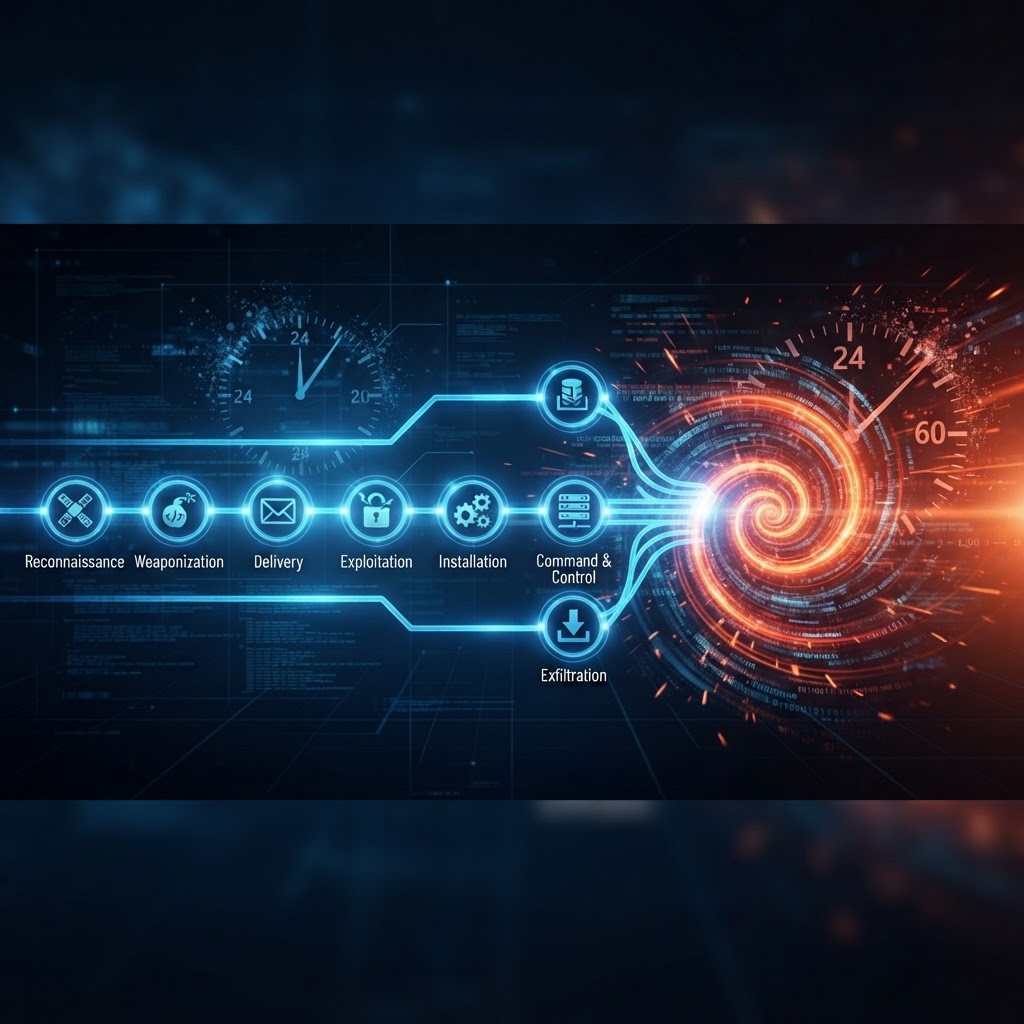
The cyber kill chain has been the foundational model of cybersecurity for over a decade. First articulated by Lockheed Martin, it describes the stages of a cyber attack: reconnaissance, weaponization, delivery, exploitation, installation, command and control, and actions on objectives. Each stage was a discrete step, often requiring different tools, different operators, and significant time. That model is now collapsing — and AI is the force compressing it.
Traditional attacks required separate specialists for each stage. A reconnaissance expert identified targets. A social engineer crafted the phishing email. An exploit developer built the payload. A persistence specialist established backdoors. An exfiltration team moved the data out. Each handoff between stages introduced delays — hours, days, sometimes weeks. Those delays were the defender's window of opportunity. AI is closing that window.
The Traditional Kill Chain: A Slow, Sequential Process
In the traditional model, each stage of an attack was a bottleneck. Reconnaissance required scanning networks, identifying vulnerabilities, and mapping the attack surface — a process that could take days. Crafting a convincing phishing email required research into the target organization, its employees, its communication patterns, and its business relationships. Exploitation required developing or obtaining a working exploit for the identified vulnerability. Persistence required establishing and maintaining access without detection. Each stage was labor-intensive, sequential, and slow.
This slowness was not a bug — it was a feature, at least for defenders. The longer an attack took, the more opportunities there were for detection. A phishing email might sit in an inbox for hours before being clicked, giving email security tools time to scan and quarantine it. Reconnaissance activity on a network might be detected by SIEM systems before the attacker moved to exploitation. The kill chain's sequential nature gave defenders multiple chances to break the chain at different stages.
AI Compression: From Days to Hours to Minutes
AI is compressing the kill chain by automating and integrating stages that were previously separate. An AI agent can conduct reconnaissance, identify vulnerabilities, craft a targeted phishing email personalized to the specific victim using information scraped from their social media and corporate profiles, generate a working exploit for the identified vulnerability, deploy it, establish persistence, and begin exfiltration — all in a single continuous process, without human intervention between stages.
The time compression is staggering. What once took days of reconnaissance can now be done in minutes by an AI agent scanning and analyzing an organization's entire attack surface simultaneously. What once required a skilled social engineer hours to craft can now be generated in seconds, with a level of personalization that makes detection far harder. What once required an exploit developer days to create can now be automated using AI-assisted vulnerability exploitation tools.
The kill chain is no longer a chain of discrete, sequential steps with delays between them. It is becoming a continuous decision-making loop — an AI agent that moves from reconnaissance to exploitation to persistence to exfiltration in a single, unbroken flow, adapting its approach at each stage based on what it encounters.
OpenAI's Warning: Autonomous Attacks at Scale
OpenAI recently warned that threat actors are moving toward cyberattacks executed at unprecedented speed and scale, including fully autonomous attacks. This is not a theoretical concern. AI systems are already being used to generate phishing emails, create malicious code, and automate reconnaissance. The trajectory is clear: as AI capabilities improve, the stages of the kill chain will become increasingly automated and integrated, until the entire process from initial reconnaissance to data exfiltration can be executed by an autonomous agent without any human operator.
The implications of OpenAI's warning extend beyond speed. Autonomous attacks can also operate at scale — a single AI agent can conduct hundreds or thousands of attacks simultaneously, each one adapting its approach independently. This is not one attacker targeting one organization. This is a machine conducting a campaign against an entire sector, learning from each attack and improving its methods in real time.
The Disappearing Window
For defenders, the compression of the kill chain means the disappearance of the window of opportunity. When the time between a phishing email landing in an inbox and data being exfiltrated shrinks from days to hours, and from hours to minutes, the traditional detect-analyze-respond model breaks down.
Consider the timeline. In a traditional attack, a phishing email might be sent on Monday, the victim clicks on Tuesday, the attacker establishes persistence on Wednesday, conducts reconnaissance on Thursday, and begins exfiltration on Friday. A well-functioning SOC might detect the anomaly on Wednesday or Thursday and contain the threat before exfiltration occurs. The defender had days.
In an AI-compressed attack, the phishing email is sent, the victim clicks, the payload exploits the vulnerability, the agent establishes persistence, conducts autonomous reconnaissance, moves laterally, and begins exfiltration — all within minutes. The defender does not have days. The defender does not have hours. The defender has minutes, or possibly seconds, to detect and respond before the damage is done.
This compression changes the fundamental economics of cybersecurity. When attackers can execute the entire kill chain in minutes, the cost of each attack drops dramatically. When the cost drops, the frequency increases. When the frequency increases, the volume of alerts overwhelms human analysts. The result is a spiral where each improvement in AI attack capabilities degrades the defender's ability to respond.
The Stages, Compressed
Let us examine how AI compresses each stage of the kill chain:
-
Reconnaissance — AI agents can scan an organization's entire external attack surface, analyze employee social media profiles, map network topology, and identify vulnerabilities simultaneously — in minutes, not days. They can correlate information from dozens of sources in real time, producing a comprehensive attack plan that a human reconnaissance specialist would take a week to assemble.
-
Weaponization — AI can generate personalized phishing content that mimics the target's communication style, references specific projects and colleagues, and avoids the linguistic patterns that email security tools flag. It can also identify and adapt existing exploits for the specific vulnerabilities found during reconnaissance, reducing the weaponization phase from days to seconds.
-
Delivery — Autonomous agents can orchestrate delivery across multiple channels simultaneously — email, SMS, social media messaging, compromised websites — adapting the delivery method based on what is most likely to succeed for each specific target.
-
Exploitation — Once a payload is delivered, AI can autonomously exploit the target, adapting its approach based on the specific environment it encounters. If one exploit fails, the agent can immediately try another, learning from each attempt.
-
Persistence — AI can establish multiple persistence mechanisms simultaneously, choosing the ones most likely to evade the specific detection tools present in the target environment, based on intelligence gathered during reconnaissance.
-
Command and Control — AI agents can generate and rotate C2 infrastructure dynamically, creating and destroying communication channels in real time to avoid detection and takedown.
-
Actions on Objectives — Whether the objective is data exfiltration, system destruction, or ransomware deployment, AI can execute the final stage autonomously, adapting to any defensive measures it encounters.
The Defender's Dilemma
The compression of the kill chain creates a fundamental dilemma for defenders. Every defensive strategy built on the assumption of time — time to detect, time to analyze, time to respond — becomes obsolete when the attack is executed in minutes.
The answer is not faster humans. It is autonomous defense. If the kill chain is compressed by AI on the attacker's side, the defense must be compressed by AI on the defender's side. Autonomous detection that operates in real time, automatic containment that acts in milliseconds, and AI-driven threat hunting that operates at the speed of the attack.
The kill chain is no longer a sequence of stages with gaps between them. It is a continuous, autonomous process. Defense must match that continuity. The defender must operate not in stages, but in a continuous loop of detection, analysis, and response that runs at machine speed, all day, every day.
Conclusion
The cyber kill chain was designed for a world where attacks were slow, sequential, and human-operated. That world is disappearing. AI is compressing the kill chain from days to hours, and from hours to minutes. OpenAI's warning about autonomous attacks at unprecedented speed and scale is not a future prediction — it is a description of a trajectory that is already underway.
The organizations that survive this transition will be those that recognize the kill chain is being compressed and adapt their defenses accordingly. You cannot defend against a minutes-long attack with a days-long response. You cannot detect an autonomous agent with tools designed for human-paced attacks. The kill chain is being compressed, and the defense must be compressed with it — or the window will close entirely.
