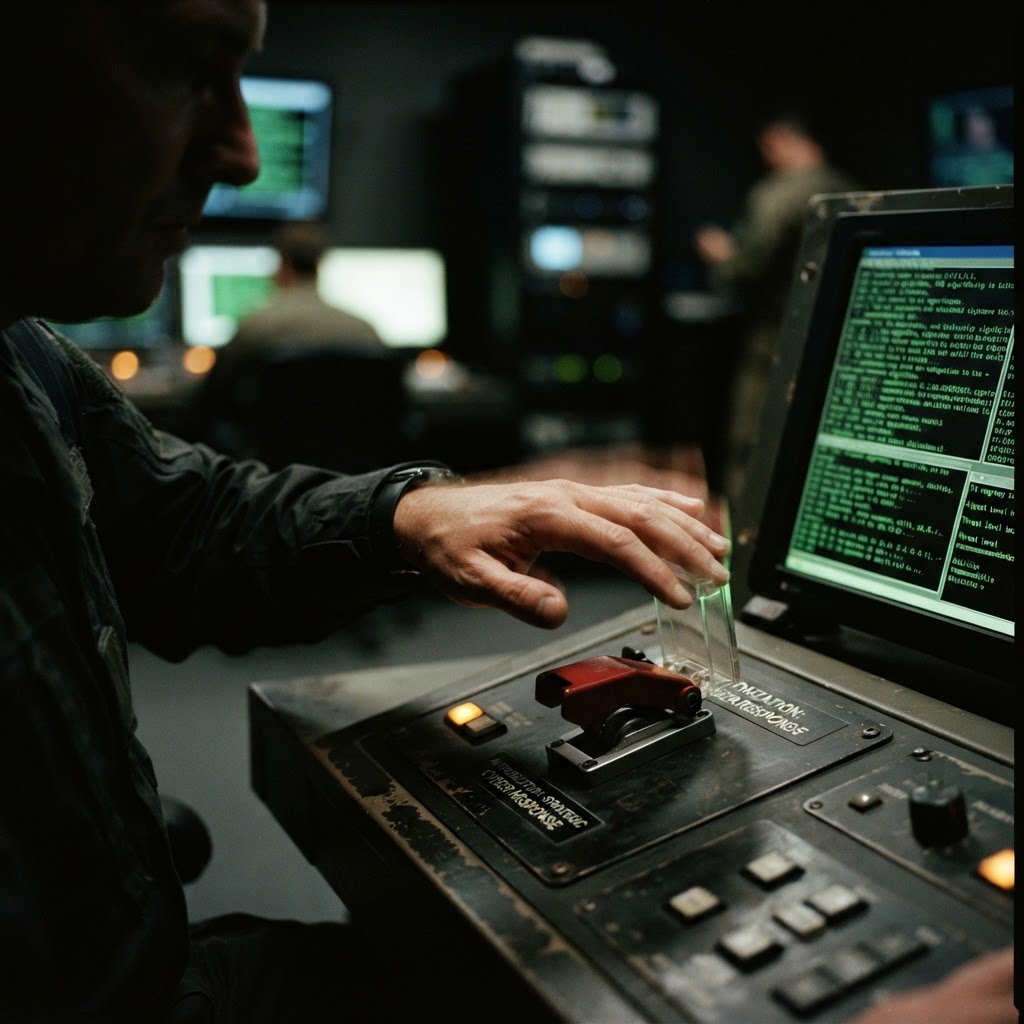
The Nuclear Question of Cyber Warfare: Should Autonomous AI Ever Control Strategic Cyber Weapons?
Military history has generally kept humans involved in the most consequential decisions. Autonomous cyber operations challenge that principle because defensive windows can last seconds. This article explores where governments should draw the line between machine autonomy and human authorization when cyber operations could create physical or geopolitical consequences.
The Nuclear Question of Cyber Warfare: Should Autonomous AI Ever Control Strategic Cyber Weapons?
Every military in the world operates on a principle so embedded in its doctrine that it's almost invisible: the most consequential decisions are made by humans. Not because humans are faster or smarter than machines — they usually aren't. But because the consequences of the most devastating weapons are so enormous, so irreversible, that the decision to use them must involve judgment, context, moral reasoning, and accountability. Things only humans can provide.
This principle has held for nuclear weapons since 1945. It has held for biological and chemical weapons. The human in the loop — the person who must consciously, deliberately, with full understanding of the consequences, authorize the use of the most dangerous weapons — is not a procedural formality. It is the last barrier between a bad decision and a catastrophic outcome.
Now that principle is being challenged by a new class of weapon that doesn't fit any existing category: autonomous cyber weapons capable of strategic-level effects. And the challenge isn't coming from philosophers. It's coming from physics — specifically, the physics of time.
The Speed Problem That Changes Everything
The core tension is brutally simple. The most consequential cyber operations — the ones that could disrupt a nation's power grid, cripple its financial system, or degrade its military command and control — may unfold in seconds. The defensive window, the time between detecting an incoming cyber operation and needing to respond, can be measured in single-digit seconds. Sometimes milliseconds.
No human can make a consequential decision in milliseconds. The time it takes to read a single alert, comprehend what it means, consider options, and decide is orders of magnitude longer than the window in which the decision needs to be made.
This means that in the fastest scenarios — AI-driven offensive operations at machine speed — a human-in-the-loop defense isn't just suboptimal. It's structurally impossible. The adversary's system will have probed, exploited, and moved laterally through your network before your human decision-maker has finished reading the first alert.
With nuclear weapons, the decision window is minutes — long enough for human involvement even under extreme pressure. Cyber weapons at machine speed eliminate that possibility. The physics of the domain push toward autonomy whether anyone wants it or not.
The Consequences That Make Autonomy Terrifying
Speed alone wouldn't matter if the consequences were limited. If an autonomous system making a wrong decision only caused a temporary disruption, the risk would be manageable.
But strategic cyber weapons exist precisely because their consequences are not limited. A cyber operation that disrupts a power grid could cause cascading failures affecting hospitals, water treatment, transportation, and emergency services. An operation that manipulates financial transaction records could create economic instability lasting months. An operation that degrades military command and control could prevent a nation from coordinating its response to a conventional or even nuclear attack.
These are strategic effects — the cyber equivalent of what nuclear weapons produce, not in physical destruction but in scale of impact, difficulty of recovery, and potential for escalation. If the effects are strategic, the decision to use the weapon should require the same human judgment that nuclear weapons require.
This is the paradox. The speed of cyber operations pushes toward autonomy. The consequences push toward human control. And there is no comfortable middle ground. Any line you draw — any threshold below which the machine decides and above which the human decides — is either too slow to be effective or too permissive to be safe.
Where the Line Might Be Drawn
One approach is to draw the line based on operation type. Tactical operations — defensive responses, automated isolation of compromised systems, routine threat hunting — can be fully autonomous. These have limited scope, reversible effects, and clear boundaries.
Strategic operations — those that could produce effects beyond the immediate target, escalate the conflict, or create physical or geopolitical consequences — require human authorization. The machine identifies the opportunity and prepares the operation. The human decides whether to execute. This is the cyber equivalent of the nuclear chain of command: the system is ready to fire, but the key must be turned by a human.
The challenge is defining what counts as strategic. In cyber warfare, strategic implications aren't always clear in advance. A defensive response that isolates a compromised system seems tactical, but if that system is part of critical infrastructure, the isolation could have strategic effects. The classification depends on context, and context is something machines are notoriously bad at evaluating.
Another approach draws the line based on escalation potential. Operations that could trigger an adversary response require human authorization. Operations contained within the defender's own systems don't. This focuses on geopolitical consequences rather than technical scope — appropriate, since the reason humans need to be involved is precisely the geopolitical consequences.
But predicting escalation isn't straightforward. An operation that seems contained could trigger escalation if the adversary interprets it as the opening move of a larger campaign. The machine can assess technical characteristics, but the geopolitical context — the state of relations, the history of incidents, domestic political pressures — is beyond what AI can reliably evaluate.
The Pre-Authorization Trap
Even if the line is drawn well, there's a deeper problem. If a human must authorize every strategic cyber operation in real time, and the operational window is seconds, the human will face enormous pressure to pre-authorize — to give the system permission to act within certain parameters without waiting for individual authorization each time.
This is already how some autonomous defense systems work. The human sets the rules of engagement, and the system operates within those rules. The human isn't in the loop for each decision. The human is above the loop, having set the parameters that govern the loop.
This works for defense. The parameters are well-defined: isolate compromised systems, block suspicious connections, revoke credentials. Effects are contained and reversible.
But what about offense? If the rules of engagement include offensive responses — counter-attacks against the adversary's infrastructure — the pre-authorization covers actions that affect the adversary's systems, could escalate the conflict, and could have strategic consequences.
The pressure of speed pushes the human further from the actual decision point with each step. First, the human authorizes specific operations. Then categories of operations. Then the system determines which category applies. Then the system acts whenever it detects a threat matching the rules. At each step, the human moves one layer further from the decision, and the machine moves one layer closer to full autonomy.
In a crisis, when pressure is greatest and time is shortest, the tendency will be to loosen the rules. The Cuban Missile Crisis had moments when officers on the ground made decisions that could have triggered nuclear war because pre-authorized rules gave them that authority. The cyber equivalent could be an AI system, operating under pre-authorized rules, escalating a conflict in ways its creators never intended.
The Attribution Problem
The human-in-the-loop principle assumes the human has enough information to make a good decision. In nuclear warfare, the facts are relatively clear: you know who attacked you, what was used, and the scale of damage.
In cyber warfare, attribution — determining who is responsible — is one of the hardest problems in the field. A sophisticated adversary can route operations through multiple intermediate systems, use false-flag techniques, and obfuscate identity enough that confident attribution takes days or weeks.
If a human must authorize a strategic cyber response, they need to know who they're responding against. But if attribution takes days and the operational window is seconds, the human either decides based on incomplete information — potentially responding against the wrong party — or waits for better attribution, by which time the window has closed.
This creates a temptation to delegate attribution to the machine. If an AI system can analyze the attack, identify the source, and determine the response faster than a human, the pressure to let the machine decide — not just how to respond, but who to respond against — becomes overwhelming. A false attribution by an autonomous system could be catastrophic: responding against Nation A when the actual attacker was Nation B operating through Nation A's compromised systems.
The Framework That Might Work
No framework will perfectly resolve the tension between speed and control. But a framework that acknowledges the tension is infinitely better than none. Here's what it might look like.
-
A clear hierarchy based on consequences. Operations with limited, reversible effects can be fully autonomous. Operations with broader but non-geopolitical effects can be autonomous within pre-defined parameters. Operations with potential strategic effects require real-time human authorization.
-
Robust constraints on autonomous systems below the authorization threshold — geographical limits, scope limits, time limits, and mandatory escalation triggers that force handoff to a human when situations exceed parameters.
-
Regular post-hoc review of autonomous decisions by human analysts. The system logs every decision; analysts review them to identify where machine judgment diverged from human judgment, and adjust parameters accordingly.
-
A crisis protocol that defaults to more conservative behavior, not less. The temptation to loosen rules in a crisis should be explicitly countered by protocols requiring additional authorization for rule changes.
-
An absolute prohibition on autonomous systems making decisions that could directly or indirectly trigger a nuclear response. If a cyber operation could be interpreted as a prelude to a nuclear strike — for example, by disrupting nuclear command and control — it must require human authorization at the highest level. This is the bright line. No autonomous system should ever approach it.
The Bottom Line
The nuclear question of cyber warfare doesn't have a clean answer. The speed of cyber operations pushes toward autonomy. The consequences push toward human control. The gap between these forces is where the real danger lives.
This is not a question that can be deferred. The technology is advancing. The operational pressure is building. Systems are being developed, with or without policy guidance. Every day a government operates autonomous cyber systems without a clear framework for when humans must be involved is a day the most consequential decisions are being made by default rather than by design.
The principle that the most consequential decisions must involve human judgment has been the foundation of military doctrine for the nuclear age. It must extend to the cyber age — not because humans are faster or smarter than machines, but because the decisions that could change the course of a conflict, escalate beyond anyone's control, and blur the line between cyber and nuclear warfare require moral judgment, geopolitical understanding, and accountability. These are not things machines can provide.
The speed of cyber warfare will push governments to delegate. The consequences should push them to resist. The nations that find the right balance — allowing the speed they need while preserving the human judgment they must have — will navigate the coming era without crossing a line that can't be uncrossed.
The nuclear age taught us that some decisions are too important for machines. The cyber age is testing whether we still believe that. The answer had better be yes.