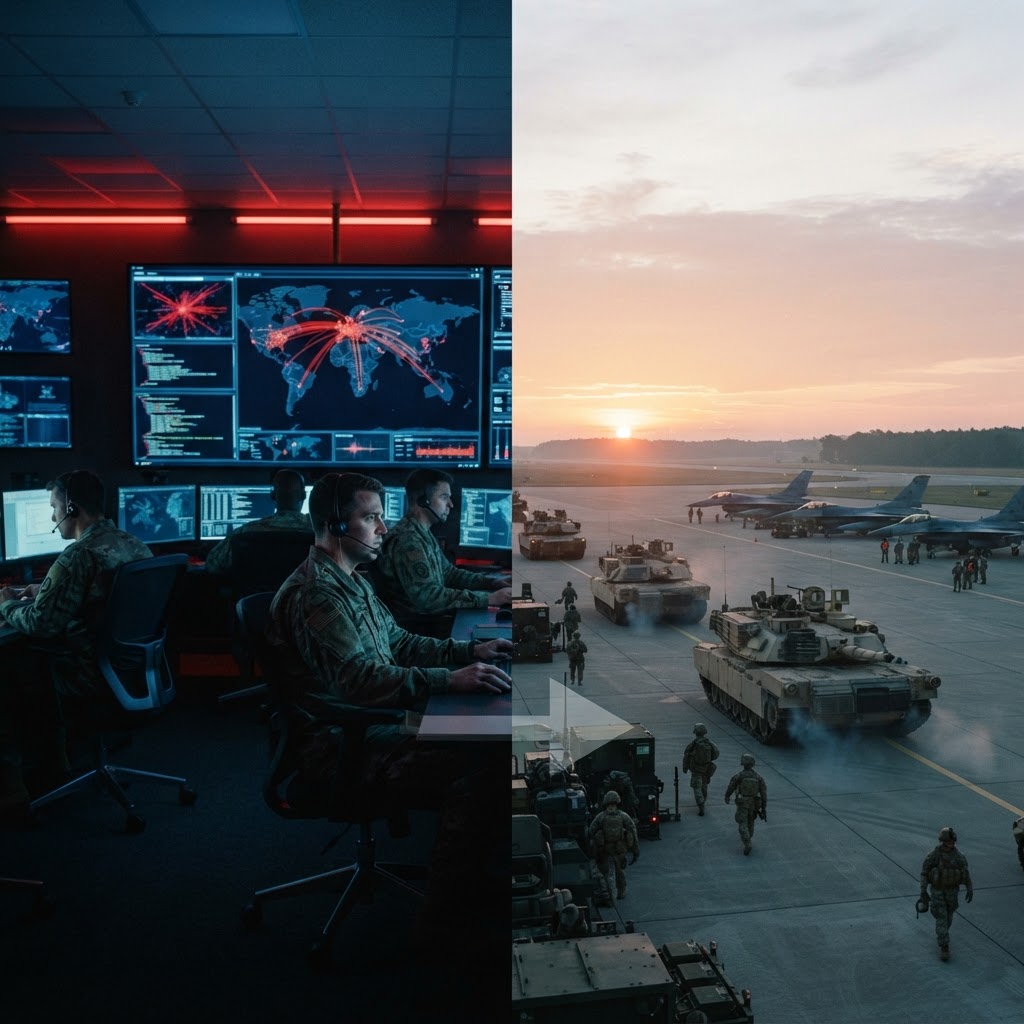
The Digital First Strike: Could AI Launch a Cyberattack Before a Conventional War Begins?
Future conflicts may begin in cyberspace hours or even days before the first missile is launched. This article examines how AI-powered cyber operations could be used as a digital first strike to disrupt an adversary's communications, military logistics, government networks, financial systems, energy infrastructure, and command capabilities before conventional forces move.
The Digital First Strike: Could AI Launch a Cyberattack Before a Conventional War Begins?
Every war in history has begun with a first move. The element of surprise — striking first, before the adversary is ready — has been a fundamental principle of military strategy since the earliest recorded battles. From the Trojan Horse to Pearl Harbor to the Six-Day War, the nation that strikes first gains an advantage that can determine the outcome of the entire conflict.
But what if the first strike doesn't come from a missile, a bomber, or an infantry division? What if it comes from a server rack in a building nobody is watching, hours or even days before the first shot is fired?
That's the scenario that keeps defense planners awake at night. And with the rise of AI-powered cyber operations, it's becoming less hypothetical every day.
The Logic of the Digital First Strike
The logic is brutally simple. If you're going to fight a conventional war, you want your adversary as blind, deaf, and disorganized as possible when the shooting starts. You want their communications down. You want their supply lines disrupted. You want their command structure confused. You want their intelligence systems feeding them bad information. You want their infrastructure — the power that runs their military bases, the fuel that powers their vehicles, the networks that coordinate their forces — compromised before a single soldier crosses a border.
Historically, achieving this kind of pre-conflict disruption required sabotage — commandos blowing up communications relays, agents planting explosives in fuel depots, intelligence services recruiting insiders to disable systems from within. These operations were risky, limited in scale, and difficult to coordinate across an entire nation's infrastructure.
AI-powered cyber operations change the equation. Instead of a handful of sabotage teams risking their lives to disrupt a few targets, an AI system can quietly prepare to disable hundreds of critical systems simultaneously — and execute that disruption in the hours or days before conventional forces move. The digital first strike happens silently, invisibly, while the target nation doesn't even know it's at war.
The Timeline: Hours or Days Before
The most dangerous aspect of a digital first strike is the timing. In traditional warfare, the first action is the attack itself — the missile launch, the tank crossing, the bomber taking off. The target knows it's under attack the moment it happens. There might be warning signs — troop buildups, diplomatic breakdowns, intelligence indicators — but the actual attack begins the conflict.
A digital first strike inverts this timeline. The cyberattack comes first — hours or days before any conventional military action. The target is already under attack before it realizes a war is about to start. By the time the first missile is launched, the target's communications are down, its logistics systems are compromised, its command networks are unreliable, and its ability to coordinate a response has been significantly degraded.
This timeline creates a fundamentally different kind of conflict. The target isn't responding to a surprise attack — it's recovering from one while simultaneously trying to fight a conventional war. The attacker, having already degraded the target's capabilities, begins the conventional phase with a decisive advantage.
The window could be hours or it could be days. A longer window allows for deeper, more systematic disruption — but it also increases the chance that the target detects the cyber operations and begins to respond before the conventional attack begins. A shorter window — hours rather than days — minimizes detection risk but limits the depth of disruption. The optimal timing would depend on the specific strategic objectives, and AI systems are well suited to calculating that optimization.
Targeting Communications and Command Systems
The first and most obvious target of a digital first strike is the adversary's communications infrastructure. Military command and control systems depend on networks. If those networks are disrupted or destroyed, the military's ability to coordinate a response is crippled. Orders can't be transmitted. Intelligence can't be shared. Units can't coordinate. The military becomes a collection of isolated forces rather than a coordinated fighting machine.
AI agents targeting communications systems would focus on the infrastructure that carries military traffic — satellite ground stations, fiber optic backbone networks, military communication hubs, and the civilian telecommunications infrastructure that military systems often depend on. They would attempt to disrupt routing infrastructure, degrade bandwidth, and where possible, manipulate the content of communications — injecting false orders, altering intelligence reports, and creating confusion within the command structure.
The goal isn't permanent destruction — it's temporary paralysis. You don't need to destroy the communications infrastructure permanently. You just need to make it unreliable enough, for long enough, that the adversary can't coordinate an effective response during the critical opening hours of the conventional attack.
Disrupting Military Logistics
Armies march on their stomachs, and modern militaries run on supply chains. Fuel, ammunition, food, medical supplies, spare parts — all of these need to move from depots to front-line units through a logistics network that is increasingly digitized. The software systems that manage inventory, route shipments, coordinate transport, and track supplies are as critical to modern military operations as the weapons themselves.
A digital first strike targeting military logistics would attempt to disrupt these software systems — corrupting inventory databases to show wrong stock levels, manipulating routing systems to send supplies to the wrong locations, disrupting transportation management systems to delay or misdirect shipments. The result would be a military that has the supplies it needs but can't get them where they need to go — or worse, doesn't even know what it has or where it is.
AI agents are particularly well suited to this kind of operation because logistics systems are complex and interconnected. Disrupting one node — a major supply depot's management system, a key transportation hub's scheduling platform — can cascade through the entire network. An AI system that has mapped the logistics network during the reconnaissance phase can identify the nodes where disruption would cause the most cascading damage.
Government Networks: Blinding the State
Beyond military targets, a digital first strike would go after the government networks that coordinate the national response to a crisis. The systems that manage emergency communications, coordinate between civilian and military authorities, and enable the leadership to make and communicate decisions are all potential targets.
If these systems are disrupted, the government's ability to respond to the conventional attack — to issue orders, coordinate emergency services, mobilize reserves, and communicate with allies — is significantly degraded. The leadership may not have an accurate picture of what's happening. They may not be able to communicate with military commanders. They may not even be able to determine which systems are compromised and which are still reliable.
AI agents targeting government networks would focus on the communication and coordination systems rather than individual workstations. The objective is to fragment the government's decision-making capability — to make it impossible for the leadership to get accurate information, issue coherent orders, or coordinate a unified response.
Financial Systems: Economic Paralysis
Financial infrastructure is often overlooked in military planning, but it's critical to a nation's ability to wage war. Money funds the military. Banks process payments to suppliers, contractors, and personnel. Financial markets reflect confidence in the nation's ability to survive the conflict. If the financial system is disrupted — payments fail, markets freeze, banks can't process transactions — the economic engine that powers the war effort stalls.
A digital first strike targeting financial systems would attempt to disrupt payment processing infrastructure, corrupt banking databases, and create enough uncertainty in the financial system that economic activity grinds to a halt. The target nation's military might have the budget to fight, but if the banking system can't process payments, that budget is meaningless. Suppliers can't be paid. Contracts can't be fulfilled. The economic foundation of the war effort crumbles.
AI agents are well suited to this kind of attack because financial systems are deeply interconnected. A disruption in one bank's processing system can cascade through the entire financial network. An AI system that has mapped these interdependencies can identify the precise points where disruption would cause the widest cascading failure.
Energy Infrastructure: Turning Off the Lights
Energy infrastructure is perhaps the most physically significant target of a digital first strike. Power grids, oil and gas pipelines, refineries, and fuel distribution networks are all controlled by industrial control systems — SCADA systems, PLCs, and other operational technology that is often less secured than IT networks.
Disrupting the power grid doesn't just turn off the lights. It disrupts everything that depends on electricity — communications, water treatment, transportation, healthcare, and the industrial base that supports the military. A nation without power is a nation that can't fight a modern war.
AI agents targeting energy infrastructure would attempt to manipulate control systems to cause outages, disrupt fuel distribution, and degrade the energy infrastructure's ability to recover. The objective, again, is temporary paralysis — enough disruption, for long enough, to prevent the target nation from effectively responding to the conventional attack that follows.
The AI Advantage: Coordinated Simultaneous Disruption
What makes AI essential to the digital first strike concept is coordination. A human-operated cyber campaign targeting communications, logistics, government, financial, and energy systems simultaneously would require hundreds of operators, months of preparation, and a level of cross-sector coordination that is barely achievable even for the most sophisticated intelligence agencies.
An AI system can manage that coordination. It can oversee hundreds of agents operating across all five sectors simultaneously, adjusting the attack in each sector based on real-time feedback from the others. If the communications disruption is working well, it can redirect agents to deepen the logistics disruption. If the energy sector defense is stronger than expected, it can shift resources to the financial sector where the attack is succeeding. The entire operation is coordinated as a single, adaptive campaign — something no human command structure could manage at this scale and speed.
This coordination capability is what makes the digital first strike plausible as a military strategy rather than just a theoretical scenario. Without AI, the coordination problem is too hard. With AI, it's an engineering challenge — and one that is being actively worked on.
Recognizing the Preparations
If the digital first strike is the most dangerous new concept in cyber warfare, the most important defensive capability is the ability to recognize that preparations for one are underway. The challenge is that these preparations look like normal cyber espionage — quiet network mapping, vulnerability identification, and slow, patient establishment of access.
The difference between espionage and first-strike preparation is intent. An espionage operation establishes access to collect intelligence. A first-strike preparation establishes access to execute disruption on command. The technical actions are often identical — the same vulnerabilities are exploited, the same systems are compromised, the same persistence mechanisms are established. The only difference is what the attacker plans to do with the access.
This makes detection extraordinarily difficult. A nation-state that has been penetrated by a sophisticated adversary has no easy way to know whether the intruders are there to watch or to prepare for a first strike. The indicators are subtle — the placement of tools that could be used for disruption rather than just collection, the establishment of access to systems that have intelligence value versus systems that have disruption value, the pattern of compromised systems suggesting preparation for coordinated action rather than ongoing espionage.
AI systems can help here too. By continuously monitoring the behavior of known and suspected threat actors across an organization's infrastructure, AI can identify patterns that suggest preparation for coordinated disruption rather than simple espionage. A sudden shift in targeting — from intelligence-collection systems to infrastructure-control systems — is a red flag. The deployment of tools designed for disruption rather than data theft is another. The establishment of access paths that would enable simultaneous action across multiple sectors is perhaps the strongest indicator.
The Pre-Conflict Defense Strategy
Defending against a digital first strike requires a fundamentally different approach to cybersecurity. Traditional defense is reactive — it detects attacks and responds to them. Pre-conflict defense must be proactive — it must detect preparations for attacks that haven't happened yet.
This means treating every sophisticated intrusion as a potential first-strike preparation, not just an espionage operation. It means hardening critical infrastructure — communications, logistics, government networks, financial systems, energy infrastructure — to a level that assumes a determined, well-resourced adversary is already inside and preparing to strike. It means building redundancy and resilience into systems so that even if some are disrupted, others can take over. And it means developing autonomous defensive capabilities that can detect and respond to coordinated, multi-sector attacks at machine speed.
Most importantly, it means recognizing that in the age of AI-powered cyber warfare, the first battle of the next war may already be underway. The preparations are happening now — in the quiet, patient penetration of critical infrastructure networks around the world. The question is whether the target nations are watching closely enough to see them.
The Bottom Line
The concept of a digital first strike — a coordinated AI-driven cyberattack against an adversary's critical infrastructure, executed in the hours or days before a conventional war begins — is not science fiction. It's a logical extension of existing military doctrine to a new technological reality. Every component of the scenario described here — AI-driven reconnaissance, automated exploitation, coordinated multi-sector attacks, adaptive real-time strategy — is technically feasible with technology that exists today or is in active development.
The nation that develops the capability to execute a digital first strike gains an advantage that has no precedent in military history: the ability to cripple an adversary's ability to fight before the fighting starts. The nation that fails to develop defenses against it faces the prospect of entering a conventional war already half-defeated — its communications down, its logistics disrupted, its government blinded, its economy paralyzed, and its energy infrastructure compromised.
The digital first strike is the future of pre-conflict strategy. The only question that matters is whether the nations that would be targeted are preparing for it — or whether they'll discover its reality only after it's already been used against them.