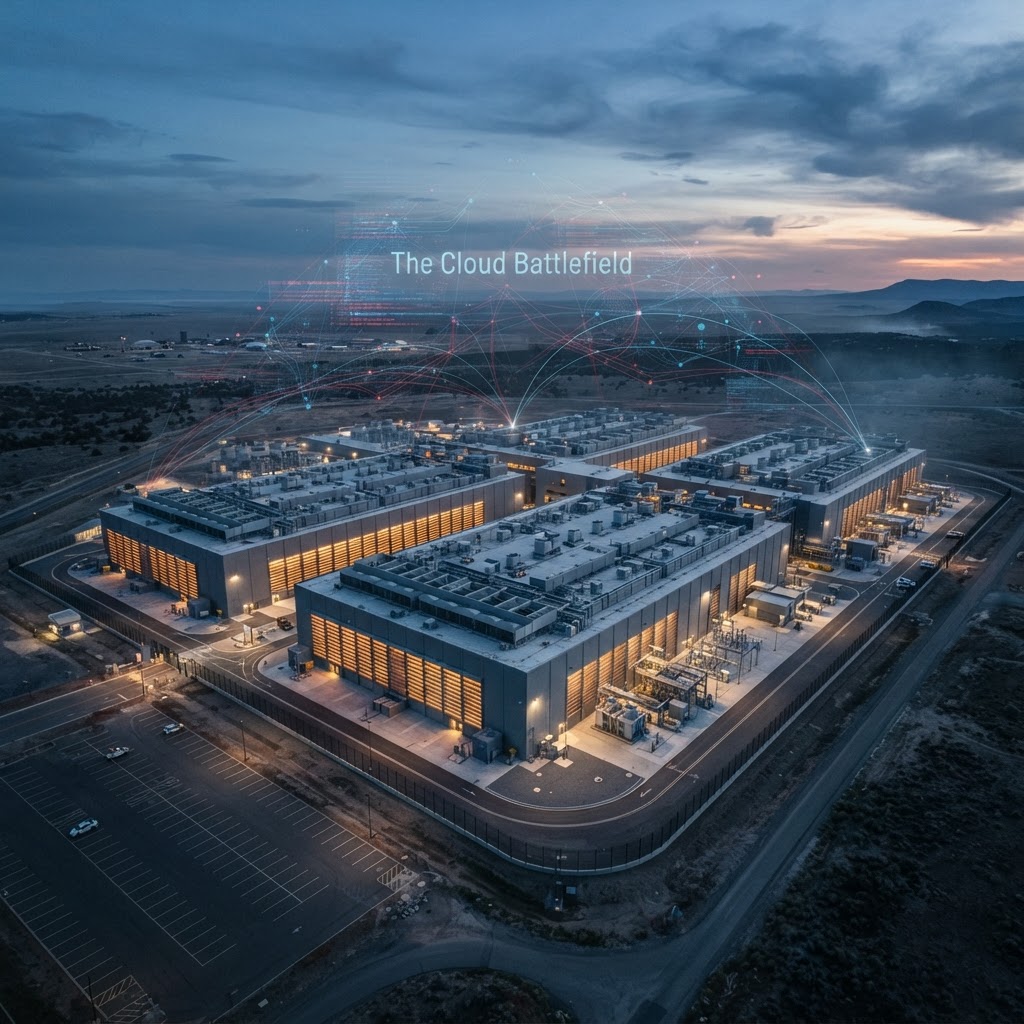
The Battle for the Cloud: Why the Next War Could Be Fought Inside Data Centers
Governments, businesses and defense contractors increasingly depend on shared cloud infrastructure. This article examines why cloud identity systems, APIs, AI infrastructure and data centers could become strategic terrain during geopolitical conflict—and why protecting physical territory may no longer be enough.
The Battle for the Cloud: Why the Next War Could Be Fought Inside Data Centers
There used to be a simple answer to the question of where a war would be fought. You looked at a map. You identified the territory that mattered — the border regions, the shipping lanes, the capital cities, the resource deposits — and you planned your military strategy around controlling those physical spaces. Geography was destiny. Whoever held the ground held the advantage.
Geography still matters. But something has shifted in the last decade that's made the old map incomplete in a way that most military planners are only beginning to grasp. The territory that matters now isn't just physical. It's digital. And the most important digital territory — the terrain that governments, businesses, and defense contractors increasingly depend on for everything from communications to intelligence to weapons systems — is the cloud.
The next war won't only be fought on land, at sea, and in the air. It could be fought inside data centers. And the nations that control, protect, and can deny access to cloud infrastructure may hold an advantage that no number of troops or tanks can compensate for.
The Quiet Migration of National Capability to the Cloud
It happened gradually, the way most transformative shifts do. First, companies moved their email to the cloud. Then their data. Then their applications. Then their entire IT infrastructure. The reasons were economic and practical — cloud computing offered scalability, reliability, and cost efficiencies that on-premises data centers couldn't match. For most organizations, the decision was obvious.
What wasn't obvious, at least at first, was the strategic implication. As businesses moved to the cloud, so did the services that governments and defense contractors rely on. Intelligence agencies use cloud infrastructure to process satellite imagery. Military branches use cloud-based logistics systems to manage supply chains. Defense contractors use cloud platforms to design and test weapons systems. Government agencies use cloud services to manage everything from tax records to emergency communications to classified databases.
The migration wasn't uniform, and it wasn't total. Classified systems still run on air-gapped, on-premises infrastructure. Critical military command systems maintain dedicated networks. But the surrounding infrastructure — the logistics, the communications, the analytics, the supply chain management — has moved to commercial cloud platforms at a pace that has quietly transformed the national security landscape.
The result is a situation that would have been unthinkable twenty years ago: significant portions of the national defense capability of major powers now run on shared commercial infrastructure operated by a handful of private companies. The cloud is no longer just a business tool. It's national security terrain.
Cloud Identity: The Keys to the Kingdom
If the cloud is the battlefield, then identity is the first objective. Every cloud environment — whether it's a corporate application landscape, a government agency's data platform, or a defense contractor's engineering systems — is governed by identity and access management. Identity determines who can access what. It's the perimeter, the gatekeeper, and the access control system all in one.
In the on-premises world, identity was relatively contained. Your network had a boundary. Your directory services were internal. Your authentication systems were under your control. If an adversary wanted access, they had to breach your perimeter, which was a physical and technical challenge with well-understood defensive measures.
In the cloud, identity is the perimeter. There is no network boundary in the traditional sense. The boundary is a set of policies and authentication mechanisms that determine which identities can access which resources. If an adversary can compromise an identity — through phishing, credential theft, social engineering, or exploitation of an authentication vulnerability — they can often bypass every other security measure the organization has in place. They don't need to breach a firewall. They just need to log in.
This makes cloud identity systems a strategic target in a way that traditional network perimeters never were. A nation-state that can compromise the identity infrastructure of an adversary's cloud environments can gain access to systems across government, defense, and critical infrastructure — all through the same access mechanism. The identity system isn't just a security control. It's a single point of strategic failure.
The concentration of cloud identity systems across a small number of providers makes this worse. If several major government agencies and defense contractors all use the same cloud identity provider, a vulnerability or compromise in that provider's identity system could potentially affect all of them simultaneously. The vendor concentration risk that the cybersecurity industry has been warning about for years becomes, in the context of geopolitical conflict, a strategic vulnerability.
APIs: The Connective Tissue of Modern Warfare
APIs are the interfaces through which cloud services communicate with each other and with the applications that depend on them. They're the connective tissue of the cloud — the mechanism by which data flows between systems, services are orchestrated, and functionality is composed. They're also, increasingly, the mechanism through which modern military and intelligence operations are conducted.
A defense contractor's weapons design system pulls simulation data from a cloud-based analytics platform via an API. A military logistics system communicates with a commercial shipping platform via an API. An intelligence agency's data processing pipeline pulls satellite imagery from a cloud storage service via an API. Every one of these API connections is a potential attack surface — an entry point through which an adversary could potentially intercept data, inject malicious commands, or disrupt the service.
APIs are also where the complexity of cloud security becomes most apparent. A single cloud environment might have hundreds of APIs, each one connecting to a different service, each one with its own authentication requirements, rate limits, and security configurations. Securing all of them is a challenge that most organizations are still struggling to meet. In a geopolitical conflict, an adversary that can identify and exploit a vulnerable API in a critical cloud environment gains a foothold that traditional security measures may not detect — because the access looks legitimate. It's coming through the front door.
The strategic implication is that the API layer of cloud infrastructure is not just a technical concern. It's a military concern. The nation that can map, understand, and potentially exploit the API infrastructure of an adversary's cloud environments has a pathway into the systems that the adversary's military, intelligence, and government operations depend on. Protecting physical territory doesn't protect this layer. You can't put a fence around an API.
AI Infrastructure: The Prize Inside the Cloud
The migration of AI capabilities to the cloud has added a new dimension to the strategic importance of cloud infrastructure. AI is computationally intensive. Training frontier models requires enormous compute resources — specialized chips, massive data sets, and infrastructure that only a handful of organizations can provide. For most governments and defense contractors, building this infrastructure on-premises is economically impractical. They rely on cloud-based AI infrastructure.
This means that the AI capabilities that increasingly drive military intelligence, logistics optimization, threat detection, and decision support are running on shared cloud infrastructure. The models, the training data, the inference endpoints, and the entire AI pipeline are hosted in data centers that are owned and operated by commercial cloud providers.
In a geopolitical conflict, this AI infrastructure becomes a strategic target. An adversary that can disrupt, degrade, or compromise an opponent's cloud-based AI infrastructure can blind their intelligence capabilities, degrade their decision support systems, and eliminate the computational advantage that AI provides. The attack doesn't target the AI model itself. It targets the infrastructure the model depends on — the compute resources, the data pipelines, the APIs that connect the model to the applications that use it.
There's also a data dimension. The training data for military and intelligence AI systems — the satellite imagery, the signals intelligence, the operational data — is stored in cloud environments. An adversary that gains access to this data through a cloud compromise doesn't just disrupt the AI capability. They steal the knowledge base that it was built on. They learn what the adversary knows, how they think about their intelligence, and what their models are trained to detect.
Data Centers: The Physical-Digital Nexus
Cloud infrastructure, for all its abstraction, runs on physical hardware in physical buildings. Data centers — enormous facilities packed with servers, networking equipment, cooling systems, and power supplies — are the physical manifestation of the cloud. They are also, increasingly, strategic military targets.
A data center is a concentration point. It houses the computing infrastructure for potentially hundreds of organizations — government agencies, defense contractors, critical infrastructure operators. Disrupting a data center — through a cyber attack on its management infrastructure, a physical attack on its power supply, or a combination of both — can degrade the capabilities of every organization that depends on it.
This creates a targeting paradox that military planners are still working through. Traditional military doctrine focuses on destroying the adversary's physical capability — their bases, their factories, their supply depots. But in a world where military capability runs on cloud infrastructure, the equivalent of a factory or a supply depot might be a commercial data center that also hosts civilian services, foreign companies, and non-military government agencies. Attacking it isn't just a military operation. It's an attack on the shared infrastructure of the digital economy.
The geographic concentration of data centers adds another layer of strategic complexity. Major cloud providers operate regions with multiple data centers, but these regions are geographically clustered — often near major population centers, coastal areas, or specific geographic features that provide cooling and power advantages. An adversary that understands this geography can identify the physical locations where a relatively small number of attacks could have an outsized impact on the adversary's cloud-dependent capabilities.
Denial of Service as a Weapon of War
One of the most direct ways that cloud infrastructure could become a battlefield is through denial of service — not the kind of DDoS attack that briefly takes a website offline, but a sustained, sophisticated campaign to degrade or eliminate an adversary's access to the cloud services they depend on.
This could take several forms. A cyber attack on a cloud provider's management infrastructure could disrupt service provisioning, making it impossible for dependent organizations to spin up new resources or scale existing ones. An attack on the cloud provider's authentication systems could lock users out of their own environments. An attack on the physical infrastructure — power, cooling, networking — could take entire data centers offline.
In a geopolitical conflict, the ability to deny an adversary access to their cloud infrastructure could be as strategically significant as the ability to deny them access to their power grid or their telecommunications network. The cloud is infrastructure. Degrading it degrades every capability that depends on it.
There's also a sovereignty dimension. Many nations depend on cloud infrastructure operated by companies headquartered in other nations. In a conflict, the host nation could potentially restrict or cut off the adversary's access to cloud services provided by companies within its jurisdiction. This is the cloud equivalent of a trade embargo, and it's a capability that major powers are already thinking about. If your military runs on a cloud platform operated by a company in a nation that might one day be your adversary, your defense capability has a strategic vulnerability that no amount of technical security can fully mitigate.
The Sovereignty Problem: Your Cloud, Their Territory
This leads to one of the most uncomfortable questions in the cloud-and-national-security conversation: who controls the infrastructure your nation depends on?
When a government agency or defense contractor uses a cloud platform operated by a company headquartered in another country, it is effectively placing critical national capability on someone else's territory. The data is subject to the laws of the country where it's stored. The infrastructure is subject to the regulatory authority of the country where it operates. And in a conflict, access to that infrastructure could be restricted, cut off, or weaponized by the host nation.
This isn't a theoretical concern. Several governments have already begun to recognize the strategic risk of depending on foreign cloud infrastructure for national security capabilities. Some have launched sovereign cloud initiatives — building domestic cloud infrastructure specifically for government and defense use, operated by domestic companies under domestic legal jurisdiction. These initiatives are expensive, technically challenging, and limited in scale compared to the capabilities offered by major commercial cloud providers. But they reflect a recognition that in a world where the cloud is strategic terrain, depending on someone else's cloud is like basing your military on someone else's territory.
The sovereignty problem doesn't have a clean solution. The economic and technical advantages of commercial cloud infrastructure are real, and no nation can realistically replicate the scale and capability of the major cloud providers with domestic alternatives. The question is how to balance the benefits of commercial cloud adoption against the strategic risk of depending on infrastructure that a potential adversary could control or disrupt.
What Needs to Change
If cloud infrastructure is going to be strategic terrain in future conflicts, nations need to start treating it that way. Several things need to happen.
First, governments need to conduct a comprehensive assessment of their cloud dependency — not just which services are in the cloud, but which capabilities are critical to national defense and how they would be affected by a disruption of those cloud services. You can't defend what you haven't mapped, and most governments don't have a complete picture of how dependent their critical capabilities are on commercial cloud infrastructure.
Second, cloud identity systems need to be treated as critical national infrastructure. The identity layer is the new perimeter, and it needs the same level of protection, redundancy, and scrutiny that physical borders and military networks have historically received. This means investing in advanced identity security — multi-factor authentication, conditional access policies, continuous monitoring for credential compromise, and zero-trust architectures that assume the perimeter has already been breached.
Third, API security needs to become a national security priority, not just a developer concern. APIs are the entry points to cloud infrastructure, and securing them requires a fundamentally different approach than traditional network security. It means inventorying every API, testing it for vulnerabilities, monitoring it for abuse, and designing it with the assumption that it will be targeted by sophisticated adversaries.
Fourth, nations need to invest in cloud resilience — the ability to maintain critical capabilities even when cloud services are degraded or disrupted. This means redundancy across providers, backup systems that can operate independently, and the ability to failover quickly when primary cloud services are unavailable. It also means deciding which capabilities are too critical to run on shared infrastructure at all.
Fifth, the sovereignty problem needs honest engagement. Nations need to have difficult conversations about which cloud dependencies are acceptable and which represent unacceptable strategic risk. They need to invest in domestic alternatives where the risk is unacceptable, and they need to negotiate agreements with allied nations to ensure continuity of access to critical cloud services during a conflict.
The Bottom Line
The next war could be fought inside data centers. Not because data centers are the only target, but because they are the infrastructure that everything else runs on. The communications systems, the logistics networks, the intelligence platforms, the weapons design systems — all of these increasingly depend on shared cloud infrastructure that has become, without anyone fully intending it, a critical component of national defense.
Protecting physical territory is no longer enough. A nation can have the strongest military, the most advanced weapons systems, the most capable intelligence agencies — and still be strategically vulnerable if the cloud infrastructure that underpins those capabilities is compromised, disrupted, or controlled by an adversary. The battlefield has expanded. It now includes the servers, the APIs, the identity systems, and the data centers that constitute the digital backbone of modern national power.
The nations that recognize this shift — that treat cloud infrastructure as strategic terrain, invest in its defense, and address the sovereignty and concentration risks that it creates — will be the ones best positioned for the conflicts of the future. The nations that don't will discover, possibly too late, that their most critical capabilities were sitting on someone else's servers all along.
The battle for the cloud has already begun. The question is whether nations will defend it before they need to, or after the walls come down.