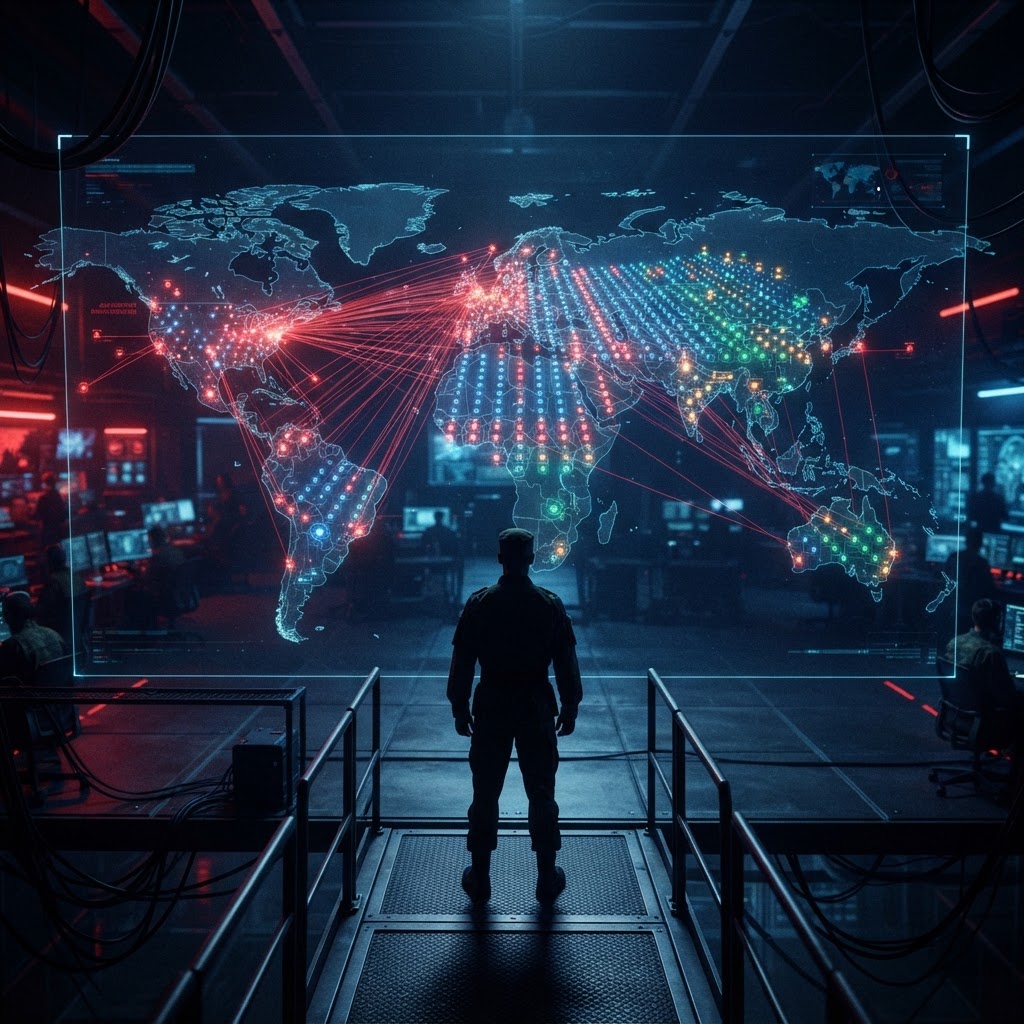
Autonomous Cyber Armies: Will Governments Deploy Thousands of AI Hacking Agents?
Human cyber forces are fundamentally limited by personnel. AI forces are limited primarily by computing resources. A government might eventually be able to deploy thousands of cyber agents simultaneously against an adversary's infrastructure. This article explores the emergence of AI cyber armies and what happens when cyberwarfare becomes massively scalable.
Autonomous Cyber Armies: Will Governments Deploy Thousands of AI Hacking Agents?
Let's talk about the one thing nobody in the cybersecurity world wants to say out loud.
Every military on earth built its cyber capability around people. Talented operators, trained for years, cleared for access to the most sensitive systems, working in teams to breach foreign networks and defend their own. These human cyber forces have always been the bottleneck — not because the people aren't good enough, but because there simply aren't enough of them. You can train a fighter pilot in two years. Training a world-class cyber operator takes longer, and the attrition rate is brutal when the private sector pays three times what a government salary offers.
Now remove the people from the equation.
A government that can deploy AI hacking agents doesn't face a personnel problem. It faces a compute problem. And compute is something you can buy.
The Scalability Gap That Changes Everything
Here's the fundamental shift that makes autonomous cyber armies so dangerous: human cyber forces scale linearly with headcount, while AI cyber forces scale exponentially with computing power. If you want twice as many human operators, you need to recruit, train, clear, and retain twice as many people — a process that takes years and costs a fortune. If you want twice as many AI agents, you provision more compute. It takes minutes.
This scalability gap is not theoretical. It's already playing out in the commercial AI sector, where companies routinely deploy thousands of AI agents to process data, analyze documents, and execute tasks simultaneously. The same infrastructure that powers a customer service chatbot at scale can, in principle, power a cyber operation at scale. The only difference is the objective function.
For governments, this changes the math of cyber warfare entirely. A nation-state that once fielded a cyber unit of, say, 200 operators can theoretically deploy thousands of autonomous agents — each one as capable as a single human operator, each one working around the clock, each one adapting to the defenses it encounters. The constraint is no longer how many people you can hire. The constraint is how much compute you can allocate.
That's a completely different kind of arms race.
What an Autonomous Cyber Army Actually Looks Like
To understand what a massively scalable AI cyber force might look like in practice, it helps to break down how the work would be distributed among specialized agents — much like a military operation divides responsibilities among different units.
Reconnaissance Agents
The first wave would be agents tasked with mapping the adversary's attack surface. These reconnaissance agents would fan out across the target's networks — scanning for open ports, identifying running services, mapping network topology, cataloging software versions, and flagging potential vulnerabilities. Thousands of them could operate simultaneously, each covering a different segment of the target infrastructure. Where a human reconnaissance team might take weeks to map a single large network, a swarm of agents could map an entire country's critical infrastructure in hours.
Exploitation Agents
Once vulnerabilities are identified, a second wave of agents would move to exploit them. These exploitation agents would be armed with a toolkit of known exploits and the ability to generate new ones in real time using AI-assisted vulnerability exploitation. They would prioritize targets based on strategic value — not just what's exploitable, but what matters most. A power grid control system takes priority over an unimportant web server. Each agent works independently but reports back to a coordination layer.
Intelligence Analysis Agents
While the exploitation agents are breaching systems, a parallel set of agents would be analyzing the data flowing in. These intelligence agents would process intercepted communications, analyze captured documents, decode encrypted traffic, and identify patterns that human analysts might miss. They work at a scale that no human team could match — simultaneously analyzing data from thousands of compromised systems, flagging the intelligence that matters, and feeding it back to the coordination layer.
Defensive Monitoring Agents
Some of the most valuable agents wouldn't attack at all — they'd watch. These agents would monitor the adversary's defensive responses in real time. When the target's security team detects an intrusion and starts blocking IPs, these agents would see it happen and alert the other agents to shift their approach. When a defensive system is reconfigured, these agents would detect the change and adapt the attack strategy accordingly. They are the eyes and ears of the autonomous army, ensuring that the offensive agents are always one step ahead of the defenders.
Coordination Agents
At the top of the hierarchy, coordination agents would serve as the command structure — not human commanders, but AI systems that aggregate information from all the other agents, make strategic decisions about where to focus resources, and direct the overall operation. These coordination agents would be the closest thing to a general on the battlefield — except they process information at machine speed and can adjust the entire operation in milliseconds.
The Specialization Problem
Here's where it gets interesting. In a human cyber team, each operator is a generalist — they can do reconnaissance, but they can also write exploits, analyze data, and adapt to defenses. That's because training a human to do all of these things, while difficult, is feasible. You invest years in a person and you get a versatile operator.
AI agents don't need to be generalists. You can train one model to be exceptional at finding vulnerabilities, another to be exceptional at analyzing intercepted data, another to be exceptional at evading detection. Each one is a specialist, and together they form a team that's more capable than any individual agent. This specialization is what allows an autonomous cyber army to be both massive in scale and sophisticated in capability.
The combination of scale and specialization is what makes this fundamentally different from anything that's come before. A human APT group might have 50 operators who are all competent at multiple disciplines. An autonomous cyber army could have 5,000 agents, each one world-class at a single discipline, coordinated by AI systems that orchestrate their activities at machine speed. No human organization — no matter how well-funded — can match that.
What Happens When Cyber Warfare Becomes Massively Scalable
The implications of massively scalable cyber warfare extend far beyond the battlefield. When a government can deploy thousands of AI hacking agents against an adversary, the nature of the conflict changes in several important ways.
The Defense Overwhelm Problem
The most immediate consequence is that traditional defensive systems get overwhelmed. A SIEM platform that processes 10,000 events per second can handle a human-operated attack that generates a few hundred suspicious events. But what happens when thousands of autonomous agents generate hundreds of thousands of events simultaneously? The noise floor rises so high that the signal — the actual intrusion that succeeds — becomes nearly impossible to detect. Defenders drown in alerts while the real attack slips through.
This is not a hypothetical scenario. Security operations centers are already struggling with alert fatigue from human-paced attacks. Multiply the alert volume by a thousand, and the existing defensive model simply breaks. You cannot hire enough analysts to watch that many alerts. You cannot build enough rules to filter that much noise. The defense, too, must become autonomous — but that's a separate challenge, and the offense has a head start.
The Infrastructure Targeting Problem
When a government can deploy thousands of agents simultaneously, it can target an adversary's entire critical infrastructure at once — not sequentially, not in waves, but all at the same time. Power grids, water systems, transportation networks, financial systems, healthcare infrastructure, military communications, government networks — every sector hit simultaneously by hundreds of specialized agents, each one independently working to find and exploit weaknesses.
This is the cyber equivalent of a combined-arms assault — but at a scale that no human military command structure could coordinate. The strategic implications are profound. A nation hit by this kind of attack wouldn't just lose one service. It could lose all of them, all at once, with no warning and no time to mount a sector-by-sector defense.
The Attrition Problem
Human cyber operations have a natural rhythm. Teams deploy, conduct operations, rotate out, rest, and redeploy. There are lulls. The target has time to recover between waves.
Autonomous cyber armies don't take breaks. They operate continuously, 24/7, with no rotation, no fatigue, and no drop in performance. The target is under permanent assault. Every vulnerability that gets patched is replaced by a new one discovered by a reconnaissance agent. Every defense that gets deployed is analyzed by a monitoring agent and circumvented by an exploitation agent. The defender is in a constant state of reaction, never getting ahead, never able to stabilize.
This kind of sustained pressure is devastating. Even if the defender successfully blocks 99% of the agents' attempts, the 1% that succeed are enough to maintain access, exfiltrate data, and degrade systems over time. The attacker doesn't need to win every engagement. The attacker just needs to keep attacking.
The Escalation Problem
Perhaps the most dangerous aspect of massively scalable cyber warfare is the risk of escalation. When thousands of autonomous agents are operating against an adversary's infrastructure, the potential for unintended consequences is enormous. An agent might compromise a system that its creators didn't intend it to target. It might trigger a cascading failure that affects civilian infrastructure. It might provoke a response that neither side anticipated.
In a human-operated cyber campaign, there are checkpoints — moments where a human operator or commander reviews the situation and decides whether to proceed, escalate, or withdraw. In a fully autonomous campaign, those checkpoints may not exist. The agents are given an objective and pursue it. If the objective is broadly defined — "degrade the adversary's critical infrastructure" — the agents may interpret that objective in ways that go beyond what their creators intended.
How Close Are We?
The honest answer is: closer than most people think, but not quite there yet.
The individual capabilities needed to build an autonomous cyber army already exist. AI systems can discover vulnerabilities, generate exploits, analyze data, and adapt to defenses. These are not future capabilities — they are present capabilities, demonstrated in research labs and, increasingly, in the wild.
What doesn't fully exist yet is the integration — the coordination layer that would allow thousands of specialized agents to work together as a cohesive force. The challenge is not unlike the challenge of building a military: you don't just need soldiers, you need a command structure, communication protocols, rules of engagement, and the ability to adapt to a changing battlefield.
But this integration challenge is an engineering problem, not a theoretical one. It's the kind of problem that well-resourced military research programs are designed to solve. And the nations investing most heavily in this kind of research — China, the United States, Russia, Israel — are the ones most likely to solve it first.
The timeline is the subject of intense debate among security analysts. Some believe fully autonomous cyber armies are five to ten years away. Others think elements of this capability already exist in classified programs. The truth is probably somewhere in between: partial autonomous capabilities exist today, and the path to full deployment is shorter than the path to international agreement on whether to allow it.
The Defense: Autonomous vs. Autonomous
If the offense can deploy thousands of agents, the defense needs thousands of agents too. This is the logic that drives the parallel development of autonomous cyber defense — AI systems that can detect, analyze, and respond to threats at machine speed, without human intervention at every step.
But the defense faces a structural disadvantage. The attacker only needs to succeed once. The defender needs to succeed every time. An autonomous cyber army of 5,000 agents only needs one of them to find and exploit a vulnerability. An autonomous defense of 5,000 agents needs to catch every one of the attacker's attempts. This asymmetry has always existed in cybersecurity, but autonomous cyber armies amplify it dramatically.
The defense also faces a trust problem. An autonomous defensive system that can take action — isolating systems, revoking credentials, blocking traffic — must be trusted to act correctly. That trust requires boundaries, transparency, and human oversight — which slow the system down. The offensive system has no such constraints. It can act freely, take risks, and accept failures. The defender must be careful. The attacker can be reckless.
The Question Nobody Wants to Answer
Here's the question that governments around the world are grappling with right now: should autonomous cyber armies be developed at all?
The argument for development is straightforward: if your adversary is building them, you have to build them too. The nation that fields autonomous cyber capabilities first gains a decisive advantage. In the logic of military competition, unilaterally disarming is not a viable strategy.
The argument against development is that the risks are too high. A technology that can autonomously attack critical infrastructure at scale, without human oversight, is a technology that can cause unintended catastrophe. The potential for escalation, for cascading failures, for civilian harm, and for conflict spiraling beyond anyone's control is real and serious.
Neither argument is wrong. That's what makes this so difficult.
What the International Community Should Be Doing Right Now
The window for action is not closed, but it is closing. Several steps are urgently needed:
First, governments need to have honest, classified conversations with each other about the capabilities they're developing. Not public disclosures — no nation will reveal its cyber weapons. But back-channel discussions, similar to the ones that helped manage nuclear deterrence during the Cold War, are essential. Without some level of mutual understanding, the risk of miscalculation is extreme.
Second, there needs to be an international framework specifically addressing autonomous cyber weapons. The existing UN discussions on cyber stability and on lethal autonomous weapons systems don't adequately cover this space. A new framework — one that addresses the unique challenges of AI-driven cyber operations at scale — is needed.
Third, every nation developing these capabilities needs to establish clear internal rules of engagement for autonomous cyber systems. What decisions can an AI agent make on its own? What decisions require human approval? What targets are off-limits? These rules need to be developed before the capability exists, not after it's been deployed.
Fourth, the private sector companies building the AI systems that enable these capabilities need to be part of the conversation. The gap between commercial AI and military AI is narrowing. The companies at the frontier of AI development have a responsibility to think about how their technologies could be weaponized — and what guardrails might prevent it.
The Bottom Line
Autonomous cyber armies are not science fiction. They are the logical endpoint of two parallel trends — the militarization of cyber operations and the development of autonomous AI — that have been converging for years. The individual technologies exist. The integration challenge is being worked on. The strategic logic driving development is compelling. And the international framework to govern these systems does not exist.
A government that can deploy thousands of AI hacking agents against an adversary's infrastructure would have a capability unlike anything in the history of warfare — a force that scales with compute rather than personnel, operates at machine speed rather than human speed, and attacks at a scale that overwhelms any human-paced defense.
Whether this capability will be used responsibly — with meaningful human control, clear limits, and international agreements — or recklessly, in a free-for-all that risks unintended catastrophe, is the question that will define the next decade of cyber warfare. And right now, nobody knows the answer.
What we do know is this: the technology is coming. The race is on. And the nations that win it will have a power that no nation has ever had before — the ability to wage cyber warfare not with teams of dozens, but with armies of thousands. Whether that power makes the world safer or more dangerous depends entirely on what we do next.
