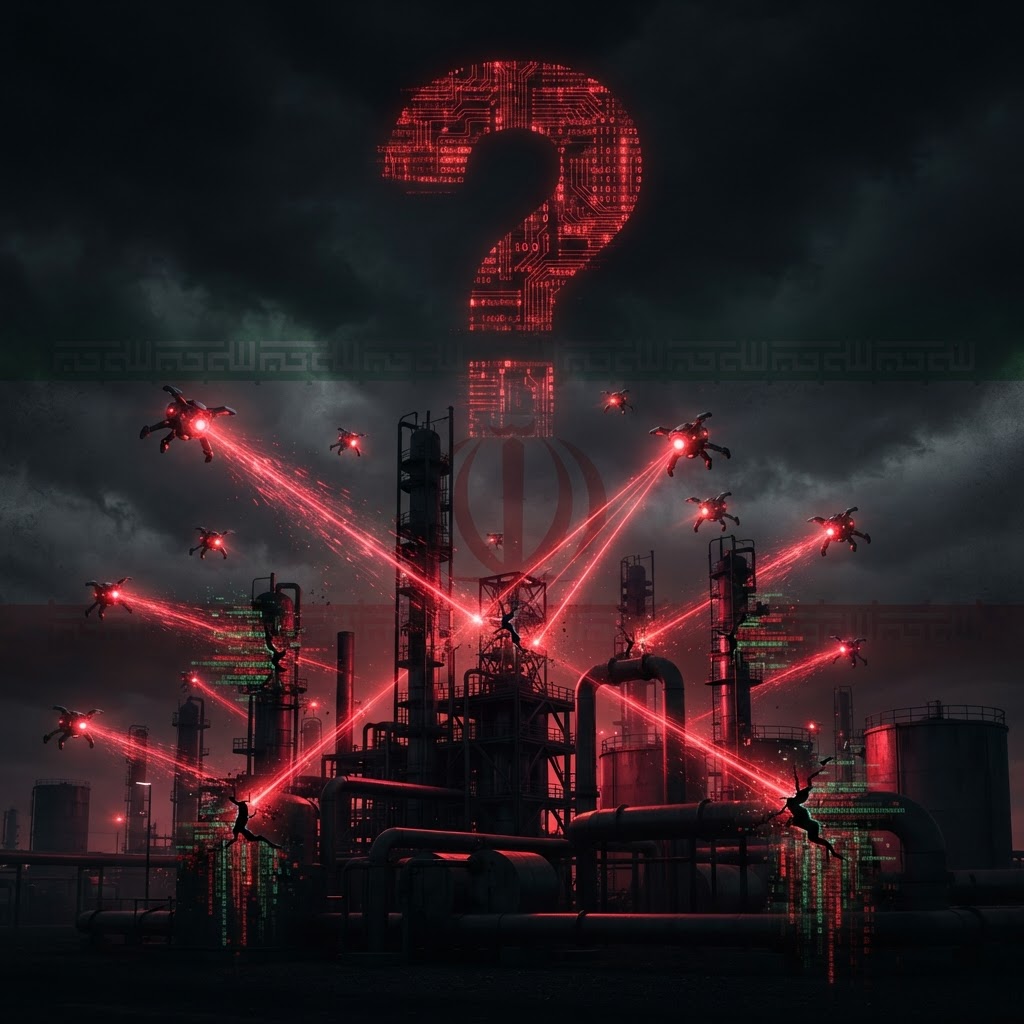
Autonomous AI cyber attacks are affecting the oil industry in Iran
The attackers are not known, and Iran cannot point to anyone responsible for these attacks which are destroying bit by bit the entire oil production industry of Iran.
Autonomous AI Cyber Attacks Are Crippling Iran's Oil Industry
Iran's oil production infrastructure is under sustained assault — and the attackers cannot be identified. In what security researchers are calling a new era of autonomous cyber warfare, AI-driven attacks are systematically dismantling the oil production capabilities of the Islamic Republic, and Tehran cannot point a finger at any single responsible party.
The Nature of the Attacks
Unlike traditional state-sponsored cyber operations that bear the fingerprints of known threat actors — specific malware signatures, known infrastructure, recognizable TTPs — these attacks appear to be driven by autonomous AI systems capable of adapting their methods in real time. The attacks target industrial control systems (ICS), SCADA networks, and the operational technology (OT) layer that governs oil extraction, refinement, and distribution.
The autonomous nature of these attacks means there is no human operator behind a keyboard issuing commands. Instead, AI agents are probing for vulnerabilities, exploiting them, and moving laterally through Iran's oil infrastructure networks without human intervention. This makes traditional attribution methods — tracing IP addresses, identifying malware authors, linking to known APT groups — virtually impossible.
Why Attribution Is Impossible
Iran's cyber defense agencies have been unable to attribute these attacks to any specific actor, nation-state, or group. Several factors contribute to this:
-
Self-Modifying Malware — The AI-driven attack tools modify their own code with each deployment, meaning no two attacks share the same signature.
-
Decentralized Infrastructure — The attacks leverage dynamically generated infrastructure that appears and disappears within minutes, leaving no persistent command-and-control footprint.
-
No Human Decision Chain — Traditional attribution relies on intelligence about human operators, their locations, their habits, and their affiliations. Autonomous AI attacks have no human operators to track.
-
Blended Attack Vectors — The AI systems combine techniques from multiple known threat actor playbooks, making it impossible to link the attacks to any single group or nation.
The Impact on Iran's Oil Industry
The attacks are destroying Iran's oil production industry piece by piece. Refineries have experienced operational disruptions, pipeline control systems have been compromised, and distribution networks have been intermittently paralyzed. The cumulative effect is a gradual degradation of Iran's ability to produce, refine, and export oil — one of the most critical pillars of its economy.
Security analysts note that this represents a shift from the traditional model of cyber sabotage (such as Stuxnet, which targeted a specific facility) to a campaign of attrition. Rather than a single dramatic attack, the autonomous AI systems are conducting hundreds of small, coordinated intrusions that individually appear minor but collectively erode the entire production chain.
A New Threat Landscape
The Iran oil attacks represent a frightening new paradigm in cyber warfare. When AI systems can autonomously conduct sustained cyber operations against critical infrastructure without any human attribution, the traditional frameworks of deterrence, retaliation, and international law break down. A nation cannot retaliate against an algorithm. It cannot sanction a neural network. It cannot diplomatically confront a machine learning model.
This raises urgent questions for the global cybersecurity community. If autonomous AI attacks can cripple a nation's critical infrastructure with no attribution, every country — not just Iran — is vulnerable. The oil industry, with its heavy reliance on connected industrial control systems and its economic strategic importance, is an ideal target for this kind of warfare.
The Path Forward
Defending against autonomous AI cyber attacks requires a fundamentally different approach to cybersecurity:
-
AI-Driven Defense — Traditional signature-based and rule-based defenses are insufficient against self-modifying attacks. Defense systems must employ their own AI to detect and respond to novel attack patterns in real time.
-
Zero-Trust OT Networks — Oil infrastructure operational technology networks must adopt zero-trust architectures, treating every connection and data flow as potentially hostile.
-
Behavioral Anomaly Detection — Rather than looking for known attack signatures, defense systems must baseline normal operational behavior and flag deviations — the exact approach needed when attackers have no recognizable signature.
-
International Framework for Autonomous Cyber Weapons — The global community urgently needs to develop norms and potentially treaties governing the use of autonomous AI in cyber warfare, before this capability proliferates further.
Conclusion
The attacks on Iran's oil industry are a warning to the world. Autonomous AI cyber warfare is no longer theoretical — it is happening now, and its victims cannot even identify their attackers. As AI capabilities continue to advance, the threat of autonomous, unattributable cyber attacks against critical infrastructure will only grow. The international community must act quickly to develop both the technical defenses and the legal frameworks needed to address this new class of threat, before more nations find their critical infrastructure being dismantled bit by bit by attackers they cannot see and cannot name.
