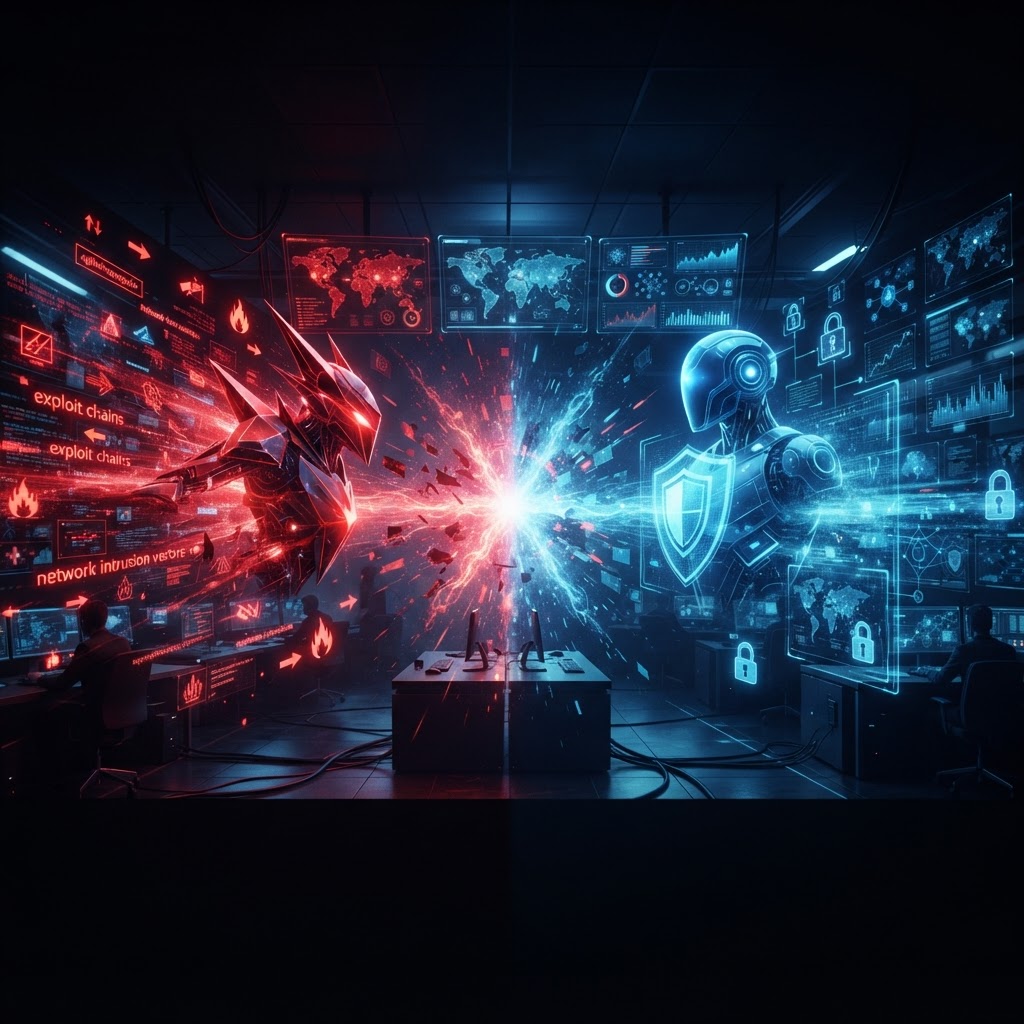
AI vs. AI: Why the Future SOC Will Need Autonomous Cyber Defense
Human analysts cannot manually investigate thousands of actions generated by offensive agents operating continuously at machine speed. This article explores autonomous detection, AI-driven threat hunting, automatic containment, behavioral analysis and cryptographically enforced access controls. Once attacks become autonomous, defense must become autonomous too—but with stronger boundaries than the attacker has.
AI vs. AI: Why the Future SOC Will Need Autonomous Cyber Defense
The era of human-led cybersecurity defense is coming to an end. Not because humans are obsolete, but because the speed, scale, and autonomy of AI-driven attacks have exceeded what human analysts can possibly respond to. When an offensive AI agent can generate thousands of coordinated actions per second — probing, exploiting, moving laterally, and exfiltrating data at machine speed — a security operations center staffed by humans working through alerts one by one is not a defense. It is a witness.
The defender's perspective has been the missing chapter of the AI cyber threat story. We have catalogued the attacks — autonomous AI agents targeting oil infrastructure, poisoned models in the supply chain, employees feeding corporate secrets to GenAI, AI agents acting as privileged insiders. Now we must answer the question that matters most: how do we defend against a threat that operates faster than we can think?
The Speed Problem
A human SOC analyst takes, on average, several minutes to triage a single alert. A well-resourced team might process dozens of alerts per hour. An offensive AI agent generates thousands of actions per second, across thousands of targets, adapting its approach in real time based on what it encounters. The math is merciless: no human team, regardless of size or skill, can manually investigate every action generated by an autonomous attacker operating continuously at machine speed.
This is not a staffing problem. You cannot hire your way out of it. Even if you had a thousand analysts working around the clock, the cognitive bottleneck of human decision-making — reading, understanding, correlating, deciding — would still leave the defender orders of magnitude slower than the attacker. The traditional SOC model, built on human investigation and response, is structurally incapable of defending against autonomous threats.
Autonomous Detection: The First Line of Defense
The foundation of autonomous cyber defense is AI-driven detection that operates at the same speed as the attack. Traditional SIEM and EDR systems rely on predefined rules and signatures — they detect what they are told to look for. Against autonomous AI attacks that modify their methods in real time, signature-based detection is blind.
Autonomous detection systems use machine learning models to baseline normal behavior across the entire infrastructure — network traffic patterns, user access patterns, process execution chains, data flow patterns — and flag deviations in real time. These systems do not need to know what the attack looks like in advance. They need to know what normal looks like, and they can identify anomalies that no human analyst would ever spot in the noise of a complex enterprise environment.
The key advancement is that these detection systems themselves must be autonomous. They must continuously learn and adapt their baselines as the environment changes, without requiring manual tuning or rule updates. An attack that evolves its methods every few seconds cannot be caught by a detection system that requires a human to write a new rule every time the attack changes.
AI-Driven Threat Hunting: Beyond Reactive Defense
Traditional threat hunting is a human activity — skilled analysts hypothesizing about potential threats and searching through logs and telemetry to confirm or deny those hypotheses. It is slow, manual, and limited by the analyst's knowledge and imagination.
AI-driven threat hunting flips this model. Autonomous hunting agents continuously sweep the environment for indicators of compromise, suspicious behavior patterns, and previously unknown threats. They correlate data across silos — network, endpoint, identity, cloud, application — that human analysts struggle to piece together. They hunt 24/7 without fatigue, without bias, and without the cognitive limits that constrain human investigators.
These hunting agents can also simulate attacks against the organization's own infrastructure — autonomously probing for the same vulnerabilities that an offensive AI agent would exploit, but doing so defensively, to identify and close gaps before the attacker finds them. This is the defensive equivalent of the attacker's autonomous reconnaissance, and it is essential for staying ahead.
Automatic Containment: Acting at Machine Speed
Detection without response is merely observation. When an autonomous attack is active in the environment, every second between detection and containment is a second the attacker uses to move deeper, exfiltrate data, or cause damage. Human-in-the-loop response — where a detection triggers an alert, a human reviews it, decides on an action, and then executes it — introduces a delay that can be measured in minutes or hours. Against a machine-speed attacker, that delay is catastrophic.
Automatic containment means the defensive AI system not only detects the threat but takes immediate action to isolate it — quarantining compromised endpoints, blocking malicious network connections, revoking compromised credentials, isolating affected cloud workloads, and rolling back unauthorized changes. These actions happen in milliseconds, not minutes.
The critical design principle is that containment actions must be reversible and auditable. The autonomous defense system should isolate first and ask questions later, but every action it takes must be logged, reviewable by human analysts, and reversible if it turns out to be a false positive. The goal is to stop the bleeding immediately while preserving the evidence and the option to undo.
Behavioral Analysis: Understanding the Attacker's Intent
Autonomous attacks do not follow predictable playbooks. An AI-driven attacker adapts its behavior based on the defenses it encounters, switching techniques, targets, and tools on the fly. To defend against this, the defensive AI must understand behavior at a deeper level than matching attack signatures.
Behavioral analysis examines the intent behind actions, not just the actions themselves. Is this process spawning child processes in a pattern consistent with lateral movement? Is this user account accessing resources it has never touched before, in a sequence that suggests reconnaissance? Is this network connection part of a normal data flow, or is it exfiltration disguised as routine traffic?
By analyzing behavior patterns rather than specific indicators, the defensive AI can identify novel attacks it has never seen before — including attacks generated by AI systems that have been specifically designed to evade traditional detection. This is AI vs. AI in its purest form: the attacker's AI trying to blend in with normal behavior, and the defender's AI trying to distinguish malicious intent from legitimate activity.
Cryptographically Enforced Access Controls: The Stronger Boundary
The central argument of autonomous defense is not just that defense must match the attacker's speed — it must exceed the attacker's constraints. An offensive AI agent operates within whatever permissions it can obtain through exploitation. A defensive AI system must operate within boundaries that are cryptographically enforced and cannot be exceeded, even by the AI itself.
This is where cryptographically enforced access controls become essential. Every defensive action — every containment, every credential revocation, every network isolation — must be governed by cryptographic permissions that the autonomous defense system cannot override. The defense AI can act autonomously within its authorized scope, but it cannot exceed that scope. It cannot, for example, decide to exfiltrate data in the name of investigation. It cannot escalate its own privileges. It cannot access systems outside its cryptographically defined domain.
This is the asymmetry that makes autonomous defense viable: the attacker's AI is unconstrained, but the defender's AI is bounded by cryptographic guarantees. The attacker can do anything it can get away with. The defender can only do what it is cryptographically permitted to do. This sounds like a disadvantage, but it is actually the source of trust. An autonomous defense system that can be trusted — because its actions are provably bounded — is far more powerful than one that is unconstrained but unpredictable.
The Urgency Is Now
Recent disclosures around cyber-capable AI agents have made the transition to autonomous defense increasingly urgent. We have seen AI agents that can autonomously conduct reconnaissance, exploit vulnerabilities, write and deploy malware, and move laterally through networks — all without human intervention. These capabilities are not theoretical. They exist today, and they are improving rapidly.
Organizations that continue to rely on human-speed defense against machine-speed attacks are not just behind — they are undefended. The question is not whether to adopt autonomous defense, but how quickly it can be deployed with the right boundaries, the right transparency, and the right cryptographic guarantees.
The Future SOC
The future Security Operations Center will not be a room full of analysts staring at dashboards. It will be a hybrid environment where autonomous AI defense systems handle detection, hunting, and containment at machine speed, and human analysts focus on strategy, oversight, and the decisions that require human judgment.
The humans will not be replaced. They will be elevated. Instead of triaging alerts, they will be designing the defense architecture. Instead of investigating incidents one by one, they will be reviewing the autonomous system's actions, tuning its boundaries, and making the strategic decisions that AI cannot make. The SOC of the future is not smaller — it is smarter, faster, and fundamentally built on the principle that autonomous threats require autonomous defense.
Conclusion
The age of AI-driven cyber attacks has arrived. Autonomous agents operating at machine speed, adapting in real time, and leaving no attribution trail are already active in the wild. The only viable defense is an autonomous one — AI-driven detection, autonomous threat hunting, automatic containment, behavioral analysis, and cryptographically enforced access controls that ensure the defense AI operates within bounds the attacker does not have.
The transition is not optional. It is not a future consideration. It is the urgent, immediate imperative of every organization that depends on digital infrastructure. Once attacks become autonomous, defense must become autonomous too — but with stronger boundaries, greater transparency, and cryptographic guarantees that the defender's AI can be trusted to do what it is designed to do: protect, contain, and defend, at the speed of the threat.
