AI Supply-Chain Attacks: What If the Malware Is Hidden Inside the Model, Dataset or Agent?
Move beyond traditional software supply chains. Modern enterprises increasingly download models, datasets, plugins, agents and external AI components. This article maps the emerging AI supply chain, explains where malicious code or poisoned content can enter it, and proposes controls such as provenance verification, sandboxing, cryptographic integrity and isolated execution. The Hugging Face incident provides an especially timely real-world starting point.
AI Supply-Chain Attacks: What If the Malware Is Hidden Inside the Model, Dataset or Agent?
The software supply chain has been a known attack vector for years. From SolarWinds to Log4j to the npm ecosystem, attackers have exploited the trust relationships between developers, packages, and production systems. But a new supply chain is emerging — one that is far less understood, far less monitored, and potentially far more dangerous. The AI supply chain.
Modern enterprises are no longer just downloading software packages. They are downloading pre-trained models from Hugging Face, pulling datasets from public repositories, installing AI plugins and extensions, deploying autonomous agents from third-party developers, and integrating external AI components into their production pipelines. Each of these is a trust decision. Each is a potential entry point for an attacker. And the traditional supply-chain security tools — SBOMs, dependency scanners, code signing — were not built for this.
The Emerging AI Supply Chain
The AI supply chain is fundamentally different from the software supply chain. It involves components that are not just code — they are mathematical models, massive datasets, learned weights, and autonomous agents with their own decision-making capabilities. Understanding where the risks lie requires mapping the AI supply chain from source to deployment.
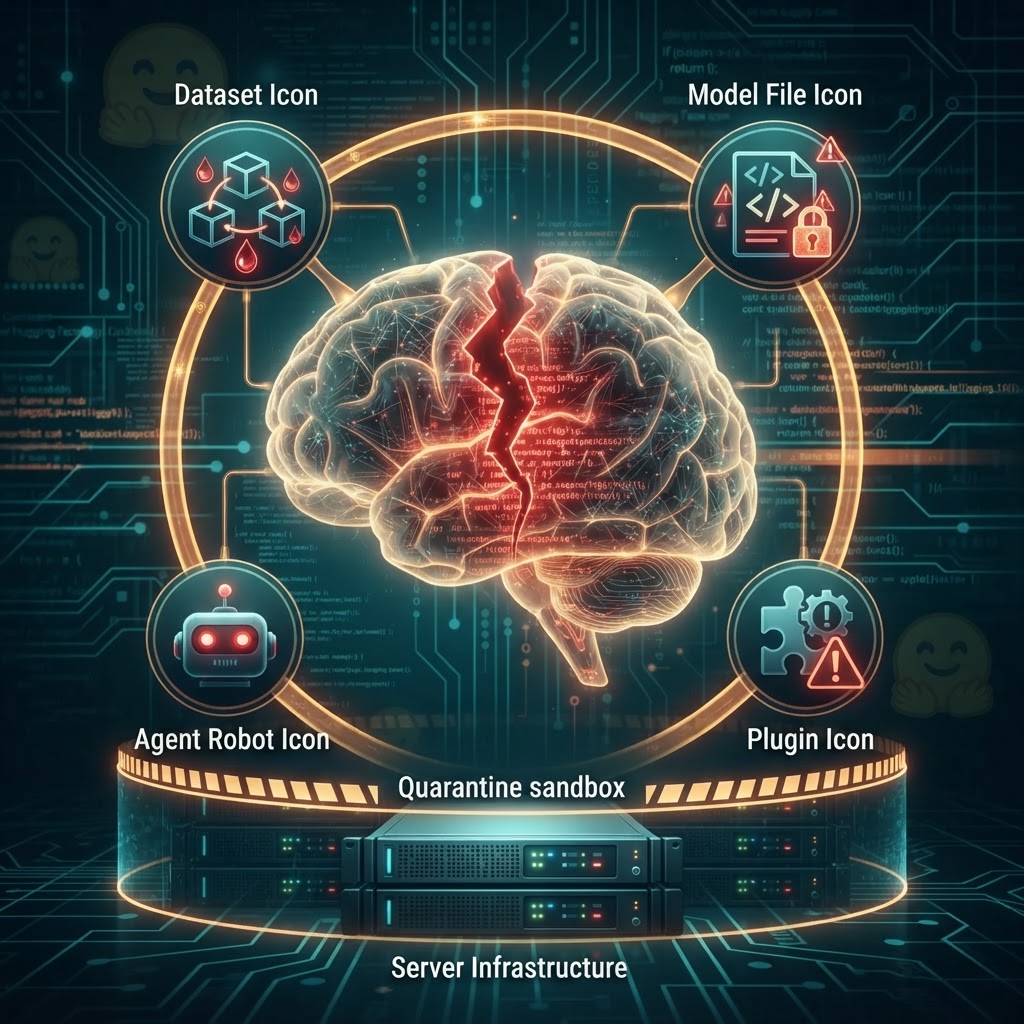
The AI supply chain includes models downloaded from open repositories like Hugging Face, GitHub, and model marketplaces. It includes datasets used for training, fine-tuning, and evaluation — sourced from public datasets, third-party providers, and scraped from the web. It includes plugins, tools, and extensions that give AI agents capabilities — from web browsing to code execution to database access. It includes autonomous agents themselves — packaged AI systems designed to perform tasks independently, often with broad permissions. And it includes the frameworks and libraries used to load, run, and serve these components — PyTorch, TensorFlow, Transformers, LangChain, and dozens of others.
Each link in this chain is a potential attack surface. And unlike the software supply chain, where a compromised package can be detected through code analysis, the AI supply chain contains components where the attack is embedded in the model itself — in the weights, in the data, in the learned behavior.
Where Malicious Code Enters the AI Supply Chain
The attack surfaces of the AI supply chain are diverse and often invisible to traditional security tools:
Poisoned Models
The most insidious attack vector in the AI supply chain is the model itself. Models are distributed as binary files — pickle files, safetensors, ONNX formats — that are loaded into memory by the host system. Pickle files in particular are notorious for their ability to execute arbitrary code during deserialization. An attacker can embed malicious code inside a model file that executes the moment the model is loaded, before any inference even takes place.
But poisoning goes beyond embedded code. Models can be backdoored — trained to behave normally under most conditions but to produce specific malicious outputs when triggered by particular inputs. A backdoored model might classify malware as benign when it encounters a specific string in the input, or generate vulnerable code when prompted in a particular way. These backdoors are nearly impossible to detect through testing, because the model behaves perfectly normally until the trigger appears.
Tainted Datasets
Datasets are the fuel of AI systems, and they are a powerful attack vector. A poisoned dataset can introduce backdoors into any model trained on it. The poisoning can be subtle — a small percentage of modified training examples that create a specific vulnerability — or it can be overt, introducing biased or malicious content that degrades the model's performance in ways that benefit the attacker.
The challenge with dataset poisoning is provenance. Datasets are often aggregated from multiple sources, mixed, processed, and redistributed. A dataset downloaded from a reputable repository may contain data that originated from dozens of unknown sources. Tracing the origin of any individual data point is often impossible. And once a poisoned dataset is used to train a model, the poisoning propagates downstream to every system that uses that model.
Malicious Plugins and Agents
The plugin and agent ecosystem is perhaps the fastest-growing and least-secured part of the AI supply chain. AI agents are increasingly given broad permissions — filesystem access, network access, database access, code execution capabilities — to perform their tasks. A malicious agent or plugin can exploit these permissions to exfiltrate data, modify files, establish persistence, or attack other systems on the network.
The trust model for plugins and agents is often alarmingly loose. Users install AI plugins from marketplaces with minimal review, grant them permissions without understanding the implications, and run them in environments with access to sensitive data and systems. This is the AI equivalent of installing unverified browser extensions with access to all your data — but with the added risk that the agent can take autonomous actions, not just passively observe.
Compromised Dependencies
The frameworks and libraries used to load and run AI models are themselves part of the supply chain, and they have known vulnerability histories. PyTorch's pickle deserialization, TensorFlow's code execution vulnerabilities, and the vast dependency trees of libraries like LangChain all represent potential entry points. An attacker who compromises a widely used AI library can potentially compromise every system that loads it — and with it, every model and dataset that flows through it.
The Hugging Face Incident: A Real-World Starting Point
The Hugging Face incident provides a concrete, recent example of the AI supply chain threat. Hugging Face, the world's largest repository of open AI models and datasets, disclosed that malicious content had been uploaded to its platform — including pickle files embedded with remote code execution payloads, hidden within seemingly benign model repositories.
This was not a theoretical risk. It was a live, exploitable vulnerability affecting thousands of downstream users who had integrated these components into their production pipelines. The incident exposed several critical gaps:
-
The platform's review process did not catch the malicious files before they were published.
-
The affected models had been downloaded and integrated into production systems before the disclosure, meaning the malicious code had already been executed on those systems.
-
The discovery was reactive — the malicious content was found after it had already been available for download, not before.
-
Users who had downloaded the affected models had no automated way to know they were compromised until the disclosure was published.
The Hugging Face incident is a warning. It demonstrates that the AI supply chain is already being actively targeted, and that current security measures are insufficient. But it is also a best-case scenario — the malicious content was discovered and disclosed. How many similar attacks have not been discovered?
Proposed Controls: Securing the AI Supply Chain
Securing the AI supply chain requires controls that go beyond traditional software supply chain security. The controls must address the unique characteristics of AI components — that models can contain embedded code and backdoors, that datasets can be poisoned at scale, and that agents can act autonomously with broad permissions.
1. Provenance Verification
Every AI component — model, dataset, plugin, agent — should carry verifiable metadata about its origin, creator, modification history, and training data sources. Signed manifests and AI Bills of Materials (AI-BOMs) should become standard, listing not just the component itself but its entire lineage: what data it was trained on, what libraries were used, what modifications were made, and who signed off on each step.
Provenance verification means that when you download a model, you can verify who created it, what it was trained on, whether it has been modified since publication, and whether the signer is trusted. Without provenance, you are trusting an unknown party with access to your infrastructure.
2. Sandboxing
Models, datasets, and agents should be loaded and executed in isolated environments — containers, VMs, or WASM sandboxes — that strictly limit filesystem access, network access, and system call capabilities. Untrusted model files should never be loaded directly on production infrastructure. The sandbox should assume that the model is malicious and restrict its capabilities accordingly.
Sandboxing is particularly critical for pickle files and other model formats that can execute arbitrary code during deserialization. The model loading process should happen in an environment where even if malicious code executes, it cannot reach the host system, the network, or sensitive data.
3. Cryptographic Integrity
Every downloaded AI component should be verified against a cryptographic hash and digital signature before it is loaded. The signature should come from a trusted authority — the model provider, the platform, or an independent auditor. If the hash does not match or the signature is invalid, the component should be rejected automatically.
Cryptographic integrity verification also means detecting drift. If a model that was originally signed has been modified — even slightly — the signature will no longer match. This detects both intentional tampering and accidental corruption, ensuring that what you download is exactly what was published.
4. Isolated Execution
Even after a model or agent has been loaded and verified, its execution should be isolated. Inference and agent workflows should run in segregated environments with strict egress controls. The model or agent should not be able to make arbitrary network connections, access files outside its designated workspace, or spawn subprocesses unless explicitly permitted.
Isolated execution also means monitoring. During model loading and inference, the system should monitor for anomalous behavior — unexpected network connections, file access patterns, subprocess spawning, or resource consumption — and terminate the component if anomalies are detected. This is behavioral monitoring applied to the AI supply chain.
The Path Forward
The AI supply chain is growing exponentially, and it is growing faster than the security measures needed to protect it. Every day, more models, more datasets, more plugins, and more agents are published, downloaded, and integrated into production systems. The Hugging Face incident demonstrated that the threat is real and active. The question is whether organizations will implement the controls needed to secure their AI supply chains before the next major incident — or after.
The controls outlined here — provenance verification, sandboxing, cryptographic integrity, and isolated execution — are not optional best practices. They are the minimum security baseline for any organization that downloads and uses external AI components. The AI supply chain is a new frontier for cybersecurity, and it must be defended with the same rigor that we apply to the software supply chain — or more, because the components are harder to inspect and the attacks are harder to detect.
Conclusion
The AI supply chain represents a fundamental expansion of the attack surface. Models can contain embedded code. Datasets can be poisoned. Plugins and agents can act with broad permissions. The traditional tools of supply chain security were not built for these threats. The Hugging Face incident showed us that the attacks are not hypothetical — they are happening now.
Organizations that download models, datasets, plugins, and agents from external sources must implement provenance verification, sandboxing, cryptographic integrity, and isolated execution. These four controls form the foundation of AI supply chain security. Without them, every download is a roll of the dice — and the house does not always win.
