AI Supply-Chain Attacks: What If the Malware Is Hidden Inside the Model, Dataset or Agent?
Modern enterprises increasingly download models, datasets, plugins, agents and external AI components. This article maps the emerging AI supply chain, explains where malicious code or poisoned content can enter it, and proposes controls such as provenance verification, sandboxing, cryptographic integrity and isolated execution. The Hugging Face incident provides an especially timely real-world starting point.
The Emerging AI Supply Chain
Modern enterprises increasingly download models, datasets, plugins, agents and external AI components from open repositories like Hugging Face, GitHub, and commercial marketplaces. Each download is a trust decision — and the surface area is enormous.
Where Malicious Code or Poisoned Content Enters
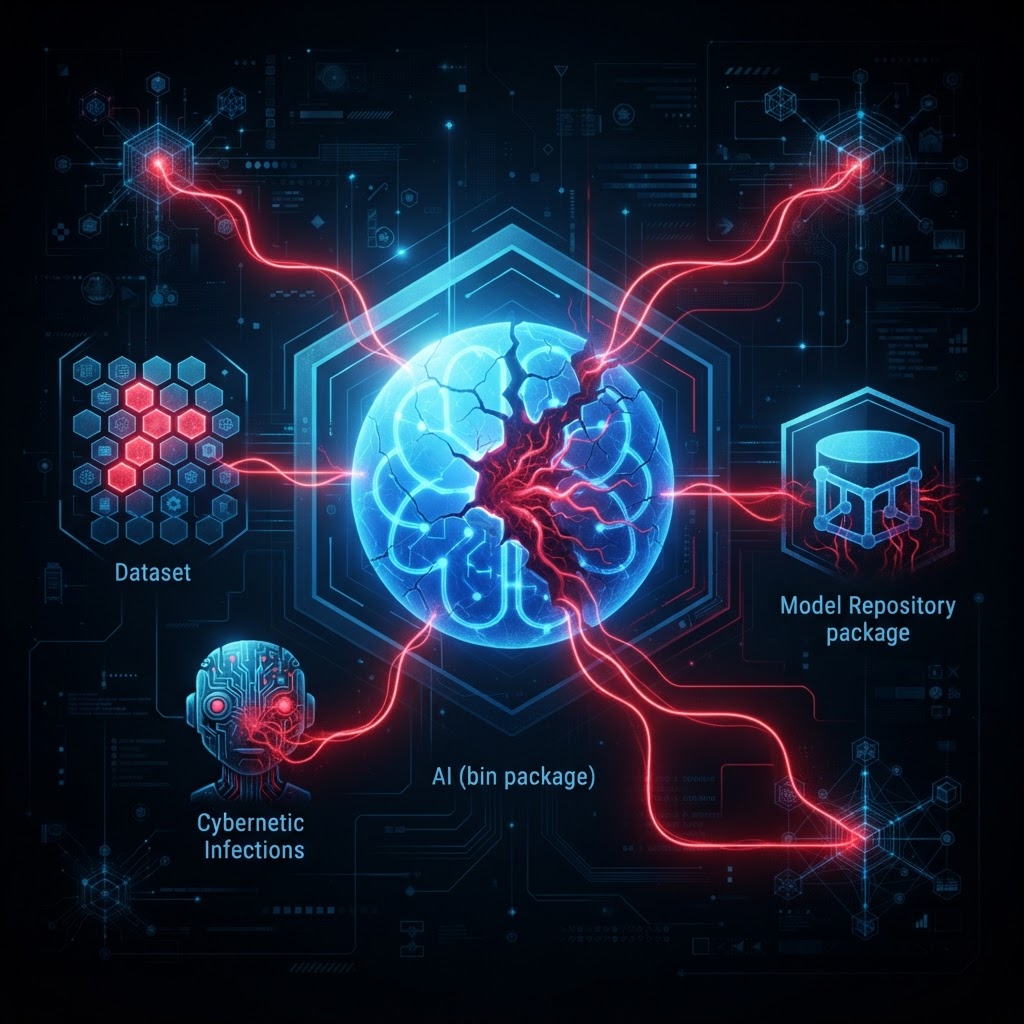
The AI supply chain has multiple attack surfaces:
-
Poisoned Models — Adversaries can embed malicious code inside model weights or pickle files. When loaded, the model executes arbitrary code on the host system.
-
Tainted Datasets — Datasets can be poisoned at collection time or modified in transit. Subtle perturbations can introduce backdoors that trigger specific misclassifications when certain inputs appear.
-
Malicious Plugins & Agents — Third-party agents and plugins can run with broad permissions, exfiltrating data or manipulating downstream systems.
-
Compromised Dependencies — The libraries and frameworks used to load and run models (PyTorch, TensorFlow, transformers) are themselves part of the supply chain and have known vulnerability histories.
The Hugging Face Incident: A Real-World Starting Point
In 2024, Hugging Face disclosed that a malicious dataset uploaded to its platform contained code designed to execute on download. The incident exposed how open model repositories — which are foundational to modern AI development — can be weaponized. Researchers found pickle files embedded with remote code execution payloads, hidden within seemingly benign model repositories. This was not a theoretical risk; it was a live, exploitable vulnerability affecting thousands of downstream users who had integrated these components into production pipelines.
Proposed Controls
-
Provenance Verification — Every model, dataset, and agent should carry verifiable metadata about its origin, creator, and modification history. Signed manifests and SBOMs (Software Bills of Materials) for AI components should become standard.
-
Sandboxing — Models and agents should be loaded and executed in isolated environments — containers, VMs, or WASM sandboxes — that limit filesystem, network, and system access. Never execute untrusted model files on production infrastructure.
-
Cryptographic Integrity — Use content hashes and digital signatures to verify that downloaded components have not been tampered with since publication. Detect drift between the published artifact and what was downloaded.
-
Isolated Execution — Run inference and agent workflows in segregated environments with strict egress controls. Monitor for anomalous network connections, file access patterns, or subprocess spawning during model loading and inference.
Conclusion
The AI supply chain is a new frontier for cybersecurity. As organizations increasingly depend on externally sourced models, datasets, and agents, the risk of malware hiding inside trusted AI components grows. The Hugging Face incident demonstrated this is not hypothetical. Provenance verification, sandboxing, cryptographic integrity, and isolated execution are not optional best practices — they are the minimum controls needed to secure the AI supply chain.