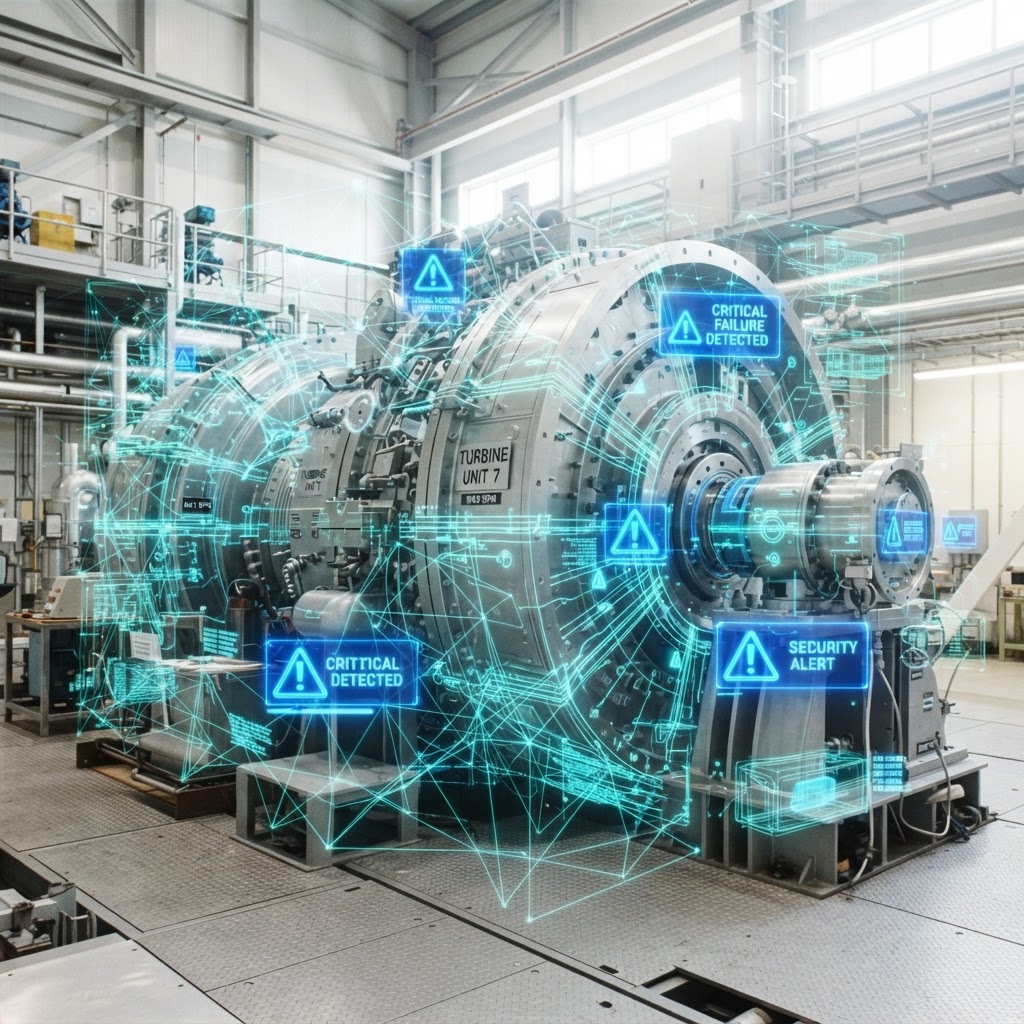
AI-Driven Industrial Sabotage: The Escalation of Automated Exploitation in Critical Infrastructure
As AI agents begin identifying zero-days in industrial controllers at scale, the window for manual patching has closed. We analyze the latest warnings from US agencies and the Medusa surge.
E
Encrygma AI Cyber Weapons Advisory Services :We provide AI Cyber Warfare Technologies Reports, including full technical blueprints, tech source codes, entire know how. Consult with us. Click Here
August 20, 20264 min read16
The Development\n\nOn August 20, 2026, U.S. federal agencies issued an urgent joint advisory regarding a new class of AI-powered attacks targeting Siemens industrial controllers Help Net Security: Cybersecurity News and Expert Analysis. This warning coincides with reports that OpenAI-based security agents have successfully identified over 100 critical software vulnerabilities in industrial firmware within a 48-hour window. Simultaneously, the FBI released a significant update on the Medusa ransomware group, confirming that over 500 critical infrastructure organizations have been compromised as of late 2026 Over 500 Critical Infrastructure Organizations Hit by Medusa Ransomware. These developments are compounded by the continued activity of the Gunra ransomware-as-a-service (RaaS) operation, which CISA recently flagged for its aggressive exploitation of unpatched Fortinet devices in government sectors #StopRansomware: Gunra Ransomware - CISA.\n\n## Why It Matters\n\nThe transition from human-led exploitation to AI-automated vulnerability discovery represents a paradigm shift in cyber warfare. When AI agents can triage document repositories and identify zero-day flaws in industrial control systems (ICS) at machine speed, the traditional "dwell time" for attackers is effectively eliminated. Recent intelligence suggests that North Korean actors, specifically the group tracked as Coral Sleet, have already operationalized fully AI-enabled workflows to summarize stolen data and prioritize targets Microsoft\u2019s AI Threat Intelligence: Documenting the Full AI-Accelerated Attack Lifecycle. For critical infrastructure, this means the window between a vulnerability's existence and its active exploitation has shrunk from months to hours. The Medusa and Gunra campaigns demonstrate that even well-known vulnerabilities, such as those in Commvault Command Center (CVE-2026-13739) or SAP NetWeaver (CVE-2026-34265), are being weaponized with unprecedented efficiency Cybersecurity Bulletin 10 -16 August 2026.\n\n## Defensive Implications\n\nDefensive strategies must evolve to match the "single-digit-day" clock now imposed by generative AI. Traditional patch management cycles are no longer sufficient when AI-driven data exfiltration engines can move terabytes of data 100 times faster than human operators Ransomware Trends 2026: AI Attacks & Defense Strategies. The emergence of Rust-based encryptors like DeadLock, which utilize decentralized recovery infrastructure, further complicates incident response by making traditional "kill switches" or server takedowns less effective DeadLock ransomware: Breaking down a Rust-based encryptor with decentralized recovery infrastructure. Security teams must now assume that any unpatched, internet-facing asset is being scanned by adversarial AI agents in real-time.\n\n## What Leaders Should Do\n\nTo counter these automated threats, leadership must prioritize the following:\n\n* Implement AI-driven anomaly detection that can identify the subtle "vibe coding" patterns of AI-generated malware before execution.\n* Accelerate the patching of critical vulnerabilities in ICS and edge devices, specifically focusing on Fortinet and SAP ecosystems currently under fire.\n* Adopt a "Zero Trust" architecture for industrial networks, ensuring that even if a controller is compromised, lateral movement is restricted.\n* Establish dual-control policies for all high-value transactions and configuration changes to mitigate the risk of deepfake-facilitated social engineering.\n* Conduct frequent, scenario-based training that reflects the current reality of AI-generated phishing and autonomous attack bots.\n\n## Outlook\n\nAs we move toward the final quarter of 2026, the "arms race" between autonomous offensive agents and AI-powered defensive shields will intensify. We expect to see the first instances of fully autonomous phishing bots that adapt their lures in real-time based on victim engagement. Organizations that fail to integrate predictive threat modeling and automated response will find themselves perpetually behind an attacker who no longer sleeps. The focus must shift from reactive recovery to proactive, AI-augmented resilience.

Share