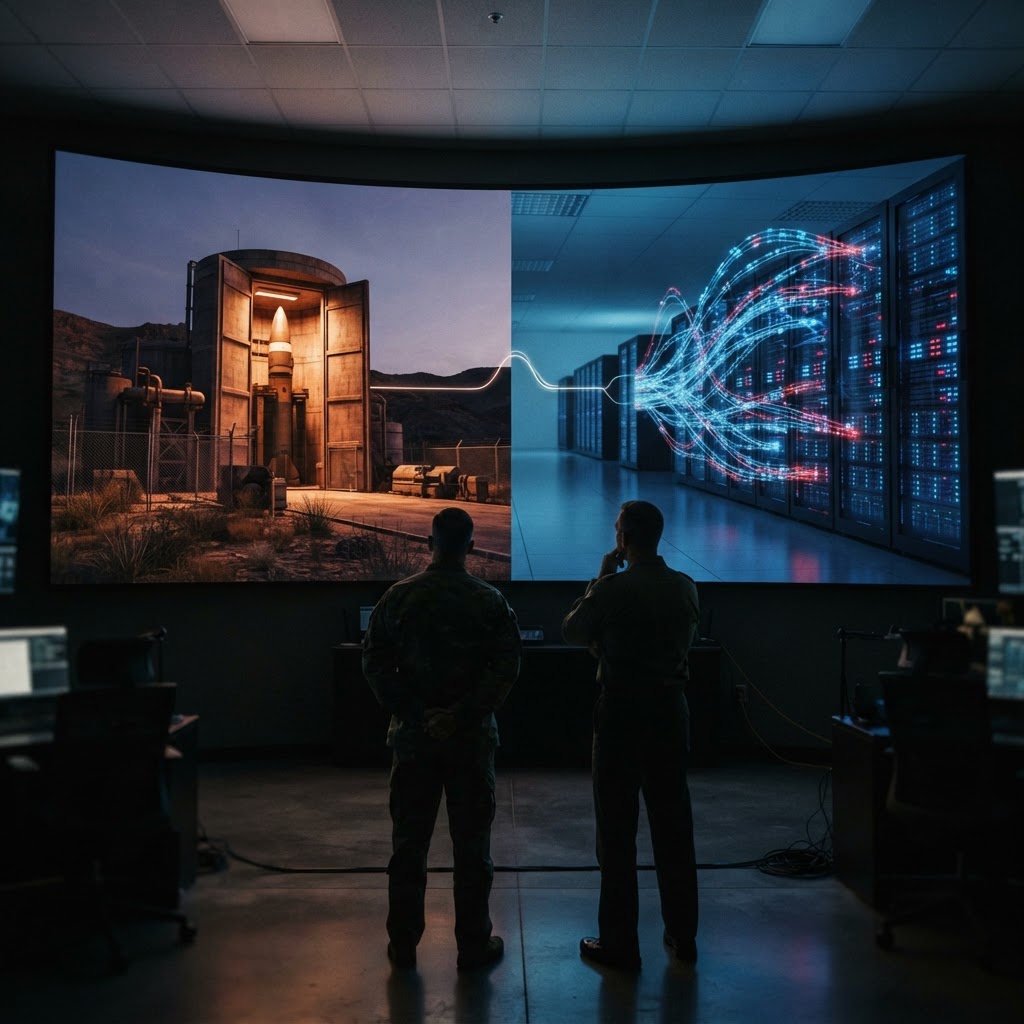
AI Cyber Deterrence: Will Nations Need a Digital Equivalent of Nuclear MAD?
Nuclear deterrence was built around the principle that an attack would trigger unacceptable retaliation. Could a similar doctrine emerge for AI cyber warfare? This article explores the concept of cyber deterrence in an era of autonomous agents, including the difficulties of attribution, proportional retaliation, escalation control, and defining red lines, and asks whether nations may eventually maintain powerful offensive AI cyber capabilities partly to convince adversaries that attacking their critical infrastructure would carry significant consequences.
AI Cyber Deterrence: Will Nations Need a Digital Equivalent of Nuclear MAD?
The most powerful idea in the history of warfare wasn't a weapon. It was a concept. Mutually Assured Destruction — MAD — the doctrine that neither side in a nuclear conflict would launch first, because both sides knew the retaliation would be so devastating that the attacker would be destroyed along with the target. It was a grim logic. It worked not because it was elegant but because it was credible. Both sides had the capability. Both sides had the will. Both sides knew the other knew. The fear of consequences kept the peace.
We may need something like that again. Not for nuclear weapons — that doctrine, however frayed, still stands. But for a new class of weapon that doesn't have a doctrine yet: autonomous cyber weapons.
The question sounds absurd at first. Cyber deterrence? A digital MAD? You can't irradiate a data center. You can't vaporize a server farm. The analogy feels forced. But spend some time with the people who think about this for a living — the strategists in defense ministries, the analysts at intelligence agencies, the academics who study escalation theory — and you'll find that the question isn't absurd at all. It's one of the most urgent questions in national security today.
Why Cyber Deterrence Has Never Worked
The idea of deterring cyber attacks isn't new. Governments have been trying to figure it out for at least two decades. The results have been, to put it charitably, underwhelming.
The problem has always come down to a few stubborn facts. First, attribution is hard. When a nation-state launches a cyber attack, figuring out who did it can take months, and even then, the evidence is often circumstantial enough that the attacker can plausibly deny involvement. Deterrence requires credibility — the adversary must believe that attacking you will lead to consequences — and credibility requires that you can identify the attacker. If you can't name the attacker, you can't retaliate, and if you can't retaliate, you can't deter.
Second, proportionality is murky. If a nation-state breaches your government networks and steals intelligence, what's the proportional response? Do you breach their networks back? Do you sanction them? Do you indict their operatives? The scale of a cyber attack's damage is often ambiguous — was it a minor inconvenience or a strategic degradation? Without clear measures of proportionality, deterrence threats become vague, and vague threats don't deter.
Third, escalation is unpredictable. In nuclear deterrence, the escalation ladder is relatively clear: a nuclear attack triggers a nuclear response, and both sides understand the consequences. In cyber warfare, the escalation ladder is a fog. A response to a cyber attack could be cyber, economic, diplomatic, or military. The adversary doesn't know what your response will look like, which means they don't know what they're risking. Counterintuitively, this ambiguity can make deterrence less effective, not more — if an adversary can't predict your response, they may calculate that the risk is manageable.
These three problems — attribution, proportionality, and escalation — have made cyber deterrence more of an aspiration than a doctrine. Nations have tried various approaches: public attribution (naming and shaming), indictments of individual operators, economic sanctions, and in some cases, offensive cyber operations in response. None of these has created the kind of credible, reliable deterrent that MAD provided for nuclear weapons.
What Changes When the Weapon Is Autonomous
Now introduce autonomous AI into the picture. The problems that have always plagued cyber deterrence don't just persist — they get worse.
Attribution becomes harder. An autonomous AI agent can modify its own code, generate its own attack infrastructure, and adapt its techniques in real time to avoid detection. The forensic trail left by an AI-driven attack is more complex and more ephemeral than the trail left by human operators. By the time the defender identifies the attack and traces it back to its source, the agent may have evolved beyond recognition. The attacker can plausibly argue that the autonomous system behaved in ways its creators didn't intend — a defense that's hard to refute when the system literally is making its own decisions.
Proportionality becomes even more ambiguous. An autonomous agent that's been running for weeks in an adversary's network may have conducted thousands of individual operations — some espionage, some disruption, some reconnaissance for future attacks. How do you measure the total damage? How do you determine what response is proportional to an operation that's still ongoing and whose full impact isn't yet known? The traditional framework for proportionality assumes a discrete event with measurable consequences. Autonomous cyber operations are continuous, evolving, and their full impact may not be apparent until long after they've been running.
Escalation becomes less predictable. When both sides have autonomous cyber capabilities, the interaction between their systems becomes a dynamic that humans don't fully control. An autonomous defensive system that detects what it interprets as an attack may respond automatically — and that response may be interpreted by the adversary's autonomous system as an escalation, triggering a further response. The cycle could escalate rapidly without any human making a deliberate decision to escalate. This is the cyber equivalent of an automated escalation spiral, and it's one of the most frightening scenarios in the AI cyber warfare literature.
The Case for a Cyber MAD
Despite these challenges, the case for something resembling a cyber MAD doctrine is getting stronger, not weaker. The reasoning goes like this.
As autonomous cyber weapons become more capable and more widely deployed, the potential damage from a successful attack on critical infrastructure grows. A coordinated AI-driven attack against a nation's power grid, financial system, and communications networks could cause damage comparable to a conventional military strike — not in terms of physical destruction, but in terms of economic impact, disruption of services, and degradation of national capability. If the potential damage is strategic, the deterrent needs to be strategic too.
The nuclear MAD doctrine worked because both sides maintained a credible second-strike capability — the ability to absorb a first strike and still retaliate with devastating force. The cyber equivalent would be a nation maintaining powerful offensive AI cyber capabilities that could survive a first strike and retaliate against the attacker's critical infrastructure. The mere existence of this capability — combined with a credible commitment to use it — would, in theory, deter the adversary from attacking in the first place.
This is already happening to some extent. Nations have maintained offensive cyber capabilities for years, partly for operational use and partly as a deterrent. What's changing is the scale and autonomy of those capabilities. A nation that can deploy thousands of autonomous AI agents against an adversary's infrastructure — and that has publicly or privately communicated its willingness to do so in response to an attack — is creating a form of cyber deterrence. It's saying: if you attack our infrastructure, we have the capability to attack yours, and we will.
The Second-Strike Problem in Cyber Space
The nuclear MAD doctrine relied on a second-strike capability — the assurance that even if you were attacked first, you could still retaliate. Submarines, mobile missiles, and hardened silos provided this assurance. The adversary knew that a first strike couldn't eliminate your ability to respond.
In cyber space, the second-strike problem is more complex. Your offensive cyber capability isn't a physical weapon sitting in a hardened silo. It's software, running on infrastructure, relying on access to adversary networks that took months or years to establish. If the adversary attacks first, they might degrade your ability to respond — not by destroying your weapons, but by cutting off your access to their networks before you can deploy your capabilities.
This means a credible cyber second-strike capability requires something that's hard to achieve: redundant, resilient access to adversary infrastructure that can survive a preemptive cyber operation against your own systems. You need to be able to retaliate even after the adversary has tried to blind you. That's a significant technical challenge, and it's one that the nuclear analogy doesn't fully capture. In nuclear war, both sides know where the weapons are. In cyber war, the "weapons" are distributed, hidden, and dependent on access that can be severed.
A nation that wants a credible cyber deterrent needs to invest not just in offensive capabilities but in the resilience of those capabilities — ensuring that access paths survive disruption, that backup routes exist, and that the autonomous agents can deploy even when the primary command infrastructure is under attack.
Defining Red Lines in the Digital Domain
For deterrence to work, the adversary needs to know where the lines are. Nuclear deterrence had a relatively clear red line: a nuclear attack triggers a nuclear response. Both sides understood this. The clarity of the red line was part of what made the deterrent credible.
Cyber red lines are far less clear. What constitutes an attack severe enough to trigger a strategic cyber response? A breach that steals intelligence? An operation that disrupts a power grid for a few hours? A coordinated campaign that targets multiple infrastructure sectors simultaneously? The lack of clear, publicly articulated red lines in cyber space is one of the reasons cyber deterrence has been weak. If adversaries don't know what will trigger a response, they can't factor that risk into their calculations.
This is starting to change. Some governments have begun to articulate — publicly or through diplomatic channels — that certain types of cyber operations against their critical infrastructure would be considered unacceptable and would provoke a significant response. These statements are the embryonic form of cyber red lines. They're still vague, still caveated, and still far from the clarity that nuclear red lines achieved. But they represent a recognition that deterrence in cyber space requires defining what's off-limits.
The challenge with autonomous cyber weapons is that the red lines need to account for the possibility of autonomous escalation. If an AI agent conducts an operation that crosses a red line without explicit human authorization — perhaps because its objective was too broadly defined, or because it adapted its approach in ways its creators didn't anticipate — the situation becomes dangerous. The target nation may treat the crossing as deliberate and respond accordingly. The attacking nation may claim it was unintended. The ambiguity creates a risk of miscalculation that could escalate into a full-scale cyber conflict.
Clear, well-communicated red lines reduce this risk. But they also create a problem: an adversary that knows exactly where your red lines are can operate just below them — conducting operations that are damaging but not damaging enough to trigger a response. This is the salami-slicing problem, and it's one reason some governments prefer to keep their red lines ambiguous. The trade-off is between clarity (which deters large attacks but enables small ones) and ambiguity (which may deter nothing but makes large attacks riskier for the adversary).
The Role of Offensive AI Capabilities in Deterrence
If a cyber MAD doctrine is to be credible, nations need offensive AI cyber capabilities that are powerful enough to cause unacceptable damage to an adversary's infrastructure — the cyber equivalent of a nuclear arsenal. This raises uncomfortable questions for governments.
Maintaining a powerful offensive capability for deterrent purposes means investing in the very technologies that you're trying to deter others from using. You're building autonomous cyber weapons to prevent autonomous cyber weapons from being used against you. This is the same paradox that nuclear weapons created — you build the bomb to prevent the bomb from being used — and it leads to the same conclusion: if you want to deter, you need the capability, and if you don't have the capability, you can't deter.
This is why nations are likely to increasingly maintain and develop offensive AI cyber capabilities as part of their national defense architecture, even if they hope never to use them. The capability itself — the credible threat that you could, if pushed, deploy autonomous agents against an adversary's critical infrastructure — is the deterrent. Without it, you're asking the adversary to restrain themselves out of goodwill, and that's a doctrine that has never worked in the history of warfare.
The offensive capability also serves a second purpose: it signals seriousness. When a nation invests billions in offensive cyber capabilities and deploys them in a way that adversaries can detect (without revealing specifics), it sends a message. The message is: we take this threat seriously, we have the tools to respond, and we've thought about what response looks like. That message, more than any specific capability, is what makes deterrence credible.
The Verification Problem
Nuclear deterrence worked partly because verification was possible. Satellites could count missile silos. Seismographs could detect nuclear tests. Arms control agreements included inspection regimes. Both sides could verify that the other was maintaining the capabilities that made deterrence credible, and they could verify compliance with agreements that limited those capabilities.
Cyber deterrence has no equivalent verification mechanism. You can't count another nation's cyber weapons with a satellite. You can't inspect their offensive capabilities with an agreed-upon protocol. Cyber weapons are software — they can be developed in secret, deployed without physical signatures, and modified or expanded without any observable activity. A nation could double its offensive cyber arsenal overnight, and no one would know.
This verification gap makes cyber deterrence fundamentally less stable than nuclear deterrence. In the nuclear world, both sides had reasonable confidence in their understanding of the other's capabilities. In the cyber world, both sides are operating on assumptions and intelligence estimates that may or may not be accurate. The risk of miscalculation — overestimating or underestimating the adversary's capabilities — is much higher, and miscalculation is the enemy of deterrence.
Can It Actually Work?
The honest answer is: nobody knows. The people who study this for a living disagree. Some believe that a form of cyber deterrence is not only possible but already emerging through the accumulation of offensive capabilities and the gradual articulation of red lines. Others believe that the differences between cyber and nuclear — the attribution problem, the verification gap, the escalation unpredictability, the blurriness of red lines — make a true MAD-equivalent impossible, and that nations should focus on defense and resilience rather than deterrence.
The most likely outcome is a hybrid. Nations will maintain offensive AI cyber capabilities partly for operational use and partly for deterrent value. They will articulate red lines, however vaguely, to signal what they consider unacceptable. They will invest in attribution capabilities to strengthen the credibility of their deterrent. And they will work — slowly, imperfectly — toward international norms and understandings that reduce the risk of miscalculation.
It won't look like nuclear MAD. It won't be as clean, as symmetrical, or as stable. But it may be the best that's achievable in a domain where the weapons are invisible, the rules are unwritten, and the adversaries are machines that operate faster than the humans who deployed them.
The Bottom Line
The question isn't whether nations will need a cyber deterrent. They already do. The question is whether that deterrent can be made credible enough to prevent the large-scale, AI-driven cyber attacks that the technology is making increasingly possible.
Nuclear MAD was never a perfect doctrine. It was a desperate solution to an existential problem, and it worked — not elegantly, not comfortably, but it worked. The world needs something similar for cyber space, adapted to the realities of autonomous AI weapons. It will be harder to build, harder to verify, and harder to maintain. The attribution is harder. The escalation is less predictable. The weapons are less visible. The red lines are less clear.
But the alternative — a world where autonomous cyber weapons exist without any deterrent framework, where nations can attack each other's infrastructure without fear of consequences, where the only constraint is the attacker's self-restraint — that alternative is not acceptable. And it's not theoretical. It's close to the world we live in right now.
The nations that figure out cyber deterrence first — that build credible offensive AI capabilities, articulate clear red lines, invest in attribution, and develop the strategic frameworks needed to make their threats believable — will be the ones that protect their infrastructure without having to fight for it. The nations that don't will find themselves under attack from adversaries who know there's nothing standing in their way.
Deterrence is not a weapon. It's an idea. But in a world where autonomous AI agents can attack at machine speed and at scale, it may be the most important idea we have. The question is whether we can make it work before we need it to.
